
What Are the Three Types of Geothermal Heat Pumps?
The 3 Main Types of Geothermal Heat Pumps
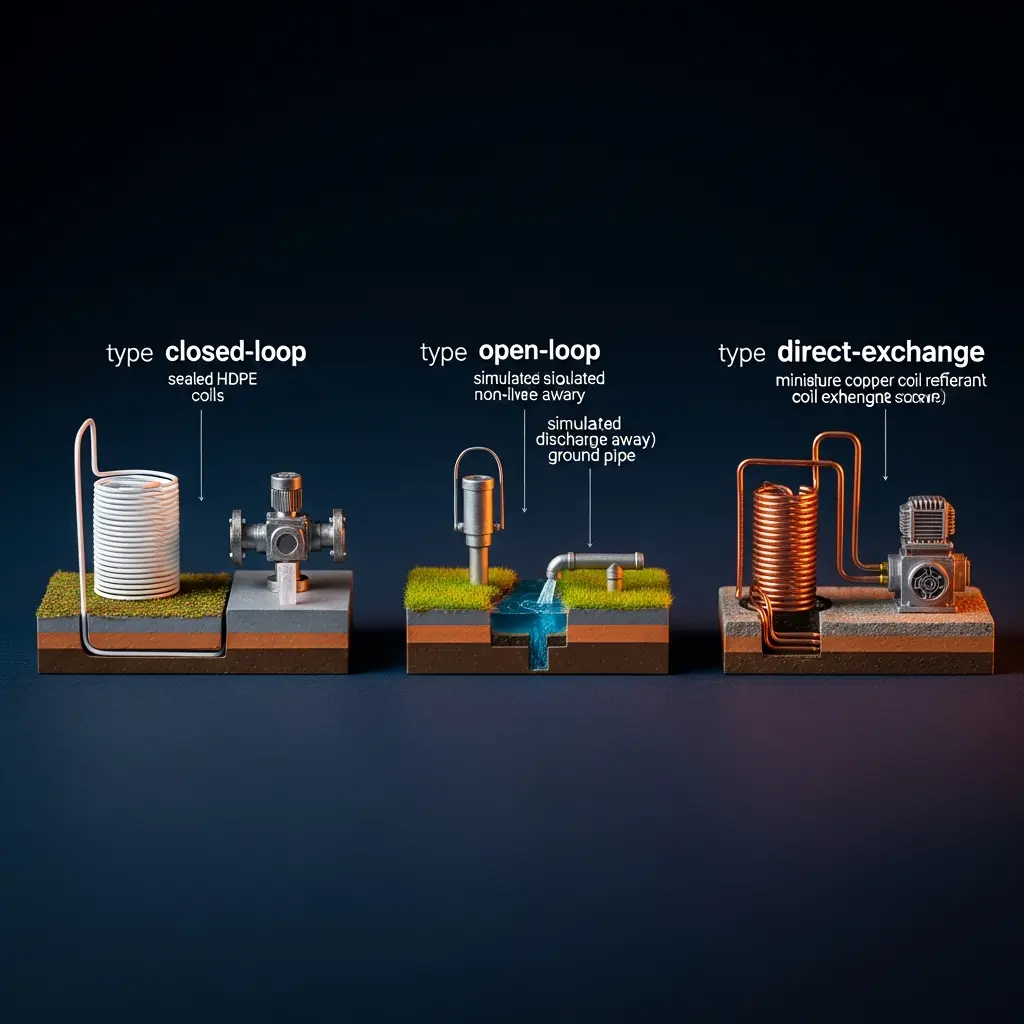
Every residential and commercial geothermal heat pump system belongs to one of three categories, defined by how the system exchanges heat with the earth:
- Closed-loop systems — A sealed circuit of high-density polyethylene (HDPE) pipe filled with a water-antifreeze mixture circulates continuously underground. No groundwater is ever consumed. Vertical, horizontal, and pond variants all share this sealed-loop design. Closed-loop systems account for roughly 95% of all geothermal installations in the United States.
- Open-loop systems — Water is drawn directly from a groundwater aquifer, passed through the heat pump's heat exchanger to transfer energy, and then returned to the aquifer via a return well or surface discharge. Open loops require a productive aquifer, suitable water chemistry, and permits in most states.
- Direct-exchange (DX) systems — Refrigerant — not water — circulates through copper tubing buried directly in the ground, eliminating the intermediate heat exchanger. DX systems achieve high efficiency in the right conditions but represent a small niche (roughly 3% of market) due to refrigerant regulations and corrosion risks in certain soils.
Each type has sub-variants and tradeoffs. The sections below walk through all three in detail so you can match the right system to your property. If you want a side-by-side comparison of the two most common categories, see our dedicated guide: Open-Loop vs. Closed-Loop Geothermal Systems.
Closed-Loop Systems: The Dominant Choice
Sealed, recirculating, and proven — closed-loop systems are the backbone of the geothermal industry. Because they never draw on or discharge groundwater, they face far fewer regulatory hurdles than open-loop alternatives, and they work in almost any soil or climate. The fluid inside the loop (typically water mixed with propylene glycol antifreeze) absorbs heat from the earth in winter and rejects heat into it in summer.
What distinguishes closed-loop installations from one another is how the pipe is installed underground. Three sub-configurations dominate:
Horizontal Closed-Loop
Horizontal loops are trenched at depths of 4–6 feet using a backhoe or chain trencher. Multiple parallel pipe runs lay flat across several hundred feet of trench, then backfill. No drilling rig required — installation cost per linear foot is the lowest of any loop type. The tradeoff is land: a 3-ton system typically needs 1,200–1,500 feet of trench, requiring roughly a quarter-acre of clear yard free of trees, septic systems, and utility corridors.
When horizontal wins: Rural lots with open fields and clay-rich soil (clay conducts heat better than sandy soil). Not viable on small lots or in areas with shallow bedrock. See also: How Deep Is a Geothermal Loop?
Vertical Closed-Loop
Vertical loops solve the land problem by going deep. A drilling rig bores narrow holes 150–400 feet into the earth, typically spaced 15–20 feet apart. A U-shaped pipe ("hairpin loop") drops into each bore hole, which is then grouted for thermal contact. A 3-ton system might require two or three bore holes, each occupying only a few square feet of surface area.
Drilling adds cost — expect $15–$25 per linear foot of bore — but vertical loops harvest heat from deeper, more stable ground temperatures and perform more consistently in harsh winters where shallow ground loses thermal capacity. For a full breakdown, see Vertical vs. Horizontal Ground Loops.
When vertical wins: Tight lots, shallow bedrock, cold climates, or any site where trenching is impractical. Higher upfront cost than horizontal, but lower than open-loop systems requiring dedicated return wells.
Pond / Lake Closed-Loop
When a property includes a suitable body of water — at least half an acre, 8 feet deep at minimum — a pond loop is often the most cost-effective geothermal installation. A supply line runs underground to the water's edge; a coiled HDPE loop rests on the pond floor. Water conducts heat far better than soil, so less pipe is needed and no drilling rig is required.
The 8-foot depth minimum is critical in northern climates: the loop must sit below the freeze line. Water quality matters too — corrosive water can degrade exterior fittings even though the closed loop itself stays sealed.
When pond loops win: Properties with an existing pond or lake meeting depth and volume thresholds. Typically the lowest installed cost of any loop type.
For a comprehensive look at loop design across all three sub-types, see Geothermal Loop Types Explained and the full installation context in The Geothermal Drilling Guide.
Open-Loop Systems: When Groundwater Works in Your Favor
Open-loop systems skip the buried loop entirely. A well pump draws water directly from an underground aquifer and routes it through the heat pump's heat exchanger. After the heat transfer, water returns to the aquifer via a return well or, where permitted, surface discharge.
The efficiency advantage is real: groundwater is a more direct heat source than soil, so open-loop systems can reach slightly higher Coefficients of Performance (COP) in favorable conditions. The complications arise in everything else.
Well Yield and Flow Rate Requirements
A geothermal heat pump needs roughly 1.5–3 GPM per ton of capacity, depending on groundwater temperature. A 3-ton residential system needs 4.5–9 GPM of sustained well yield — rising to 10 GPM/ton in cold aquifers below 50°F. A hydrogeological assessment should confirm adequate year-round flow before committing to open-loop.
Water Chemistry
Open-loop systems are sensitive to water chemistry in ways closed loops are not. High iron fouls heat exchanger passages. Hydrogen sulfide causes corrosion. Hard water deposits scale. A water quality test before system design is not optional — it determines whether filtration or chemical treatment is needed, and whether ongoing maintenance costs shift the economics versus a closed loop.
The Legal Patchwork
Groundwater withdrawal rights and return-well permitting vary enormously by state and even by county. Some states treat open-loop geothermal like any other beneficial use of groundwater and permit it straightforwardly. Others require a dedicated injection well with casing specifications, setback distances of 100–800 feet from the production well, and annual reporting. A few states restrict or effectively prohibit surface discharge of return water. Checking your state environmental agency's groundwater program before designing an open-loop system is mandatory, not optional.
See our companion article for the full comparison: Open-Loop vs. Closed-Loop Geothermal.
Direct-Exchange (DX) Systems: The Third Type
Direct-exchange geothermal takes a fundamentally different approach. Rather than circulating water through a loop, DX systems run refrigerant directly through copper tubing buried in the ground. Eliminating the intermediate heat exchanger removes one thermal resistance barrier, and DX systems can achieve high efficiency ratings as a result. The tubing is installed vertically or horizontally, though bore and trench dimensions differ from water-based loops due to refrigerant pipe sizing requirements.
Why DX Remains a Niche
Four constraints limit DX adoption. First, buried refrigerant lines fall under EPA Section 608 — an underground leak means significant environmental liability and repair cost. Second, copper is susceptible to corrosive soils; a soil corrosivity test is mandatory before installation, and many sites fail. Third, the ongoing HFC phase-down under the AIM Act creates long-term refrigerant uncertainty for a system that cannot easily switch refrigerant once buried. Fourth, the installer base is thin — relatively few HVAC contractors hold DX-specific training and certification, making service calls difficult in most markets.
DX systems are viable in niche situations: non-corrosive sandy soils, tight lots, and owners comfortable with specialized maintenance. The DOE and IGSHPA generally steer new residential projects toward water-based loops.
Sub-Type Variants Worth Knowing
Beyond the three primary categories, several sub-type configurations appear frequently enough in installer proposals and IGSHPA design standards that homeowners should recognize them:
Slinky horizontal loop: Rather than parallel straight pipe runs, slinky loops use overlapping coils of HDPE laid flat in the trench bottom. A slinky configuration packs more pipe surface area into a shorter trench — typical savings run one-third to two-thirds shorter trench length compared to conventional horizontal layouts. The tradeoff is higher per-foot pipe cost and slightly more complex installation, but for lots with limited linear space, slinky loops make horizontal installation viable where it otherwise would not be.
Standing-column well (SCW): A single deep well (typically 1,500–2,500 feet) drilled into fractured bedrock circulates water up and down within the column. During peak demand the system "bleeds" a fraction of return water, drawing in cooler aquifer water to stabilize column temperature. Common in the Northeast where bedrock is shallow; requires a bleed discharge permit.
Hybrid open+closed systems: Some commercial projects combine a closed ground loop with a cooling tower or open-loop supplement. Useful where cooling loads far exceed heating loads, preventing the ground from gradually overheating across the system's lifetime.
Decision Matrix: Which Type Fits Your Property?
Not every geothermal type works on every site. Use this framework to narrow your options before the first installer conversation. The right choice ultimately depends on a full site assessment, but this gives you a starting point.
| Your Site Conditions | Best Match | Key Requirement |
|---|---|---|
| Open yard space, moderate climate, clay or loamy soil | Horizontal closed-loop | ~¼ acre clear trench corridor |
| Small lot, suburban neighborhood, bedrock below 20 ft | Vertical closed-loop | Drilling access for a 2–4 bore rig |
| Pond, lake, or slow stream ≥ ½ acre, min. 8 ft deep | Pond/lake closed-loop | Year-round water body meeting depth threshold |
| Rural lot, productive well with 5+ GPM yield, acceptable water chemistry, state permits available | Open-loop | Return well or permitted surface discharge; water quality test |
| Tight urban lot, non-corrosive sandy soil, owner accepts specialized maintenance | Direct-exchange (DX) | Soil corrosivity test; certified DX installer in region |
| Northeast property, deep fractured bedrock, adequate bleed discharge available | Standing-column well | Fractured bedrock aquifer; bleed permit |
Once you know which loop type makes sense, the next step is sizing and budgeting. Use our Geothermal Cost Estimator to get a project range for your state, and explore the full installation process in The Geothermal Installation Process Guide.
Frequently Asked Questions
What are the three types of geothermal heat pumps?
The three types are closed-loop systems (vertical, horizontal, and pond sub-types), open-loop systems, and direct-exchange (DX) systems. Closed-loop systems circulate a sealed antifreeze-water mixture and account for roughly 95% of US installations. Open-loop systems draw and return groundwater directly. DX systems circulate refrigerant through buried copper tubing, eliminating the intermediate water loop. The DOE Energy Saver program and IGSHPA design standards are the authoritative references on all three.
What is the most efficient geothermal heat pump?
Efficiency depends on loop type, ground conditions, and equipment. Open-loop systems connected to a productive aquifer often achieve the highest real-world COP (4.0–5.5) because groundwater is a more direct heat source than soil. Among closed-loop types, vertical loops outperform horizontal in harsh winters since deep ground temperatures fluctuate less seasonally. For equipment, look for ENERGY STAR-certified units with an EER of 17.1 or higher for cooling and a COP of 3.6 or higher for heating.
Which type of geothermal heat pump is cheapest to install?
Pond/lake closed-loop systems have the lowest installation cost when a qualifying water body is present, because no drilling or heavy trenching is required for the loop field. Horizontal closed-loop is the next most affordable in open rural settings, followed by vertical closed-loop (drilling adds cost). Open-loop systems vary widely depending on well yield and return-well permitting requirements — they can be highly cost-effective or expensive depending on local geology and regulatory requirements. DX systems are typically among the more expensive options on a per-ton basis when accounting for copper tubing, refrigerant, and the specialized installation required.
Can I switch geothermal heat pump types after installation?
Rarely, and almost never cost-effectively. The buried loop infrastructure — pipe, bore holes, or well casings — is the most expensive component of any geothermal project. Converting from closed to open loop, for example, requires drilling new production and return wells while abandoning the existing loop field — effectively a full reinstall. The indoor heat pump unit can sometimes be swapped within the same loop type, but a full type conversion is a new project. Loop decisions are permanent for the system's 25+ year lifespan.
Sources
- U.S. Department of Energy, Office of Energy Efficiency and Renewable Energy — Geothermal Heat Pumps: energy.gov/energysaver/geothermal-heat-pumps
- International Ground Source Heat Pump Association (IGSHPA) — Design and Installation Standards
- ENERGY STAR — Ground Source Heat Pump Specification
- National Renewable Energy Laboratory (NREL) — Geothermal Technologies Program resources
- U.S. EPA Underground Injection Control (UIC) Program — Open-Loop Return Well Permitting: epa.gov/uic
- Massachusetts Department of Environmental Protection — Guidelines for Ground Source Heat Pump Wells
Need a Geothermal Contractor?
Search the directory for licensed installers near you. Compare credentials, read reviews, and contact directly.
Find Installers Near YouOwn a Geothermal Business?
Claim your free listing to get more qualified leads, show up in local search, and answer customer questions where they’re already looking.
Claim Your Free Listing