
How Deep Is a Geothermal Loop? Vertical, Horizontal & Pond Depths
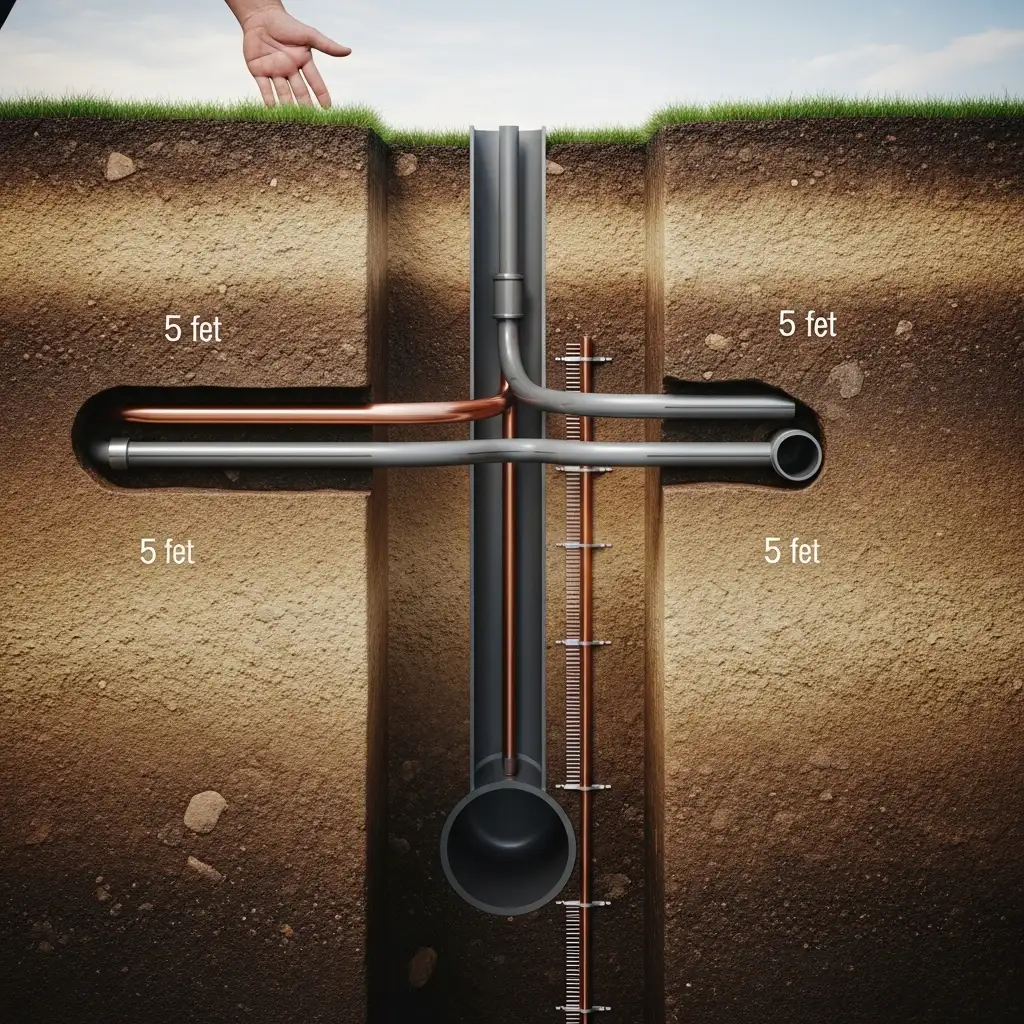
Geothermal loop depth depends on the loop type: vertical boreholes go 150–400 feet deep (most residential installs land at 200–300 ft), horizontal trenches are buried 4–6 feet below grade, and pond coils rest in 8–10 feet of water. The right choice comes down to your lot size, soil or rock type, and budget — not a single universal answer.
| Loop type | Typical depth | Range | Why this depth |
|---|---|---|---|
| Vertical closed-loop | 200–300 ft per bore | 150–400 ft | Below frost, in thermally stable soil or rock; depth compensates for poor conductivity |
| Horizontal closed-loop | 5–6 ft | 4–8 ft | Below frost line, reachable with standard trencher, adequate soil thermal mass |
| Pond / lake loop | 8–10 ft water depth | 6–15 ft | Below summer thermocline, remains liquid all winter, coils weighted to bottom |
| Standing-column (open loop) | 200–300 ft | 100–1,500 ft | Depth to adequate groundwater yield in bedrock aquifer |
Vertical Loop Depth: How Tonnage and Soil Type Drive the Number
Vertical systems use a drilling rig to bore one or more narrow holes — typically 4 to 6 inches in diameter — straight into the earth. High-density polyethylene (HDPE) U-tube pipe is inserted into each bore, grouted solid, and connected to the heat pump above grade.
The core design variable is feet of bore per ton of heat-pump capacity. IGSHPA's design methodology ties that number directly to the ground's thermal conductivity — how readily the surrounding earth absorbs or releases heat. Typical design ranges:
- 150–200 ft/ton — high-conductivity geology: saturated clay, moist sand, limestone, granite. Ground gives up or accepts heat quickly, so less footage is needed.
- 200–250 ft/ton — moderate conditions: mixed soil, silt, sandstone.
- 250–350 ft/ton — low-conductivity geology: dry sand, dry gravel, unconsolidated fill, fractured dry rock. More footage is required to move the same amount of energy.
A practical example: a 4-ton system in moderate soil might call for 4 bores × 225 ft = 900 total feet. The same system in dense wet clay might need only 4 × 175 ft = 700 feet. Bore count and depth can be traded against each other depending on site constraints. Minimum practical depth is 100–150 feet regardless of soil; going past 400 feet on a residential install is unusual and typically signals very poor rock conductivity or a large commercial system. A certified installer uses thermal conductivity test results to finalize design per IGSHPA's Design and Installation Standards.
For a hands-on estimate of how many bores your home might need, use the geothermal loop calculator and cross-reference the full loop-type comparison at the geothermal loop types guide.
Horizontal Loop Depth: Frost Line, Trencher Reach, and Thermal Mass
Horizontal systems trade drilling cost for land area. Instead of boring down, an excavator or chain trencher cuts long shallow trenches — often several hundred feet each — at 4 to 6 feet below grade. Multiple runs of pipe are laid in each trench (sometimes in a flat slinky coil to pack more surface area into less linear footage), then the trench is backfilled.
The 4–6 foot target depth is not arbitrary:
- Frost line clearance. Northern states can see frost penetrating 3–4 feet down in a hard winter. Laying pipe below that depth keeps fluid from approaching freezing conditions during peak demand.
- Trencher economics. Standard chain trenchers reach 5–6 feet efficiently. Deeper cuts require larger equipment, slower progress, and higher cost per foot.
- Soil thermal mass. At 5–6 feet, soil temperature in temperate North America typically ranges from the high 30s°F in late winter to the low 60s°F in late summer — enough differential to drive a heat pump year-round without excessive pumping energy.
In northern climates where frost penetrates unusually deep — parts of Minnesota, Michigan's Upper Peninsula, northern Maine — installers sometimes go to 7–8 feet as a buffer. In mild southern climates with shallow frost, 4 feet is often adequate. The rule of thumb is at least 2 feet below the deepest frost penetration recorded locally.
Horizontal systems need far more land than vertical: roughly 1,500–3,000 square feet of trench area per ton, so a 3-ton home may require 5,000–9,000 square feet of trench field. For cost and land tradeoffs, see open loop vs. closed loop and the deep-dive at vertical vs. horizontal ground loops.
Pond Loop Depth: Why 8–10 Feet of Water Is the Threshold
If you have a pond, lake, or slow-moving river within a few hundred feet of the building, a pond loop (also called a surface water loop) is typically the lowest-cost installation option — no drilling, no extensive trenching, just weighted coils of HDPE pipe sunk to the bottom.
The practical minimum is 8 feet of water depth measured at the shallowest point during the driest summer day. Some conservative installers require 10 feet. Here is why that number matters:
- Thermal stratification. Water stratifies by temperature. In winter, water at 39°F — its maximum density — sinks to the bottom and stays there, insulated by colder (but lighter) water above. Pond loops positioned at the bottom access this stable warmth even when the surface is frozen solid.
- Ice clearance. In a cold winter, a shallow pond can freeze several feet deep. Coils in 8–10 feet of water remain below the ice layer with comfortable margin.
- Thermocline buffer in summer. A shallow pond can approach bathwater temperatures in August. Coils deep enough to be below the thermocline access cooler bottom water, preserving cooling-mode efficiency.
Coils are weighted or anchored with concrete blocks to keep them on the bottom and spread across as much of the pond floor as possible. A typical residential pond loop requires 300–500 feet of pipe per ton of capacity, spread in flat mattress-style coils or slinky runs across the pond bottom.
Pond loops cost 20–50% less than vertical drilling when a suitable water body is available. State regulations vary — some require pond-loop permits, setbacks, or environmental review — so confirm requirements through the geothermal permits tool before assuming a pond install is straightforward.
Why the Seasonally Stable Zone Drives Heat-Pump Efficiency
Every loop depth decision traces back to one principle: the deeper you go, the more stable the ground temperature — and that stability is what makes geothermal efficient. Here is how it breaks down in a typical continental US climate:
- Surface (0–1 ft): Swings 80°F or more annually — baking in summer, frozen in winter.
- Shallow zone (1–6 ft): Swings narrow to roughly 30–40°F seasonally, lagging the surface by several weeks.
- Moderate depth (6–20 ft): Swings drop to 10–20°F; temperature changes lag the surface by 1–2 months.
- Stable zone (30 ft+): Temperature variation becomes negligible — essentially constant at the local mean annual air temperature, typically 45–75°F across the continental US.
This is why vertical loops at 200–300 feet outperform shallow alternatives: the heat pump exchanges energy with ground at a near-constant 50–60°F rather than soil that swings with the seasons. USDA NRCS Soil Climate Analysis Network (SCAN) data confirms this pattern across monitoring sites nationwide. At 6 feet — the horizontal loop sweet spot — temperatures still fluctuate, which is why horizontal systems need more total pipe footage to compensate for lower thermal stability.
For region-specific ground temperature data at 6 feet, see how cold is it 6 feet underground.
Drilling Permit Depth Thresholds: What Changes at 500 Feet
For most residential geothermal installs, drilling stays well below 500 feet — and that threshold matters because it is where regulatory oversight often shifts.
In New York, for example, the state's Division of Mineral Resources takes jurisdiction over geothermal boreholes drilled deeper than 500 feet, while wells under 500 feet fall under separate water-well regulation. Other states use similar depth cutoffs to distinguish between shallow ground-loop installations (treated like wells) and deep drilling (treated more like oil-and-gas regulation).
Practically speaking, most closed-loop residential installs never approach 500 feet per bore. A system pushing past that depth is unusual and typically signals one of the following:
- Extremely low thermal conductivity rock requiring more footage per ton
- A large commercial system where deep drilling reduces the number of bore sites needed
- A standing-column open-loop well in deep bedrock
Shallow-loop permits (under 500 feet) typically require a licensed driller, permit application, annulus grouting, and post-installation reporting to the state water agency — but requirements vary significantly. Before any drill bit touches the ground, use the geothermal permits tool to check state-specific rules, and see the full process in the geothermal drilling guide.
Frequently Asked Questions
How deep does a geothermal well need to be?
A closed-loop vertical borehole typically needs to be 150–400 feet deep, with most residential installs in the 200–300-foot range per bore. Exact depth depends on soil or rock thermal conductivity and the building's heating and cooling load. Open-loop standing-column wells may go 200 to 1,500 feet to reach a productive bedrock aquifer. Neither type reaches conventional geothermal depths — residential systems work entirely within the shallow stable-temperature zone.
How deep do you have to dig for a geothermal heat pump?
For a horizontal closed-loop system, trenches are typically dug 4–6 feet deep — enough to clear the frost line and within reach of standard trenching equipment. Vertical systems drill 150–400 feet straight down per borehole. Pond loops require no digging at all; coils are weighted and sunk to the bottom of a water body at least 8–10 feet deep. Which method requires the least disturbance depends on lot size and geology.
How deep is too deep for geothermal?
Most residential closed-loop installs stay under 400 feet per bore — beyond that, drilling costs typically outpace marginal thermal gain. Regulatory complexity also increases past 500 feet in many states, where deeper boreholes trigger oil-and-gas-style oversight. A properly designed system reaches the optimal depth based on measured thermal conductivity, not simply the deepest possible depth.
How cold is it 6 feet underground?
At 6 feet below grade, ground temperature in the continental US ranges from the low 40s°F in northern states to the low 60s°F in southern states — tracking the local mean annual air temperature. Seasonal swings at that depth are roughly 20–30°F, compared to 80°F or more at the surface, and they lag behind the surface by 4–8 weeks. That relative stability is why 4–6 feet is the standard horizontal loop target. For region-specific data, see how cold is it 6 feet underground.
Sources
- IGSHPA, Closed-Loop/Geothermal Heat Pump Systems Design and Installation Standards, 2017
- USDA Natural Resources Conservation Service, Soil Climate Analysis Network (SCAN) — soil temperature data by depth
- U.S. Department of Energy, Energy Saver — Geothermal Heat Pumps
- National Renewable Energy Laboratory (NREL), Geothermal Heat Pump Systems: Market and Industry Analysis
- New York State Department of Environmental Conservation, Closed-Loop Geothermal Boreholes Deeper Than 500 Feet
Need a Geothermal Contractor?
Search the directory for licensed installers near you. Compare credentials, read reviews, and contact directly.
Find Installers Near YouOwn a Geothermal Business?
Claim your free listing to get more qualified leads, show up in local search, and answer customer questions where they’re already looking.
Claim Your Free Listing