
What Country Gets 90% of Its Homes Heated by Geothermal?
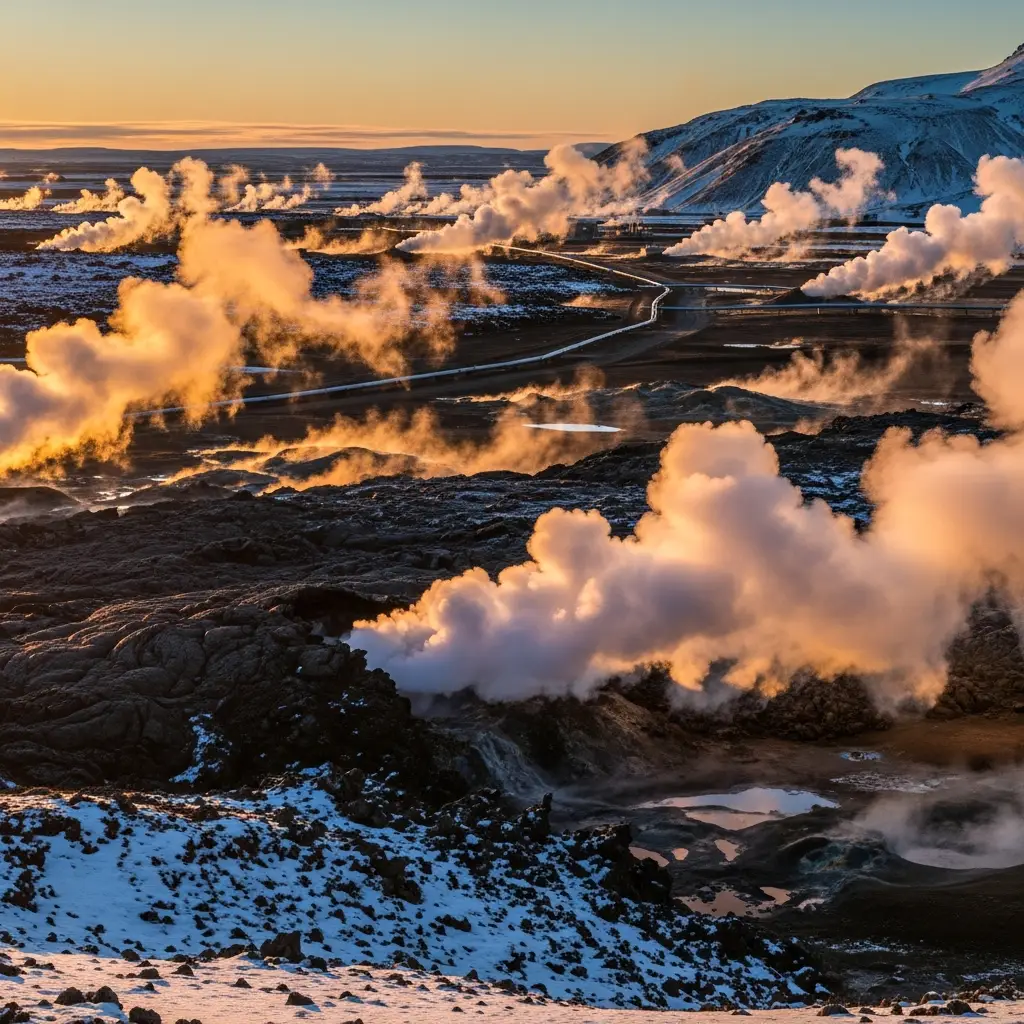
Iceland heats approximately 90% of its homes using geothermal energy drawn directly from natural underground hot water reservoirs. In the capital, Reykjavík, the figure reaches close to 100%. The country sits on the Mid-Atlantic Ridge — an active boundary between two tectonic plates — giving it access to vast hydrothermal resources at shallow depths that no other nation can match at scale.
Quick Facts: Iceland's Geothermal Dominance
- Roughly 90% of Icelandic households use geothermal energy for space heating and hot water
- Reykjavík's district heating network serves approximately 58% of Iceland's total national population
- Geothermal supplies around 25–30% of Iceland's total national electricity generation (the remainder comes from hydropower)
Why Iceland Is Unique
Iceland sits directly on the Mid-Atlantic Ridge, the tectonic boundary where the North American Plate and the Eurasian Plate are slowly pulling apart. This creates two rare conditions simultaneously: an enormous supply of volcanic heat close to the surface, and a steady flow of groundwater percolating down through fractured rock to be superheated before rising again as natural hot water.
The result is high-temperature hydrothermal resources — water ranging from roughly 80°C to over 200°C — accessible at depths of just 50 to 2,000 meters. In practical terms, Iceland can drill a well, pump naturally hot water into insulated pipes, and route it directly into homes and radiators with minimal processing. The heat is already there. No heat pump cycle is needed, no refrigerant, no compressor. The ground delivers hot water the way a municipal water system delivers cold water.
Almost nowhere else on Earth has this combination of geological luck. A handful of other volcanically active regions — parts of New Zealand, Kenya's Rift Valley, El Salvador, and a few others — have similar high-temperature resources, but not at the same scale and not with the same density of population living directly above the resource.
Iceland also benefited from deliberate national policy. Following the 1970s oil crisis, the Icelandic government invested heavily in expanding geothermal district heating to reduce dependence on imported fossil fuels. Utilities drilled new wells, extended pipelines, and connected entire districts to centralized geothermal plants. By the 1990s, imported heating fuel had largely vanished from residential use. The transition required foresight and public infrastructure investment, but the raw geological resource made it possible in the first place.
The US has no equivalent at national scale. The continental US does have high-temperature geothermal resources in specific areas of the West — but those resources are scattered, often in sparsely populated regions, and are generally used for electricity generation rather than district heating. The vast majority of the US sits on geology that offers only low-temperature ground heat: stable subsurface temperatures in the 50–60°F range at residential drilling depths. Useful, but not the same category as Iceland's boiling aquifers.
What This Means for US Homes
When Americans hear "geothermal heating," they typically encounter two very different technologies operating under the same name. Iceland's system is direct geothermal — natural hot water extracted from the ground and piped into buildings. What US installers provide to homeowners across all 50 states is a ground-source heat pump (GSHP) — an entirely different system that uses the stable, moderate temperature of the subsurface as a heat exchange medium.
A ground-source heat pump works the same way a refrigerator does, but in reverse. A refrigerant fluid circulates through pipes buried in the ground (or submerged in a well), absorbs the earth's stable low-level heat, and then a compressor upgrades that heat to temperatures useful for space heating or hot water. In summer, the cycle reverses: the system dumps heat from the house back into the cooler ground for efficient air conditioning. The ground is not a heat source the way Iceland's aquifers are — it is a heat reservoir used to make the refrigerant cycle dramatically more efficient than moving heat through outdoor air.
Because GSHPs rely on the physics of heat exchange rather than naturally hot water, they work in any US climate and any US geology. A home in Minnesota, Georgia, or Arizona can all benefit equally. You don't need volcanic activity. You don't need to be near a tectonic plate boundary. You need about 200–600 feet of subsurface access — either horizontal loops in a yard or a vertical well — and a standard electrical connection to run the compressor.
That said, a few corners of the US do have shallow hydrothermal resources closer to Iceland's category. The most notable examples:
- Boise, Idaho — home to the oldest geothermal district heating system in the United States, dating to 1892. Hot water from the Boise Front aquifer heats City Hall, the Idaho Statehouse, Boise State University buildings, and numerous residences. If you're looking for US geothermal that resembles Iceland's model, Idaho installers and geothermal resources are the closest American parallel.
- Klamath Falls, Oregon — a community geothermal district heating system has operated for decades, serving homes, businesses, and public buildings using naturally warm groundwater. Oregon's geothermal sector extends beyond Klamath Falls into high-temperature resource areas across the state's volcanic Cascade region.
- Nevada, California, and parts of Utah — these states have high-temperature hydrothermal fields used primarily for electricity generation, with some potential for district heating in communities near the resource.
- Hawaii — volcanic geology exists but large-scale exploitation faces legal, cultural, and environmental barriers that have limited development.
For the other 95% of US ZIP codes, the practical answer is a ground-source heat pump installed by one of the 2,150+ certified geothermal contractors operating nationwide. It will not heat your home the way Reykjavík heats its apartments. It will, however, cut your heating and cooling energy use by 30–60% compared to a conventional system — using the same stable-temperature-ground principle that makes Iceland's geology special, just with a heat pump cycle doing the work that Iceland's geology does for free.
Other Countries With Notable Geothermal Energy
Iceland is the most dramatic example of geothermal at scale, but other nations have made significant commitments to the resource:
- Turkey — a growing leader in direct geothermal use. The Aegean region around Denizli, Izmir, and Afyon has expanded district heating rapidly, with geothermal now supplying roughly 25% of district heating in those areas. Turkey has become one of the world's top 5 geothermal nations by installed capacity.
- New Zealand — geothermal provides around 13–17% of national electricity generation, with the Wairakei and Wairākei-Tauhara fields among the most productive. District heating is used in Rotorua and surrounding volcanic zones.
- Kenya — the Olkaria geothermal complex in the Great Rift Valley supplies roughly 17–20% of Kenya's national electricity. The country is actively expanding and is the leading geothermal producer in Africa.
- El Salvador — geothermal generates approximately 25–26% of national electricity from volcanic resources in the Santa Ana and San Miguel regions, making it one of the most geothermal-dependent nations per capita outside Iceland.
- United States — the US is actually the world's largest producer of geothermal electricity in absolute terms (primarily from The Geysers in California and Nevada fields), but geothermal represents only about 0.4% of total US electricity generation given the country's massive overall power consumption.
Could the US Use Geothermal Like Iceland?
The honest answer is no — not at residential scale, not in most of the country.
Iceland's 90% figure is a statement about geology, not technology. Iceland happened to form on top of one of Earth's most active hotspots, at exactly the location where two tectonic plates diverge. The hot water is there. The engineering challenge was building the pipes to distribute it. The US has no comparable national-scale geological endowment for direct hot-water geothermal.
Where the US can — and does — close part of the gap is through ground-source heat pumps: a technology that doesn't require Iceland's geology and works in every state. The physics are more complex (a heat pump cycle rather than direct hot-water distribution), the up-front installation cost is higher, and the scale is individual homes rather than city districts. But the result — stable, efficient, low-carbon heating and cooling — serves the same underlying purpose, using the earth's thermal mass as the anchor.
Some researchers and policymakers have proposed expanding US direct geothermal district heating in areas where shallow resources exist — the Snake River Plain in Idaho, the Oregon Cascades, parts of the Great Basin. In those corridors, small-scale systems along the Boise and Klamath Falls model are technically feasible. But that is a policy and infrastructure project spanning decades, not something available to a homeowner today making a heating decision.
For the homeowner making that decision now, the relevant question is not "can we be Iceland?" It is: "what technology delivers the most efficient, lowest-carbon heating in my specific location?" In nearly every US location, the answer involves a ground-source heat pump — and finding a qualified installer who knows your local geology, utility rates, and loop-field options.
Why Your Installer Uses a Heat Pump, Not a Hot Spring
Ground-source heat pumps are sometimes called "geothermal heat pumps" in the industry — which can make the Iceland comparison feel misleading. They share the same root: both exploit the thermal properties of the earth. But the mechanism is different.
Iceland extracts heat energy already present at high temperature in hydrothermal water. A GSHP extracts low-grade heat from the ground's stable temperature using a refrigerant cycle — the same thermodynamic principle in your kitchen refrigerator, applied to a whole house. The ground in your backyard is not hot; it is simply more stable and moderate than the outdoor air, and that stability is what makes the heat pump efficient.
The practical advantage is that GSHPs work everywhere. They don't care about volcanic activity or tectonic plates. A home in Idaho, a farmhouse in Iowa, a split-level in Georgia — all of them can run a ground-source heat pump. In climates with both heating and cooling seasons, GSHPs are typically the most efficient HVAC option available.
If you want to understand the range of systems available — horizontal loops, vertical wells, pond loops, hybrid configurations — the three main types of geothermal heat pumps each suit different site conditions and budget ranges. Cost varies significantly by region, ground conditions, and system size; the full cost guide covers what to expect. And for how system performance holds up across US climates — from the Pacific Northwest to the humid Southeast — the geothermal heating climate guide lays out the regional picture.
Frequently Asked Questions
What country gets 90% of its homes heated by geothermal energy?
Iceland. Approximately 90% of Icelandic homes are heated using geothermal energy drawn from natural underground hot water reservoirs. Iceland's position on the Mid-Atlantic Ridge — where the North American and Eurasian tectonic plates meet — gives the country access to high-temperature hydrothermal resources at shallow depths unavailable to most other nations. The Reykjavík district heating network, which began operation in the 1930s and expanded significantly after the 1970s oil crisis, is the world's largest geothermal district heating system.
Why does Iceland use geothermal energy so extensively?
Two reasons work together: exceptional geology and deliberate policy. Iceland sits on an active volcanic hotspot at a tectonic plate boundary, producing naturally hot groundwater (80–200°C) accessible without deep drilling. Following the 1970s oil crisis, Iceland's government invested heavily in geothermal infrastructure as a strategy to eliminate dependence on imported oil for heating. The combination of available resource and public investment made the transition economically straightforward compared to countries that must create heat rather than simply extract it.
Could the US use geothermal energy the way Iceland does?
Not at national residential scale. Iceland's system relies on high-temperature hydrothermal water that exists only where volcanic and tectonic activity heats groundwater to usable temperatures naturally. Most of the US lacks this geology. A few western communities — Boise, Idaho (since 1892) and Klamath Falls, Oregon — operate direct geothermal district heating using local hydrothermal resources. For the rest of the country, ground-source heat pumps achieve similar energy-efficiency goals by using a heat-pump cycle rather than natural hot water, and they work in every US climate and geology.
What other countries lead in geothermal energy?
Beyond Iceland, several countries generate significant shares of their energy from geothermal resources. El Salvador produces roughly 25–26% of its national electricity from volcanic geothermal fields. Kenya's Olkaria complex supplies approximately 17–20% of national electricity. New Zealand generates 13–17% of electricity geothermally, with district heating in volcanic zones. Turkey has rapidly expanded direct geothermal district heating, especially in the Aegean region. The United States is the world's largest geothermal electricity producer in absolute volume but geothermal represents only about 0.4% of total US generation given the country's scale.
Need a Geothermal Contractor?
Search the directory for licensed installers near you. Compare credentials, read reviews, and contact directly.
Find Installers Near YouOwn a Geothermal Business?
Claim your free listing to get more qualified leads, show up in local search, and answer customer questions where they’re already looking.
Claim Your Free Listing