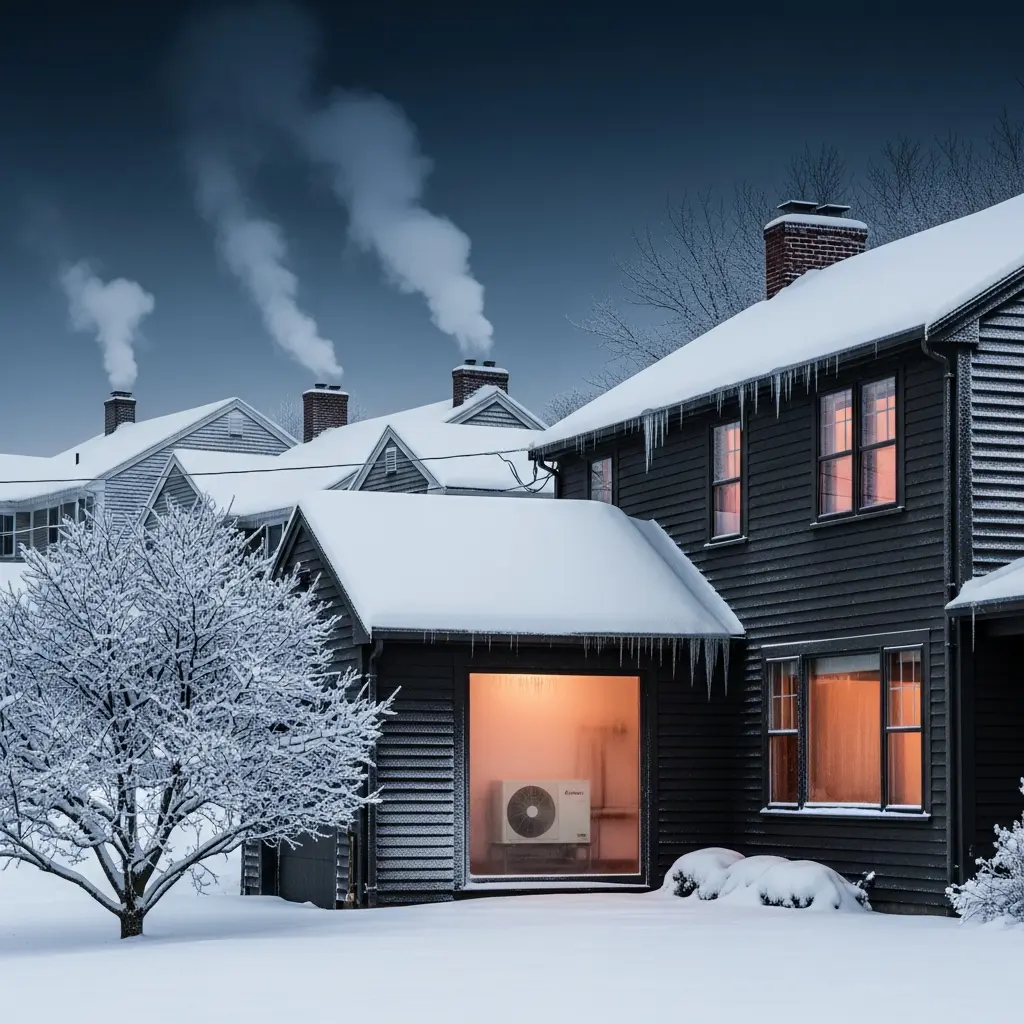

Geothermal Heating in Cold Climates: Does It Actually Work in -20°F?
Yes — geothermal heating works reliably in any cold climate, including regions that regularly see -20°F (-29°C) outdoor air. The secret is that geothermal systems harvest heat from the earth, not from outside air. At just 6 to 8 feet below the surface, ground temperatures in even the coldest U.S. states hold steady between 42°F and 52°F all winter long — a thermal buffer that outdoor air can never provide. Ground source heat pumps maintain a coefficient of performance (COP) of 3.0–4.5 even during extreme cold snaps, while air-source heat pumps can drop to COP 1.0–1.5 or shut down entirely.
Cold-Climate Geothermal at a Glance
- Works in ASHRAE zones 5, 6, and 7 — the primary heating belt covering Maine, Vermont, New York, Pennsylvania, Ohio, Michigan, Indiana, Iowa, Minnesota, and the upper Midwest
- Loop sizing increases in heating-dominant zones — expect 200–300 ft of vertical bore per ton of capacity in zone 6–7 versus 150–200 ft in milder climates
- Freeze protection is required — propylene glycol antifreeze in the ground loop prevents freeze damage; concentration varies by climate zone
- A small electric backup element is standard — properly sized systems rely on electric resistance heat strips for fewer than 150 hours per heating season, only at true design-day extremes
- Snow cover is an ally — the insulating effect of snow on the ground surface actually helps stabilize soil temperatures around shallow horizontal loops during winter
The Science: What 6 Feet of Soil Does to Outdoor Temperature Swings
To understand why geothermal heating in cold climates is not just viable but genuinely reliable, you need to grasp what happens to temperature underground.
At the surface, outdoor air in International Falls, Minnesota can plunge to -40°F on the coldest nights of January. Walk 6 to 8 feet straight down, and the story is completely different. The Minnesota Geothermal Heat Pump Association cites a stable underground temperature of 46°F to 52°F at 6–8 feet in that state, even in the dead of winter. Portland, Maine sees surface soil temperatures swing between 20°F in February and 65°F in August — but at 6 feet, that same soil never drops below about 42°F. Northern Vermont and upper Michigan show similar figures: the six-foot isotherm in these states runs roughly 40°F to 48°F year-round.
The physics behind this stability involves two distinct effects. First, soil has high thermal mass — it stores heat slowly and releases it slowly, acting as a giant thermal flywheel. The ground "remembers" summer's warmth months into winter. Second, snow cover provides meaningful insulation. A 12-inch snowpack with roughly R-2 to R-3 of thermal resistance per inch noticeably reduces heat loss from the soil surface during the coldest months, buffering the shallow ground against the full severity of outdoor air temperatures.
The result is what geothermal engineers call "thermal lag." The coldest point at 6 feet depth actually occurs in late winter or early spring — weeks after outdoor air hits its minimum — and even then, the magnitude of that minimum is dramatically smaller than what happens at the surface. The USDA Natural Resources Conservation Service Soil Climate Analysis Network (SCAN) continuously monitors soil temperatures at multiple depths across its 200+ nationwide stations, and the data consistently confirm this pattern: below 4–5 feet, seasonal temperature amplitude shrinks to single digits, while deeper zones approach the mean annual earth temperature of the region.
For geothermal systems, this matters enormously. An air-source heat pump must lift refrigerant from -20°F outdoor air to the 95–115°F supply temperature your home needs — a temperature differential of 115–135°F. A ground-source heat pump working from a 46°F ground loop faces a differential of only 50–70°F. That smaller lift is precisely why COP stays high all winter, regardless of how brutal things are above ground.
For a deeper look at what the subsurface looks like year-round, see our companion brief: How Cold Is It 6 Feet Underground?
COP Performance at Extreme Cold: Geothermal vs. Air-Source
COP — coefficient of performance — is the ratio of heat delivered to electrical energy consumed. A COP of 4.0 means you get 4 units of heat for every 1 unit of electricity. Higher is better.
The table below compares typical published COP ranges for ground-source heat pumps (GSHP) and air-source heat pumps (ASHP) across outdoor temperature conditions. GSHP values reflect a 45°F entering water temperature (EWT) from the ground loop, which is realistic for a properly sized zone 6 system.
| Outdoor Air Temperature | GSHP COP (45°F EWT) | ASHP COP | What This Means |
|---|---|---|---|
| 32°F (0°C) | 3.8 – 4.5 | 2.5 – 3.5 | Both systems run comfortably; GSHP holds clear advantage |
| 0°F (-18°C) | 3.5 – 4.0 | 1.5 – 2.0 | GSHP efficiency unchanged; ASHP degrades sharply |
| -20°F (-29°C) | 3.0 – 3.5 | 1.0 – 1.5 (or shutdown) | GSHP still delivers 3× more heat than electricity consumed; ASHP at or near its rated limit |
The pattern is clear: GSHP COP is essentially decoupled from outdoor air temperature because the system never touches outdoor air. Its only performance variable is entering water temperature from the ground loop — and as established above, that temperature barely moves between November and March. The DOE's Energy Saver program and Building Science Corporation's Digest BSD-113 both confirm that ground-source systems consistently outperform air-source systems in heating-dominated climates, with the gap widening as outdoor temperatures fall.
ASHP technology has improved significantly since 2020, with cold-climate models claiming rated capacity down to -13°F (-25°C). But "rated capacity" at a design extreme is not the same as maintaining efficiency at that extreme. At -20°F, even the best cold-climate ASHP is working near its engineering limit, while a geothermal system is operating in a range it was designed to sustain all winter.
This efficiency gap has direct dollar consequences. The Arctic Heat Pumps comparison resource and the Cold Climate Heat Pump performance study from Pacific Northwest National Laboratory (PNNL-37127) both document that heating-season energy consumption for GSHP systems in severe cold climates runs 30–50% lower than for equivalent ASHP installations.
For a broader cost-versus-performance comparison, see our geothermal cost guide and the geothermal vs. oil furnace comparison.
Loop Sizing in Heating-Dominant Cold Climates
A geothermal loop that is undersized for your climate will work hard in January, progressively cool the surrounding soil, and eventually deliver entering water temperatures too low for efficient operation — a condition called ground loop "short-circuiting" or thermal depletion. Sizing correctly from the start prevents this.
In mild or balanced heating-cooling climates (zones 3–4), a vertical closed-loop system typically requires 150–200 feet of borehole per ton of capacity. In heating-dominant cold climates (zones 5–7), that figure rises to 200–300 feet per ton, sometimes more, depending on soil thermal conductivity. Dense, water-saturated soils transfer heat more easily and allow shorter loops; dry sandy soils or fractured granite require deeper bores or additional boreholes.
Horizontal loops follow a similar pattern. In zone 4–5 regions, 400–600 feet of pipe per ton laid at 5–6 feet deep is often sufficient. In zone 6–7 territory, expect 600–800 feet per ton, requiring roughly 3,000 square feet or more of yard per ton of system capacity. That land requirement makes horizontal loops impractical for many northern residential lots, which is why vertical boring is the dominant installation method in Minnesota, Michigan, and northern New England.
IGSHPA design standards call for accounting for:
- Soil thermal conductivity (measured via thermal response test for systems over 4 tons)
- Annual ground thermal imbalance — if you heat far more than you cool, the loop field gradually cools over years and must be sized to compensate
- Borehole spacing (minimum 15–20 feet between vertical bores to prevent thermal interference)
- Minimum entering water temperature — most residential GSHP equipment is rated to function down to 25°F EWT, but efficiency drops below 32°F, so designers target a worst-case EWT above 30°F
Cold-climate installs in the Great Lakes region and northern New England regularly use 250 ft/ton as a conservative starting point, then refine based on geology. The upfront drilling cost of a slightly deeper loop pays back in consistent winter performance and loop longevity. See our installation process guide for what the drilling and loop installation sequence looks like on the ground.
Antifreeze Concentration: Getting It Right Matters
Ground-source heat pump loops in cold climates circulate a water-antifreeze mixture through the ground loop rather than pure water. The antifreeze prevents the loop fluid from freezing inside the pipes during winter operation, when the fluid can be chilled to temperatures in the high 20s°F as it absorbs heat from cold soil.
Propylene glycol is the near-universal choice for residential systems because it is food-grade, non-toxic, and permitted by regulators in every U.S. state for buried-loop applications. (Ethylene glycol — the type used in car radiators — is toxic and prohibited in many jurisdictions for earth-loop use.)
Concentration determines freeze protection depth:
- ASHRAE climate zone 5 (PA, OH, IN, southern MI, southern MN) — 15–20% propylene glycol by volume; protects to approximately 15°F to 20°F
- Zone 6 (northern MI, most of MN, northern NY, VT, NH) — 20–25% by volume; protects to approximately 5°F to 15°F
- Zone 7 (International Falls MN, northern Maine, subarctic regions) — 25–30% by volume; protects to approximately -5°F to 0°F
Higher glycol concentration lowers freeze risk but also reduces the fluid's heat-carrying capacity and increases pumping resistance. Over-concentrating — using 40–50% "just to be safe" — noticeably reduces system efficiency without meaningful additional protection at real-world loop temperatures. The right specification is enough protection to handle a multi-day power outage at design-day temperatures, not the coldest theoretically possible temperature for the region.
Installers must also verify the antifreeze is properly inhibited against corrosion. Uninhibited propylene glycol is mildly acidic and will degrade copper fittings and steel heat-exchanger components over time. DOWFROST GEO and equivalent inhibited formulations are specified for geothermal closed loops and should be tested every 5 years and recharged as needed.
Backup Heat Strategy in Cold Climates
Most ground-source heat pump units installed in zones 5–7 include an electric resistance backup element — typically a 5 kW, 10 kW, or 15 kW heat strip mounted in the air handler — that activates when the heat pump alone cannot keep pace with demand. Understanding when and how often that strip runs is the key to evaluating both your comfort and your energy costs.
In a properly designed cold-climate geothermal system, backup strips should activate for roughly 50 to 150 hours over an entire heating season. This represents roughly 1–3% of total seasonal heating hours. At those usage levels, the strip heat adds perhaps $80–$200 to annual electricity costs — a modest premium for the confidence of knowing your home will stay warm at -20°F.
The backup element is not a design failure. It is an intentional part of IGSHPA design methodology for cold-climate installs. Designing the geothermal system to carry 100% of load at the absolute coldest design temperature would require significantly more bore footage, higher upfront cost, and loop infrastructure that sits substantially over-sized during the 99% of winter hours that are less extreme. The pragmatic approach is to design the GSHP to handle the vast majority of heating load, then let a small strip handle the statistical tail of design-day extremes.
What should concern any homeowner is strip heat that runs constantly — every day, for weeks at a time, throughout the winter. Continuous backup operation is a diagnostic signal, not a design feature. It almost always indicates one of the following:
- An undersized ground loop that has depleted its thermal capacity and is delivering entering water temperatures well below design
- A refrigerant charge issue or compressor fault that has reduced the heat pump's output
- A distribution system mismatch — the heat pump is cycling correctly but air handler settings are configured to prioritize strips over compressor output
- A duct or envelope deficiency causing heat loss that exceeds system design assumptions
Modern geothermal systems include fault monitoring and lockout logic that logs strip-heat runtime. Reviewing that data with your installer after the first full heating season is a recommended cold-climate best practice.
For more context on how installation design affects cold-weather outcomes, see the installation process guide and the heating climate guide.
Real-World Cold-Climate Savings: What Homeowners Actually Experience
Abstract efficiency numbers matter less to most homeowners than a concrete sense of how much money geothermal can save in a real northern climate. The following examples are based on EIA fuel price data, typical cold-climate heating loads, and published GSHP efficiency ranges — not fabricated individual testimonials.
Maine: Heating oil to geothermal. Roughly two-thirds of Maine households heat with petroleum products — the highest share of any state, per the EIA's State Energy Profile. A typical Maine home consuming 800–1,000 gallons of heating oil per year at current regional prices of $3.50–$4.00 per gallon spends $2,800–$4,000 annually on heat. A correctly sized geothermal system in Maine typically replaces 70–80% of that heating energy with electricity at a COP of 3.5–4.0, reducing annual heating costs to roughly $900–$1,400. Savings of $2,000–$3,000 per year are realistic across Maine's zone 5–6 geography. Find a certified installer: Maine geothermal contractors.
Minnesota: Propane to geothermal. Propane in Minnesota averages $1.80–$2.20 per gallon at the farm gate. A northern Minnesota home burning 1,400–1,800 gallons of propane per year (zone 6–7 heating loads are substantial) spends $2,500–$4,000 annually. Switching to geothermal and taking advantage of Minnesota's relatively affordable electricity rates typically cuts heating energy costs to $1,000–$1,600 per year, yielding annual savings of $1,500–$2,500 or more for homes in the Duluth or International Falls corridor. Find a certified installer: Minnesota geothermal contractors.
Northern Vermont: Electric resistance to geothermal. A Vermont home that currently heats entirely with baseboard electric resistance — which operates at COP 1.0 by definition — converting to geothermal at COP 3.5 effectively multiplies the useful heat per kilowatt-hour by 3.5×. Vermont electric rates have historically run $0.20–$0.25 per kWh. A home spending $4,500 per year on electric resistance heat could see that bill drop to $1,200–$1,500 post-conversion, for savings of $2,500–$3,000 annually. Find a certified installer: Vermont geothermal contractors.
These savings projections are pre-incentive. The geothermal vs. propane comparison and geothermal vs. oil furnace comparison explore payback periods in more detail across different fuel price scenarios.
What Can Go Wrong in Extreme Cold
Geothermal heating in cold climates is robust by design, but three specific failure modes appear more frequently in severe-cold installations than in milder regions:
Frost-jacking on horizontal loops buried too shallow. In zones 5–7, the frost line runs 48–80 inches deep depending on location. Horizontal loop piping must be buried at least 6 inches below the local frost penetration depth — which in extreme cases (northern Minnesota, International Falls, upper Maine) means 5.5 to 7 feet minimum burial. Pipes installed at only 4 feet can be subject to frost-jacking: the seasonal expansion and contraction of frozen soil physically moves the pipe, stressing fittings and header connections over time. Reputable installers pull a local frost-depth specification before trenching.
Circulator pump issues from low loop pressure or glycol degradation. Pumps that are undersized for the viscosity of cold, high-concentration glycol can cavitate — forming vapor bubbles that erode the impeller. This is especially a risk at system startup after a cold soak if the circulator is running too fast for viscous 30°F fluid. Proper pump sizing for cold-fluid viscosity, combined with variable-speed circulators that ramp up gradually, prevents this. Glycol that has acidified (uninhibited or aged beyond its service interval) also becomes more viscous and aggressive toward metal components.
Auxiliary breaker and electrical panel mismatch. A 10 kW or 15 kW heat strip draws 42–63 amps at 240V. Homes that add geothermal to an older electrical service panel sometimes discover the auxiliary breaker is sized for a previous backup heat source and may not be rated for the new strip load. This is a code compliance issue and a fire risk if overlooked. A licensed electrician should inspect the panel capacity before commissioning any cold-climate geothermal installation with heat strip backup.
Frequently Asked Questions
Does geothermal heating work in cold climates?
Yes, without qualification. Geothermal heating is well-suited to cold climates because it draws heat from stable underground temperatures — typically 42°F to 52°F at 6–8 feet depth across northern U.S. states — rather than from outdoor air. Systems in Minnesota, Maine, Michigan, Iowa, and other zone 5–7 states routinely deliver COP values of 3.0–4.0 throughout winter, including during stretches of -20°F outdoor air temperatures. The primary installation considerations are loop sizing (slightly larger than in mild climates) and proper antifreeze concentration.
Does geothermal work in winter or below freezing outdoor temperatures?
Geothermal heat pumps are unaffected by outdoor air temperature because they are connected to the ground, not to outside air. When outdoor temperatures drop below freezing — whether to 20°F, 0°F, or -20°F — the ground loop continues delivering the same 40°F–50°F fluid to the heat pump. Performance is determined by ground loop temperature, not air temperature. Unlike air-source heat pumps, geothermal systems do not lose capacity or COP as outdoor temperatures fall. They produce the same amount of heat at -20°F that they do at 40°F.
Will my geothermal loop freeze?
No, not if the system was installed correctly with the appropriate antifreeze concentration. All cold-climate geothermal loops use a water-propylene glycol mixture calibrated to the local climate zone. In zone 6–7 regions, 20–25% propylene glycol provides freeze protection well below the temperatures the loop fluid actually reaches during normal operation. Even during a multi-day power outage at design-day extremes, properly charged loops do not freeze. Loops installed without antifreeze — sometimes seen in zone 4 installs where water-only was specified — should be inspected and upgraded if the system is in a colder zone than originally anticipated.
Do I need a backup heat source with geothermal?
In most cold-climate homes, yes — a modest electric resistance heat strip (5–15 kW) is included in the air handler as a backup element. On a properly sized system, this strip should activate for only 50–150 hours over an entire heating season, typically during the coldest few days of the year. Its purpose is to handle the statistical tail of design-day extremes without requiring the geothermal loop to be oversized for those rare events. If your backup strips are running for weeks at a time, that is a diagnostic signal — not a normal operating condition — and indicates the loop may need inspection or resizing.
Sources
- U.S. Department of Energy — Geothermal Heat Pumps (Energy Saver)
- Pacific Northwest National Laboratory — DOE Cold Climate Heat Pump Performance Study (PNNL-37127)
- ASHRAE — Standard 169-2021: Climatic Data for Building Design Standards (climate zone definitions)
- USDA Natural Resources Conservation Service — Soil Climate Analysis Network (SCAN)
- Minnesota Geothermal Heat Pump Association — Earth Loop Options and Ground Temperatures
- U.S. Energy Information Administration — Maine State Energy Profile; Heating Oil and Propane Update
- IGSHPA — Closed-Loop/Geothermal Heat Pump Systems Design and Installation Standards (2017)
- Building Science Corporation — BSD-113: Ground Source Heat Pumps for Residential Heating and Cooling
- Efficiency Maine — Residential Heating System Cost Calculator
- National Weather Service (NCRFC) — Frost Depth Map
Need a Geothermal Contractor?
Search the directory for licensed installers near you. Compare credentials, read reviews, and contact directly.
Find Installers Near YouOwn a Geothermal Business?
Claim your free listing to get more qualified leads, show up in local search, and answer customer questions where they’re already looking.
Claim Your Free Listing