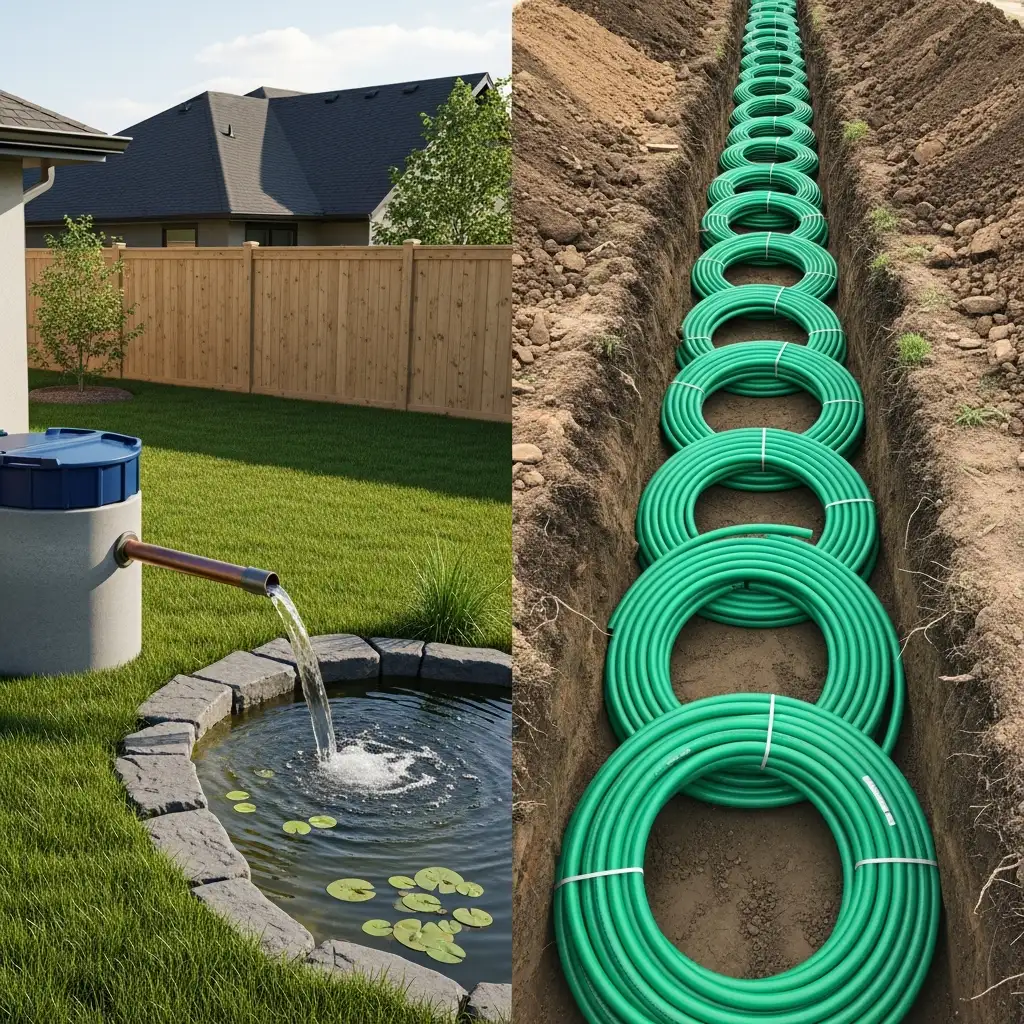

Open Loop vs Closed Loop Geothermal: Pros, Cons & Cost Per Type
Closed-loop geothermal systems use a sealed HDPE circuit filled with antifreeze and glycol — no groundwater contact, usable almost anywhere. Open-loop systems pump actual groundwater through the heat exchanger and discharge it to a return well or surface body. Open-loop installations run $18,000–$28,000 versus $24,000–$36,000 for closed-loop, but they require a reliable aquifer, adequate well yield, and permits that vary significantly by state.
Quick Comparison: Open Loop vs. Closed Loop
| Category | Closed Loop | Open Loop | Notes |
|---|---|---|---|
| Typical installed cost | $24,000–$36,000 | $18,000–$28,000 | Open loop savings hinge on aquifer quality |
| Site requirement | Adequate land or depth for loops | High-yield aquifer (≥3 GPM/ton) | Groundwater chemistry must also be acceptable |
| Groundwater contact | None — sealed antifreeze circuit | Direct — supply well + return well | Open loop may require UIC Class V registration |
| Operating pump load | Small circulator pump only | Submersible well pump + circulator | Well pump adds 300–700W continuous draw |
| Permit complexity | Building permit + well permit | Well permit + discharge/UIC permit | Several states restrict or ban new open-loop installs |
What Is a Closed-Loop Geothermal System?
A closed-loop ground source heat pump circulates a mixture of water and propylene glycol through a continuous sealed circuit of high-density polyethylene (HDPE) pipe buried in the earth. The fluid never contacts the surrounding soil or groundwater — it simply absorbs or rejects heat through the pipe wall and carries it to the heat pump inside your building.
This sealed architecture is why closed-loop systems work almost anywhere in the continental US. The three main buried configurations are:
- Vertical loops — boreholes drilled 150–400 feet deep, two pipes per borehole connected in a U-bend. Typical spacing is 15–20 feet between boreholes. Best where land is limited.
- Horizontal loops — trenches 4–6 feet deep with pipe laid in straight runs, slinkies, or stacked configurations. Cheaper to install than vertical when acreage allows.
- Pond/lake loops — coiled HDPE sunk to the bottom of a body of water at least 8 feet deep. Often the lowest-cost closed-loop option when a suitable pond sits on or adjacent to the property.
The propylene glycol antifreeze keeps the fluid from freezing in winter and is food-safe — the same compound used in the food and beverage industry. Loop fluid temperatures typically swing from around 25°F (in heating mode on the coldest days) to 90°F (in cooling mode during summer), while the surrounding earth stays in a relatively narrow band that never strays far from the local mean annual air temperature.
Closed loops account for roughly 95% of geothermal heat pump installations in the United States. Their dominance comes down to one factor: they work everywhere a borehole or trench can be dug, without any dependence on groundwater quality or quantity.
For a detailed look at how vertical and horizontal configurations compare in cost and land use, see Vertical vs. Horizontal Ground Loops. For a broader introduction to loop types, see Geothermal Loop Types Explained.
What Is an Open-Loop Geothermal System?
An open-loop system — sometimes called a groundwater heat pump — draws water directly from a supply well, passes it through the heat pump's refrigerant-to-water heat exchanger, and discharges the water either to a separate return well injected back into the same aquifer, or to a surface body such as a pond, stream, or drainage field where local regulations allow.
The thermal advantage of open-loop systems is real: groundwater in most of the continental US holds a nearly constant temperature year-round — roughly 50°F–58°F depending on latitude. That stability means the heat pump always operates at an ideal entering water temperature, with no seasonal swings. Closed-loop fluid temperatures fluctuate with the seasons; open-loop source temperatures do not.
The fundamental site requirement is adequate well yield. A typical residential geothermal heat pump needs approximately 1.5–3 gallons per minute per ton of system capacity. A 4-ton system therefore needs a well capable of sustaining 6–12 GPM continuously through a heating or cooling cycle — a yield that many shallow aquifers can't reliably produce.
Beyond flow rate, water chemistry matters enormously. High iron, manganese, hardness, or hydrogen sulfide can foul or corrode the heat exchanger over time. A water analysis is required before any open-loop design is finalized, and water treatment equipment may add $1,000–$4,000 to the project cost.
The supply and return wells must typically be completed in the same aquifer to prevent cross-contamination between water-bearing zones of different chemistry. Well spacing requirements vary by state, but 100–800 feet between supply and return wells is a common design guideline.
Want to understand how depth affects system performance for either type? See How Deep Is a Geothermal Loop? for a detailed breakdown.
Cost Comparison: Open Loop vs. Closed Loop
The upfront cost difference between open-loop and closed-loop systems is real but conditional. When a suitable aquifer exists, open-loop installations routinely run $5,000–$10,000 less than a comparable closed-loop system. The savings come from the elimination of extensive buried loop piping — no borehole drilling or long trenches, just two wells.
Typical installed cost ranges for a 3–4 ton residential system:
- Open loop: $18,000–$28,000 (supply well + return well + heat pump + distribution)
- Closed loop, horizontal: $20,000–$30,000 (trenching + HDPE pipe + heat pump)
- Closed loop, vertical: $24,000–$36,000 (drilling + boreholes + heat pump)
Operating costs complicate the picture. Open-loop systems run a submersible well pump continuously during operation — typically a 300–700W load — in addition to the heat pump's internal circulator. Closed-loop systems use only a small circulator pump (50–150W) to move the antifreeze fluid. That well pump electricity cost typically adds $150–$350 per year to the open-loop operating bill.
Lifecycle cost depends heavily on water chemistry. If groundwater is clean and the heat exchanger requires no treatment and no servicing, open-loop running costs are low. If iron fouling requires annual descaling, or if a water softener or filtration system is needed, those costs erode the upfront savings within 10–15 years. Closed-loop systems have no water treatment costs and the buried HDPE pipe carries a 25–50 year design life with essentially no maintenance.
For a full cost breakdown including drilling and installation details, see the Geothermal Installation Process Guide. To model payback for your specific situation, use the Geothermal Loop Calculator.
Permitting Differences
Permitting is where open-loop and closed-loop systems diverge most sharply from a practical standpoint.
Closed-loop systems generally require a building permit for the mechanical installation and a well permit for each borehole (in states that regulate heat exchange wells separately). Some states exempt shallow horizontal loops from well permitting entirely. The review process typically takes 2–6 weeks and rarely results in denial for residential projects where the site is otherwise suitable.
Open-loop systems face a second layer of review because they interact directly with groundwater. Depending on the state:
- A groundwater withdrawal permit may be required if annual extraction exceeds a threshold (often 1–5 million gallons per year).
- A groundwater discharge or injection permit is required for the return well in most states, and the EPA Underground Injection Control (UIC) Class V program may require registration for the injection well at the federal level. Notably, closed-loop wells are not subject to UIC requirements.
- Minnesota statute prohibits new once-through open-loop systems exceeding 5 million gallons per year and since 2015 has barred new permits for systems between 1 million and 5 million gallons annually — effectively restricting most residential open-loop systems to injection-well return configurations.
- New York requires DEC well permits and EPA UIC contact for open-loop wells, with additional wellhead protection zone restrictions in sensitive areas.
- Several other states impose de facto restrictions by requiring site-specific hydrogeological studies, water quality monitoring wells, or annual reporting that makes residential open-loop projects economically impractical.
Before committing to an open-loop design, check your state's well and groundwater permitting requirements. A local certified geothermal installer familiar with your jurisdiction will know the current rules.
When Each System Wins
Neither system is universally better. The right choice depends on what your site can support.
Open-loop is the better choice when:
- A tested well confirms sustained yield of at least 3 GPM per ton of heating/cooling capacity
- Water chemistry analysis shows acceptable iron, hardness, and pH with minimal treatment required
- State and local permitting for groundwater withdrawal and injection well discharge is routine and feasible
- Upfront cost minimization matters more than lowest lifecycle cost
- The property has limited land for horizontal trenching and soil/rock conditions make vertical drilling expensive
Closed-loop is the better choice when:
- No high-yield aquifer is available, or well yields are uncertain
- Groundwater chemistry would require treatment equipment (high iron, hardness, corrosivity)
- State or local rules restrict or ban open-loop discharge
- The property is in a wellhead protection zone or sensitive groundwater area
- Lowest total cost of ownership over a 20+ year period is the priority
- The owner prefers a system with no dependence on groundwater conditions
In practice, most geothermal installers will recommend a closed-loop system by default and only propose open-loop when site conditions clearly support it. See The Three Types of Geothermal Heat Pumps for a broader look at how system architecture choices affect performance.
Direct Exchange (DX) Systems: A Third Option
A small fraction of geothermal installations use a direct exchange (DX) system, which takes a different approach entirely. Instead of a secondary fluid loop filled with antifreeze, DX systems circulate refrigerant directly through copper tubing buried in the ground. This eliminates the intermediate heat exchanger between the ground loop and the refrigerant circuit, which improves heat transfer efficiency — refrigerant absorbs and releases heat more effectively than water-glycol mixtures.
DX systems can be more efficient in certain soil conditions and typically use shorter, smaller-diameter burial fields than HDPE closed loops for equivalent capacity. However, they carry several significant limitations:
- Copper tubing in direct soil contact is susceptible to corrosion, particularly in acidic soils or soils with high moisture and mineral content.
- A refrigerant leak underground is difficult to detect and expensive to repair, unlike a water-glycol leak that can be refilled.
- Modern high-efficiency refrigerants have different thermodynamic properties than the older R-22 and R-410A originally used in DX systems, complicating new installations.
- The DOE and most major IGSHPA-certified installers currently recommend against DX systems for most retrofit applications due to the repair-access and corrosion risk concerns.
DX systems represent a small slice of the US geothermal market and are best evaluated on a site-specific basis with an installer who has direct experience with them. For most residential buyers, closed-loop HDPE or open-loop water-source heat pumps are the practical choices.
Frequently Asked Questions
What is the difference between open and closed loop geothermal?
A closed-loop system circulates a sealed water-glycol mixture through buried HDPE pipe, never contacting groundwater. An open-loop system draws actual groundwater from a supply well, passes it through the heat exchanger, and discharges it to a return well or surface body. Closed loops work nearly anywhere; open loops require an adequate aquifer and additional permits. Both use the same type of heat pump equipment indoors — the distinction is entirely in the buried ground heat exchanger.
Is open loop or closed loop better?
Open-loop systems typically cost $5,000–$10,000 less upfront and deliver slightly better thermal performance because groundwater temperature is more stable than buried loop fluid temperature. However, closed-loop systems work in more locations, have no dependence on water quality or yield, face simpler permitting, and often have lower lifetime costs when water treatment requirements are factored in. For most homeowners without a proven high-yield well, closed-loop is the more practical and lower-risk choice.
Are open loop geothermal systems legal?
Open-loop geothermal systems are legal in most US states, but subject to permitting that varies significantly by jurisdiction. Most states require both a well permit for the supply well and a permit or registration for the return well (injection or surface discharge). Minnesota has prohibited most new once-through open-loop systems since 2015. New York requires DEC well permits and EPA UIC contact for open-loop injection wells. Some states impose restrictions in wellhead protection zones or sensitive aquifer areas. Check with a licensed installer familiar with your county and state before assuming open-loop is an option.
What is direct exchange geothermal?
Direct exchange (DX) geothermal is a system type where refrigerant — rather than a water-glycol mixture — circulates directly through copper tubing buried in the ground. Eliminating the intermediate heat exchanger between the ground and the refrigerant improves heat transfer efficiency. However, DX systems face copper corrosion risk in certain soils, make underground leaks difficult to repair, and are not recommended for most retrofit applications by the DOE. They represent a small portion of US geothermal installations and are primarily found in niche residential applications where a DX-experienced installer has evaluated the soil conditions.
Sources
- IGSHPA — Ground Source Heat Pump Standards and Applications
- EPA Underground Injection Control Program — Class V Wells Overview
- DOE Energy Saver — Geothermal Heat Pumps
- Minnesota Department of Health — Geothermal Heating and Cooling Systems
- New York State DEC — Regulated Well Types Including Geothermal
- Energy Vanguard — Open-Loop vs. Closed-Loop Ground Source Heat Pumps
- Water Well Journal — Geothermal System Design and Flow Rate Requirements
Need a Geothermal Contractor?
Search the directory for licensed installers near you. Compare credentials, read reviews, and contact directly.
Find Installers Near YouOwn a Geothermal Business?
Claim your free listing to get more qualified leads, show up in local search, and answer customer questions where they’re already looking.
Claim Your Free Listing