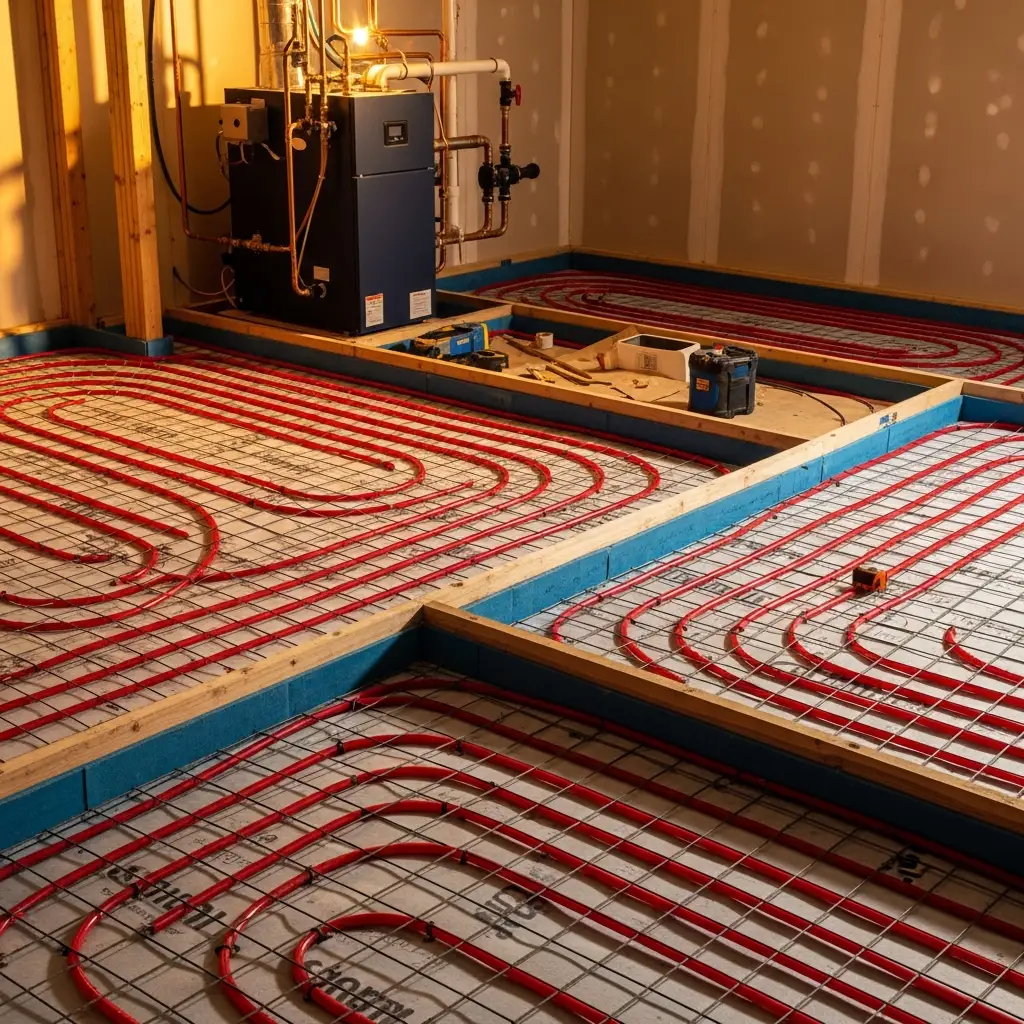

Radiant Floor Heating with Geothermal: Pairing Guide
Pairing a water-to-water geothermal heat pump with a hydronic radiant floor system produces the most comfortable, efficient heating setup available to homeowners today. A geothermal unit extracts stable ground-loop heat and delivers it as 90–110°F warm water that circulates through PEX tubing embedded in a concrete slab or installed beneath hardwood floors — precisely the temperature range radiant systems need. Expect a system COP of 4–5, a cost premium of roughly $3,000–$8,000 over a ducted geothermal install, and the best long-term operating economics for cold-climate homes in new construction or whole-floor renovation.
How the Pairing Works
Most people encounter geothermal heat pumps in a water-to-air configuration: the unit pulls heat from the ground loop, upgrades it with a compressor, and delivers conditioned air through conventional ductwork. That architecture works well, but it cannot directly supply a radiant floor system, which needs warm water — not warm air — circulating through tubing.
A water-to-water geothermal heat pump resolves this by producing hydronic output instead of air output. Ground-loop fluid (typically 45–65°F in winter, depending on climate and loop design) enters the unit's refrigerant-side heat exchanger as the heat source. The compressor upgrades that heat, and the load side of the unit delivers warm water to the building distribution system — radiant circuits, a domestic hot water tank, or both.
The temperature match is the technical key to this pairing's efficiency. Traditional boiler-driven radiant systems operate at 140–180°F, a temperature range that demands significant fuel input. Radiant floor circuits actually only need 80–120°F supply water to bring a slab or under-hardwood assembly to the 68–72°F room temperature homeowners expect. A water-to-water geothermal unit operating at rated conditions delivers supply water in the 90–110°F band — an almost exact match for radiant demand, without the temperature overshoot that wastes energy in boiler systems.
That alignment between heat-pump output temperature and system demand temperature is why the combination achieves COP values of 4–5: the compressor works least when the difference between ground-loop temperature and load-side delivery temperature is smallest. Running a 95°F radiant supply off a 50°F ground loop is far less work than running a 140°F boiler supply — and every degree the system avoids lifting translates directly to lower electricity consumption.
For loop sizing context and the trade-offs between vertical and horizontal installations that affect ground-loop entering temperatures, see our guide at Vertical vs. Horizontal Ground Loops.
Architecture: Water-to-Water vs. Water-to-Air
Choosing the right equipment architecture is the first design decision for any geothermal radiant project.
Water-to-Water (Dedicated Hydronic Unit)
A dedicated water-to-water unit has one purpose: move heat from the ground loop into the building's hydronic distribution system. There is no internal air handler, no ductwork connections. Output goes to a hydronic manifold that feeds radiant loops and, if configured, an indirect domestic hot water storage tank. This is the preferred architecture for radiant-only homes or whole-home hydronic builds. Equipment examples: WaterFurnace 5 Series 500W11/502W12 (2–15 tons), ClimateMaster Tranquility Water-to-Water (THW series, 3–70 tons), Bosch FHP WT/WW Series.
Water-to-Air (Standard Geothermal, Forced-Air Only)
The water-to-air unit — the most common residential geothermal configuration — delivers conditioned air and cannot directly supply radiant circuits. If you already have a water-to-air system and want to add radiant, you would need a separate water-to-water unit on the same ground loop, or a desuperheater loop that captures waste heat for supplemental radiant — a less efficient arrangement. For homes that need both forced-air zones (bedrooms, second floor) and radiant zones (main floor slab), a hybrid approach is common.
Hybrid: Water-to-Water Primary + Supplemental Forced Air
High-performance new construction sometimes pairs a water-to-water unit for radiant heating with a smaller water-to-air unit (or a fan-coil cassette fed from the hydronic loop) to handle cooling and ventilation. This delivers maximum comfort but also carries the highest equipment cost. For most single-family residences, a properly sized water-to-water unit with a separate mini-split or ERV for cooling is more cost-effective than a full hybrid hydronic/forced-air geothermal system.
Loop Water Temperature and Radiant Compatibility
Concrete slab radiant systems typically operate on supply water of 85–120°F, with 100–110°F common at design conditions. The floor surface temperature sits roughly 5–10°F above room air temperature, and comfort studies establish that floor surfaces above 85°F become uncomfortable underfoot — so supply temperature is deliberately moderated, not maximized.
Under-hardwood and over-floor radiant (staple-up or aluminum-plate systems beneath subfloor) require more nuanced temperature management. Wood floors are sensitive to moisture cycling that results from surface temperature swings; most manufacturers and the Radiant Professionals Alliance recommend keeping hardwood floor surface temperatures below 80°F. In practice, that means supply water in the 85–105°F range for a properly designed under-hardwood assembly, depending on floor thickness, finish type, and heat loss.
Water-to-water geothermal units from the major manufacturers deliver load-side water temperatures of 90–110°F at standard ground-loop conditions, and up to 130–145°F with vapor-injection technology (WaterFurnace 502W12 reaches 150°F; ClimateMaster THW series operates to 140°F load-side). The standard 90–110°F output lands squarely in the radiant sweet spot for slab applications. For hardwood, an outdoor reset control — which lowers supply temperature on mild days and raises it on cold days — keeps the system operating near its most efficient point while protecting the floor assembly.
Outdoor reset is not optional on a well-designed geothermal radiant system; it is standard practice. Every degree of unnecessary supply temperature the reset curve eliminates improves compressor COP and floor comfort simultaneously.
Cost Comparison vs. Alternatives
The table below compares four common heating configurations for a 2,500 sq ft home in Climate Zone 5. Costs are all-in: equipment, installation, ground loop or gas line, radiant tubing and manifolds where applicable.
| System Configuration | Installed Cost (Approx.) | Annual Operating Cost (Est.) | Notes |
|---|---|---|---|
| Geothermal water-to-air + forced-air ducted | $24,000–$36,000 | $900–$1,400 | No radiant; ductwork required |
| Geothermal water-to-water + radiant | $28,000–$45,000 | $950–$1,500 | No ductwork; premium comfort |
| Gas boiler + radiant | $12,000–$22,000 | $1,800–$3,200 | Gas operating cost dominant; no cooling |
| Air-source heat pump + radiant | $18,000–$28,000 | $1,200–$2,100 | COP degrades in cold weather; less efficient than geo |
The geothermal radiant premium over a gas boiler radiant system ($6,000–$23,000 more upfront) is recovered through lower operating costs over 8–15 years in most climate zones, faster where gas prices are high. The premium over a geothermal water-to-air system ($3,000–$8,000) reflects radiant tubing, manifolds, buffer tank, and the water-to-water unit itself in place of an air handler — but eliminates all ductwork costs, which can partially offset the difference in new construction.
See our full breakdown of geothermal economics at Geothermal Heat Pump Cost Guide.
When Geothermal Radiant Makes Sense
Use this checklist before committing to the design:
| Condition | Fit? | Why It Matters |
|---|---|---|
| New construction or full-floor slab-in renovation | Strong fit | PEX tubing installs in wet slab before pour; retrofit into existing slab is impractical |
| Climate Zone 5 or colder (upper Midwest, New England, Mountain West, most of Canada) | Strong fit | Higher heating loads amplify operating cost savings; payback accelerates |
| Long-horizon owner (15+ years planned) | Strong fit | System payback typically 10–15 years; resale value capture uncertain in shorter holds |
| Comfort priority (allergy sensitivity, no-draft preference, luxury residential) | Strong fit | Radiant is the quietest, most draft-free heating method available |
| High-end home ($600K+ value) | Good fit | Radiant floor + geothermal is a marketable premium feature at this price point |
| Rental property or short-term hold | Poor fit | Higher upfront cost; owner may not capture operating savings before sale |
| Existing forced-air duct system you want to keep | Marginal | Water-to-air geo is simpler; water-to-water retrofit adds cost without eliminating ducts |
For a detailed walkthrough of the full installation process and what to expect from a geothermal contractor, see Geothermal Installation Process Guide.
The Buffer Tank Requirement
Geothermal water-to-water systems almost always require a buffer tank between the heat pump and the radiant distribution manifold, and skipping it is a decision that tends to surface as compressor failures 5–8 years down the road.
The core problem is a flow rate mismatch. A water-to-water geothermal heat pump needs roughly 2.5–3 GPM per ton to protect the heat exchanger — a 4-ton unit needs 10–12 GPM through the load side. Radiant loops typically circulate at 0.5–0.75 GPM each, so a home with eight loops runs just 4–6 GPM total. The heat pump needs significantly more.
A buffer tank decouples the heat pump's high-flow primary loop from the radiant distribution's low-flow secondary loop. It also provides thermal mass that prevents compressor short-cycling: the tank absorbs the heat pump's output between zone calls, allowing the compressor to run full efficient cycles rather than starting and stopping every few minutes — the leading cause of early compressor failure in hydronic geothermal installations.
Standard buffer tank sizing follows a rule of thumb of 10 gallons per ton of heat pump capacity. A 3-ton system requires a 30-gallon buffer tank; a 5-ton system, 50 gallons. Most residential geothermal radiant installs land in the 40–80 gallon range. Buffer tanks themselves add $400–$800 to the project cost — a minor line item compared to the compressor replacement they prevent.
Geothermal desuperheaters and domestic hot water integration interact with buffer tank design; for that detail, see our article on Geothermal Water Heaters and Desuperheaters.
Brand Options: Water-to-Water Geothermal Units
Three manufacturers dominate the residential and light-commercial water-to-water geothermal market in North America. All are available through certified geothermal contractors; none are sold direct.
WaterFurnace — 5 Series Water-to-Water
The 500W11 (2–15 tons, single and dual hydronic configurations) is WaterFurnace's core residential water-to-water offering. The 502W12 adds vapor injection to reach supply temperatures up to 150°F — useful for mixed systems that include higher-temperature baseboard zones alongside radiant. COP at standard ARI test conditions runs 3.1–3.3 for the 500W11; the 7 Series platform achieves higher COPs through variable-speed compressor staging.
ClimateMaster — Tranquility Water-to-Water (THW Series)
ClimateMaster's THW series covers 3–70 tons, with the residential sweet spot in the 3–5 ton range. Load-leaving temperature operates up to 140°F; source entering temperature accepts 20–130°F, giving the system wide ground-loop operating range in extreme climates. The THW is frequently specified for radiant floor, snow/ice melt, and indirect domestic hot water simultaneously — three load types off one refrigerant circuit. Advanced microprocessor controls include a remote service sentinel for contractor diagnostics.
Bosch — FHP Water-to-Water Series (WT/WW)
Bosch's FHP WT/WW series water-to-water units are certified to ASHRAE/AHRI/ISO 13256-1, with COPs reaching 5.0 at full load under favorable conditions. The line skews commercial but 2–6 ton residential configurations exist. Confirm current model availability with a local Bosch FHP installer — product-line consolidation has affected residential offerings in recent years.
Also worth evaluating: Carrier and Trane both offer water-to-water configurations through their commercial divisions for larger residential projects.
Ready to connect with an installer who has water-to-water experience? Find a certified geothermal contractor in your area.
Frequently Asked Questions
Does geothermal work with radiant floor heating?
Yes — a water-to-water geothermal heat pump is purpose-built for radiant floor systems. The unit delivers 90–110°F supply water, which is exactly what PEX radiant circuits require for slab or under-hardwood heating. The combination achieves a COP of 4–5, making it significantly more efficient than gas boiler radiant or air-source heat pump radiant alternatives. The system requires a water-to-water unit (not the more common water-to-air configuration) and a buffer tank for proper hydraulic separation.
What temperature water does a geothermal radiant system deliver?
Standard water-to-water geothermal units deliver load-side supply water in the 90–110°F range at typical ground-loop conditions. Slab radiant systems run comfortably on 95–110°F supply; under-hardwood assemblies typically use 85–105°F with an outdoor reset control to protect wood flooring and maximize COP. Advanced units with vapor injection (such as the WaterFurnace 502W12) can reach 145–150°F for mixed hydronic systems that include higher-temperature zones alongside radiant.
Is geothermal radiant cheaper to operate than gas radiant?
In most North American markets, yes — often significantly. A gas boiler driving radiant typically costs $1,800–$3,200 per year in fuel for a 2,500 sq ft home in Climate Zone 5; an equivalent geothermal radiant system typically runs $950–$1,500 per year in electricity at average utility rates. The gap widens as gas prices rise and narrows if local electricity rates are high (above roughly $0.18/kWh). The geothermal system costs more upfront; payback depends on the gas-to-electricity price ratio in your market. Note that the federal §25D residential tax credit (30%, uncapped) ended December 31, 2025 under the One Big Beautiful Bill Act; state and utility incentives remain, and commercial-use systems may still qualify under §48.
Do I need a buffer tank for geothermal radiant floor heating?
Yes, in virtually all residential installations. A buffer tank — typically 40–80 gallons for a 3–5 ton system — decouples the heat pump's high flow rate (10–15 GPM) from the radiant distribution system's lower flow rate (4–8 GPM). Without it, the compressor short-cycles: it heats the small fluid volume in the distribution loop quickly, shuts off, restarts, and repeats — a pattern that degrades compressor life significantly over 5–8 years. A properly sized buffer tank (10 gallons per ton of capacity) costs $400–$800 and is one of the most cost-effective investments in system longevity on a geothermal radiant build.
Sources
- U.S. Department of Energy — Energy Saver: Geothermal Heat Pumps (energy.gov/energysaver)
- ASHRAE Handbook — HVAC Applications, Chapter on Radiant Heating and Cooling (ASHRAE, Atlanta, GA)
- WaterFurnace International — 5 Series 500W11 and 502W12 Product Specifications (waterfurnace.com)
- ClimateMaster — Tranquility THW Water-to-Water Series Product Catalog (climatemaster.com)
- Bosch Thermotechnology — FHP WT/WW Water-to-Water Heat Pump Specifications (bosch-climate.us)
- Radiant Professionals Alliance — Hydronic Radiant System Design Guidelines (radiantprofessionalsalliance.org)
- Geo-Flo Corporation — Buffer Tank Application Guide (geo-flo.com)
Need a Geothermal Contractor?
Search the directory for licensed installers near you. Compare credentials, read reviews, and contact directly.
Find Installers Near YouOwn a Geothermal Business?
Claim your free listing to get more qualified leads, show up in local search, and answer customer questions where they’re already looking.
Claim Your Free Listing