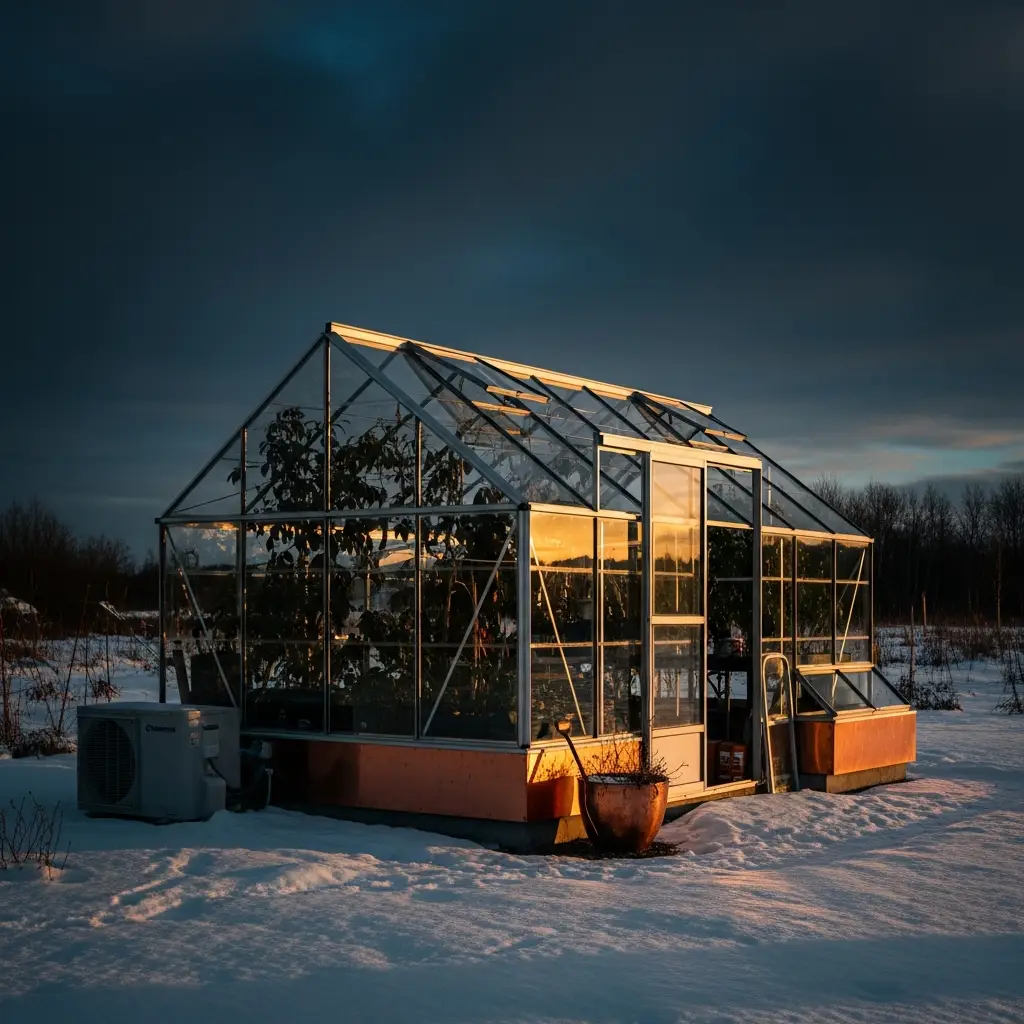

Geothermal Greenhouse Heating: Cost, ROI & System Design
Geothermal greenhouse heating uses a ground-source heat pump to extract stable underground heat and maintain 50–70°F air temperatures year-round at 30–50% of the cost of conventional propane or natural gas heating. A hobby greenhouse (200–500 sq ft) typically runs $12,000–$25,000 installed; a commercial house (1,500–5,000 sq ft) runs $40,000–$120,000. Against propane heating in cold-climate zones 4–7, payback lands between 5 and 10 years—and some growers hit it in as few as three.
Why Greenhouses Are Ideal Geothermal Candidates
Most geothermal heat pump applications struggle with one fundamental economics problem: the heating load is highest for a few weeks in winter but modest the rest of the year. Greenhouses solve that problem entirely.
A working greenhouse in climate zone 5 (think Minnesota, Wisconsin, upstate New York) runs its heating system eight to ten months out of twelve. The load profile is unusually stable—glazing panels lose heat continuously, not in spikes, so the heat pump never idles long. That steady, predictable demand is exactly what ground-source systems are built for. Unlike air-source heat pumps that lose efficiency as outdoor temperatures drop below freezing, a ground-source system draws from soil that stays 45–55°F year-round at depths of six to twelve feet. The colder the outdoor air, the bigger the advantage over propane.
Glass and polycarbonate glazing conduct heat roughly 10 times faster than insulated walls. Even a well-sealed greenhouse loses heat continuously—and that high, consistent demand turns into high, consistent geothermal utilization. High utilization is how you shorten payback periods.
There is a summer dimension too. Zone 4 and warmer greenhouses frequently overheat from June through August without active cooling. A ground-source heat pump runs in reverse during cooling mode, rejecting heat into the ground loop. A grower who installs geothermal for heat often eliminates their swamp coolers at the same time—and avoids the reliability risk of a propane furnace dying on a January night and wiping out an entire crop.
System Design Fundamentals
Getting the sizing right is the single most important decision in a greenhouse geothermal project. Undersizing by even 20% leaves growers running supplemental propane on cold nights, which destroys the financial case. The standard starting point is the surface-area heat-loss formula developed for greenhouse applications:
BTU/hour = glazing surface area (sq ft) × temperature differential (°F) × U-value of covering
For single-layer glass (U ≈ 1.0) or single-layer polyethylene (U ≈ 1.2), a 500-square-foot greenhouse trying to hold 60°F inside when it is 5°F outside (55°F differential) needs roughly 33,000 BTU/hour—about 2.75 tons of heat pump capacity. Double-wall polycarbonate (U ≈ 0.58) cuts that to around 16,000 BTU/hour. In practical cold-climate terms, plan on 1 ton (12,000 BTU/hour) of heat pump capacity for every 250–400 square feet of glazed area, with the lower end of that range applying to single-layer glazing and the higher end to insulated twin-wall panels.
For detailed sizing guidance including climate-specific calculations, see the geothermal heat pump sizing guide.
Ground Loop Options
Vertical closed-loop. Boreholes drilled 150–400 feet deep require minimal surface area—important when the greenhouse sits on a small lot or in a dense farm complex. This is typically the highest-cost loop option ($8–$15 per foot of borehole) but the most reliable thermal performance year-over-year. Ideal for hobby greenhouses in suburban settings and for commercial operations with limited land around the structure.
Horizontal closed-loop. Trenches 5–8 feet deep, running 400–600 feet of pipe per ton of capacity. Works well on rural farm properties with available open ground. Significantly less expensive than vertical drilling where soil conditions allow excavation. The tradeoff is land use: a 2-ton system needs roughly 1,500–2,000 square feet of trench field.
Pond or lake loop. When a water body sits within 200 feet of the greenhouse, submerged coils placed at 8 feet or deeper eliminate most of the drilling or excavation cost. This is the lowest-cost loop option when applicable. Many farm operations with irrigation ponds qualify. For installation details and what affects total project cost, see the geothermal installation process guide.
Heat Distribution Inside the Greenhouse
Hydronic radiant under bench-level slabs. The most common distribution method for ornamental and food-production greenhouses. PEX tubing is embedded in concrete slabs or run beneath growing benches at 6–12 inch spacing. Radiant heat warms the root zone directly, which promotes growth without drying foliage. Compatible with low-temperature geothermal delivery (95–110°F water).
In-floor radiant slab. For greenhouses with concrete floors throughout, a full in-floor system provides the most uniform heat distribution. Particularly effective in propagation and seedling houses where soil-temperature consistency is critical.
Forced-air hydronic units. Fan-coil air handlers draw geothermal-heated water and distribute warm air through overhead ductwork. Faster response time than radiant, which can be useful in large commercial houses. The significant downside for plant production: moving air dries out foliage and growing medium, increasing irrigation demand and—in some crops—disease pressure.
Cost Components
| Component | Hobby (200–500 sq ft) | Commercial (1,500–5,000 sq ft) |
|---|---|---|
| Heat pump unit | $4,000–$8,000 | $20,000–$50,000 |
| Ground loop (drilling/excavation + pipe) | $4,000–$10,000 | $15,000–$40,000 |
| Hydronic distribution system | $2,000–$4,000 | $5,000–$20,000 |
| Permits, commissioning, controls | $500–$1,500 | $2,000–$5,000 |
| Total typical installed | $12,000–$25,000 | $40,000–$120,000 |
Before any equipment is specified, invest in energy conservation measures: sealing glazing penetrations, adding thermal curtains for night insulation, and insulating the knee wall and foundation perimeter. These improvements typically pay back in 2–4 years and directly reduce the required heat pump size—shrinking the capital cost of the geothermal system itself.
For a complete breakdown of what drives geothermal installed costs across different property types, see the geothermal heat pump cost guide.
Operating Costs vs. Conventional Fuels
The financial case for geothermal greenhouse heating rests on the gap between what you pay to run the heat pump versus what you would have paid for propane or natural gas. That gap is substantial in cold climates.
Using a representative 1,000-square-foot commercial greenhouse in climate zone 5 as a benchmark—8–10 months of active heating, targeting 60°F night minimum, 70°F day:
| Heating fuel | Annual cost estimate | Assumptions |
|---|---|---|
| Propane | $6,000–$12,000 | 1,800–3,500 gal/yr @ $2.67–$3.60/gal (EIA, March 2026); lower end = Midwest pricing, upper end = Northeast |
| Natural gas (where available) | $2,500–$5,000 | ~300–600 MCF/yr; Northeast / urban fringe where service exists |
| Geothermal (electricity to run heat pump) | $1,200–$2,800 | COP 3.5–4.5; 8,000–14,000 kWh/yr @ $0.12–$0.20/kWh depending on state |
Propane is the primary comparison for greenhouse growers in rural cold-climate areas because natural gas service rarely extends to farms. The EIA's March 2026 weekly data puts the national average residential propane price at $2.674 per gallon, with the East Coast averaging $3.596 and Connecticut reaching $4.116—numbers that dramatically improve geothermal's payback math for New England growers.
The advantage compounds over time: electricity prices historically rise more slowly than propane, which tracks crude oil. Geothermal is a 20–25-year hedge against fuel price volatility. For a full lifetime cost breakdown, see the geothermal vs. propane comparison.
Climate Suitability and Payback by Region
Geothermal greenhouse heating is not equally compelling everywhere. The longer the heating season and the higher the local propane price, the faster the payback.
| Region | Heating season | Annual savings vs. propane | Typical payback |
|---|---|---|---|
| Northeast (NY, MA, ME, VT) | 8–10 months | $4,000–$8,000 | 5–8 years |
| Upper Midwest (MN, WI, IA) | 8–10 months | $4,000–$9,000 | 5–8 years |
| Mountain West (CO, MT, WY) | 7–9 months | $3,000–$6,000 | 7–10 years |
| Pacific Northwest (OR, WA) | 6–8 months | $2,000–$4,000 | 8–12 years |
| South (NC, GA, TN) | 4–6 months | Marginal | 12+ years |
The Northeast and Upper Midwest present the clearest financial case. Vermont, Maine, and Minnesota growers face both long heating seasons and some of the highest propane prices in the country, frequently exceeding $3.50–$4.00 per gallon through winter months. Find licensed installers serving agricultural operations in those areas through the Vermont installer directory and Oregon installer directory.
Pacific Northwest growers face milder winters and low hydropower electricity rates, so the math works mainly in propane-dependent rural areas of eastern Oregon and Washington. Southern growers with 4–5 month heating seasons should lean on cooling-mode economics to justify the install.
Federal and State Incentives for Agricultural Operations
The incentive landscape for commercial greenhouse geothermal is more varied—and potentially more generous—than for standard residential installations.
USDA Rural Energy for America Program (REAP)
REAP is the most significant federal funding mechanism for agricultural geothermal. Agricultural producers and rural small businesses can apply for grants covering up to 50% of eligible project costs (under Inflation Reduction Act funding) or up to 25% (under base Farm Bill funding). Grant amounts for renewable energy systems range from $2,500 to $1 million per project. Geothermal heat pump systems qualify as renewable energy projects under REAP.
For a 1,500-square-foot commercial greenhouse with a $65,000 geothermal installation, REAP could contribute $16,000–$32,000, cutting the effective project cost roughly in half before any other incentives. USDA was accepting applications for FY2025–2027 grants as of late 2024; check the USDA Rural Development portal for current application windows, as timing shifts year to year.
Section 48 Commercial Investment Tax Credit (ITC)
For income-producing greenhouses—market farms, commercial cut flower operations, commercial food producers—geothermal heat pump systems may qualify for the federal Section 48 commercial investment tax credit. The base credit is 6% of installed cost, with a potential boost to 30% if domestic content and prevailing wage requirements are met. This is distinct from the residential Section 25D credit, which does not apply to commercial operations.
Tax credit eligibility for agricultural applications is specific to the structure's income-producing use; a hobby greenhouse used solely for personal growing does not qualify. Consult a tax professional familiar with agricultural energy credits before designing the system around an ITC assumption.
State Agricultural Programs
Several states layer on additional grants or rebates for agricultural energy efficiency. Minnesota's Rural Finance Authority and Vermont's Clean Energy Development Fund have historically offered ag-specific financing that pairs well with REAP. California offers incentives through Self-Generation Incentive Program (SGIP) that can apply to qualifying greenhouse operations. Explore current state offerings via the geothermal rebates and incentives database.
Permitting for Commercial Greenhouse Installations
Permitting requirements for greenhouse geothermal installations vary significantly by state and by whether the operation qualifies as an agricultural enterprise.
Agricultural exemptions. Many states—including Iowa, Wisconsin, Minnesota, and Vermont—extend reduced permitting requirements to working farms. A commercial greenhouse that qualifies as an agricultural operation under state law may be exempt from standard commercial mechanical permits, subject instead to agricultural building codes that are less prescriptive. This can meaningfully reduce permitting cost and timeline.
Well permits for vertical loops. Vertical borehole systems require a drilling permit from the state water resources authority, separate from the building permit. In states with active ground loop standards (Wisconsin, Minnesota, Ohio), only licensed well drillers may supervise borehole work. Budget 4–8 weeks for approval.
Non-agricultural greenhouses. A hobby greenhouse on a residential lot or a retail nursery follows standard residential or light commercial mechanical permitting—the same process and timeline as any residential geothermal installation. The geothermal installation process guide covers each stage in detail.
What Can Go Wrong
Geothermal greenhouse projects that disappoint typically fail in one of three ways:
Undersized heat pump. A unit sized to 80% of peak load leaves the grower burning propane backup on the coldest 30 nights of the year—which in a zone 5 climate can represent 20–30% of total heating cost and erase most of the operating savings. Always size to calculated peak load, not rules of thumb. See the heat pump sizing guide for methodology.
Wrong distribution method for the crop. Constant airflow from fan-coil units dries growing medium, stresses foliage, and can promote fungal disease in traditional glazed greenhouses. Hydronic radiant—under-bench or in-slab—delivers heat without air movement and is the right choice for most greenhouse crops. Growers switching from propane unit heaters should not simply replicate the same forced-air architecture.
No summer cooling plan. A grower in zone 5 or warmer who installs geothermal for winter heating and assumes the greenhouse will be fine in summer is in for a surprise. Polycarbonate and glass greenhouses can reach 120°F+ on calm summer days. The ground loop has capacity to absorb heat in cooling mode, but the grower needs to design the controls, distribution, and ventilation to take advantage of it. If the heat pump is only wired for heating mode, summer cooling is unavailable regardless of what the equipment could theoretically do.
Frequently Asked Questions
Can geothermal heat a greenhouse?
Yes. A ground-source heat pump extracts heat from soil or water at 45–55°F year-round and delivers it to the greenhouse at temperatures suitable for radiant or forced-air distribution. Geothermal systems are well-suited to greenhouses because of their long, continuous heating seasons and stable heat-loss profiles. Both small hobby structures and large commercial operations have been heated successfully with geothermal systems across cold-climate zones 4–7.
How much does geothermal greenhouse heating cost?
Installed cost depends primarily on the size of the greenhouse and the ground loop type. A hobby greenhouse (200–500 sq ft) typically runs $12,000–$25,000 with a vertical or horizontal closed-loop system. A commercial operation (1,500–5,000 sq ft) generally falls between $40,000 and $120,000. USDA REAP grants and the federal Section 48 commercial tax credit can offset 25–50% of project cost for qualifying agricultural operations, bringing effective costs significantly lower.
Is geothermal worth it for a hobby greenhouse?
It depends on heating season length and current propane price. In the Northeast and Upper Midwest—where propane exceeds $3.00–$4.00/gallon and greenhouses heat 8–10 months per year—payback periods of 6–10 years are realistic. In milder climates or natural-gas-served areas, the math rarely closes for a small hobby structure. A hobby grower paying $3.50+/gallon for propane through a cold-climate winter should run the numbers seriously.
Can geothermal cool a greenhouse in summer?
Yes—and for zone 4–6 growers this is an underappreciated benefit. A ground-source heat pump operates in reverse during cooling mode, extracting heat from greenhouse air and rejecting it into the ground loop. Cooling mode is available on most standard water-to-air and water-to-water units at no additional equipment cost, though the distribution system must be designed to support it. The ground loop stays well below outdoor summer temperatures, giving geothermal a consistent efficiency edge over rooftop or window AC.
Sources
- USDA Rural Development — Rural Energy for America Program (REAP): Renewable Energy Systems Grants, rd.usda.gov
- U.S. Energy Information Administration — Weekly Heating Oil and Propane Prices, eia.gov/petroleum/heatingoilpropane/ (March 2026 data)
- ATTRA / National Center for Appropriate Technology — Geothermal Greenhouses: Exploring the Potential, attra.ncat.org
- Farm Energy Extension — Geothermal Heat for Greenhouses, farm-energy.extension.org
- U.S. DOE Energy Saver — Geothermal Heat Pumps, energysaver.gov
- ASHRAE Handbook — Fundamentals, Chapter on Heat Transfer and Thermal Properties (greenhouse glazing U-values)
- Federal Register Vol. 89, No. 200 — Notice of Funding Opportunity for REAP FY2025–2027 (Oct. 16, 2024)
Need a Geothermal Contractor?
Search the directory for licensed installers near you. Compare credentials, read reviews, and contact directly.
Find Installers Near YouOwn a Geothermal Business?
Claim your free listing to get more qualified leads, show up in local search, and answer customer questions where they’re already looking.
Claim Your Free Listing