
Geothermal Loop Leak: Signs, Repair Cost & Prevention
Geothermal loop leaks are rare — pipe makers warrant the PE100 HDPE material for 50 years, and most failures trace to joints and fittings, not the pipe. Repair costs run $2,500–$6,000, requiring excavation to reach the leak. Most "loop leak" diagnoses actually turn out to be condensate-drain clogs ($150–$300 fix) or refrigerant leaks ($400–$1,500). Verify with a pressure test before authorizing excavation.
- Loop leak frequency: rare — pipe makers warrant the material for 50 years, and most failures trace to joints, not pipe
- Typical repair cost: $2,500–$6,000 (excavation drives the bill)
- Most "loop leak" diagnoses: turn out to be condensate-drain clogs or refrigerant issues — not the loop at all
- Real loop leaks: usually fitting failures (fusion-weld defects), not pipe failure
Signs of a Possible Geothermal Loop Leak
Geothermal ground loops are closed systems — the same fluid circulates indefinitely with no scheduled refill. Any unexplained change in loop pressure or performance is worth investigating, but most of these symptoms have more common explanations than a loop leak.
System loses loop pressure. On a pressurized flow center, a properly charged loop holds roughly 30–50 psi at static (system off). Pressure that keeps falling over days or weeks — not a one-time drop after a service visit — is the clearest single indicator of a leak. Two caveats: loop pressure normally drifts with the seasons as the fluid and pipe expand and contract with temperature, so compare readings taken at the same time of year; and if your system has a non-pressurized flow center, it runs at atmospheric pressure with no gauge to read — there, a falling fluid level in the flow-center reservoir is the equivalent sign.
Frequent compressor cycling in heating mode. When loop fluid volume is low, heat exchange efficiency falls. The compressor short-cycles more than normal. This also signals a refrigerant-side issue or a dirty filter, so rule those out first.
Performance degradation without an obvious cause. Noticeably higher energy use with no filter, thermostat, or weather explanation could point to a low-fluid loop — but this symptom alone is not diagnostic.
Water seepage near the loop manifold. Rare — only visible if the leak is very close to the building entry point. Leaks in buried sections don't typically travel back to the structure.
Wet patches in the yard. A sustained shallow-loop leak can occasionally surface above the trench line. Rare, slow to develop, and easily confused with irrigation or drainage.
Glycol odor near the loop header. Propylene glycol has a faint, slightly sweet smell. Worth mentioning to a technician, though most homeowners don't notice it.
Common False Alarms
The majority of suspected loop leaks are not loop leaks. Condensate-drain clogs produce water pooling near the unit ($150–$300 to clear). Low refrigerant on the refrigerant circuit causes performance loss nearly identical to a loop-flow problem. Backup electric heat-strip activation spikes bills during cold snaps and gets blamed on the loop. Rule these out before authorizing any excavation.
Pressure-Test Verification Before Any Excavation
Pressure-testing the loop before anyone recommends excavation is best practice, not a standard requirement — the industry's CSA/ANSI/IGSHPA C448 SERIES:25 is a design-and-installation standard, and the pre-excavation test is simply the accepted way IGSHPA-trained contractors confirm a suspected leak. This single step can save you thousands of dollars — if the loop holds pressure, you know the problem is elsewhere.
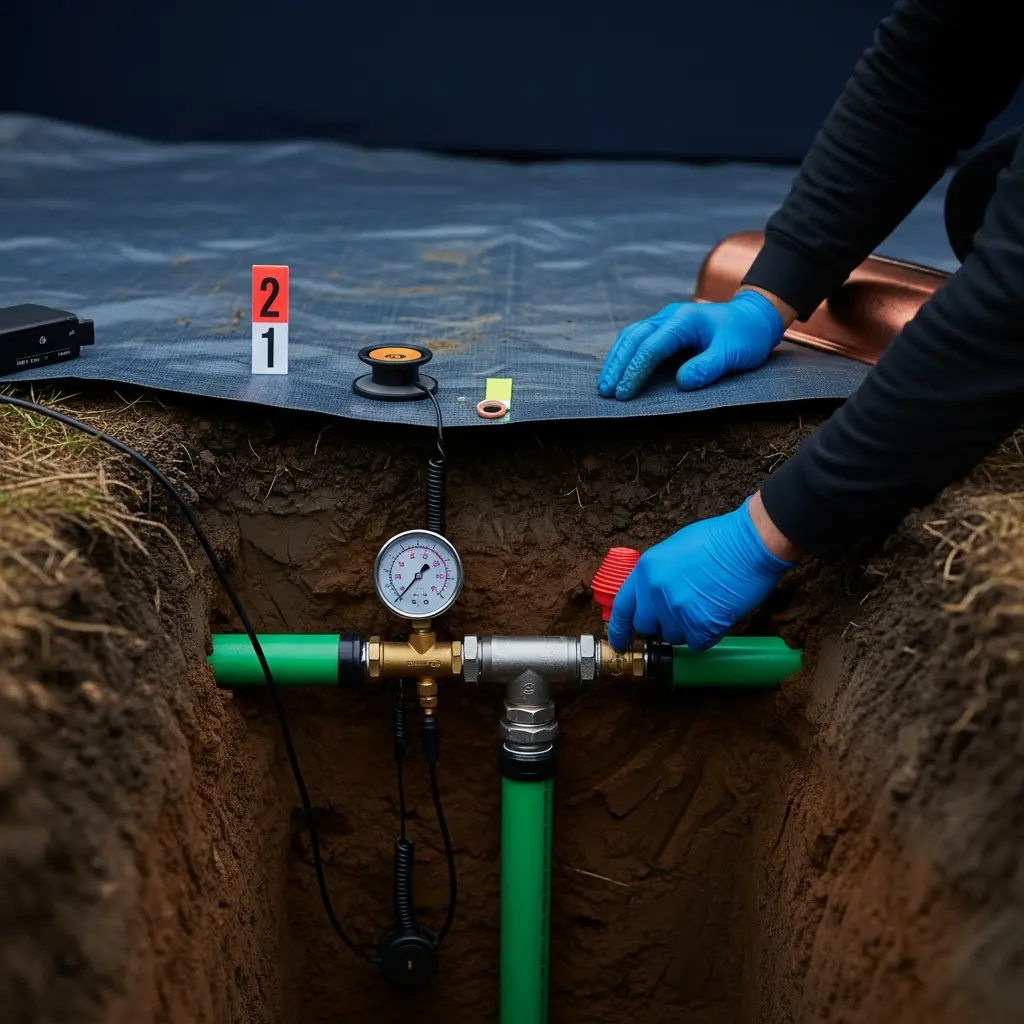
How the test works. The technician isolates the ground loop from the heat pump, pressurizes it hydrostatically — with water or the loop fluid itself, not compressed air or nitrogen — to roughly 100 psi, and monitors the gauge for hours rather than minutes. Polyethylene keeps stretching under pressure for hours, so the ASTM F2164 field procedure that IGSHPA's 2017 standard references holds the loop at test pressure for four hours, topping up as needed, before a final one-hour hold; the mechanical code's 100 psi, 15-minute test is a commissioning check for visible leaks on exposed pipe, not a diagnosis of a buried loop.
Interpreting results. Fused HDPE has no leakage allowance, so a sound loop simply holds its test pressure. Expect the gauge to fall at first as the polyethylene pipe stretches under pressure — ClimateMaster's loop-leak service bulletin (TB-C0001) puts the drop at about 10% on the first pressurization and about 5% on the second — and that stretch continues for hours, not minutes, so an early drop proves nothing either way. The technician keeps topping the loop back up to the test pressure and watches the pattern: a drop that shrinks with each top-up and then stops is expansion, and the loop is not your problem; a drop that continues at the same rate, or that persists once the pressure has been held for hours, is a leak. (Temperature swings during a long test also move the gauge, so the technician allows for them.)
Cost. A standalone pressure-test visit runs $300–$600, often included in a full diagnostic visit. If a contractor recommends excavation without one, ask for the test result before agreeing to anything. For a full picture of routine maintenance, see the Geothermal Maintenance and Service Manual.
What Actually Causes Geothermal Loop Leaks
When a loop does leak, the cause is usually one of the following.
Bad fusion weld — the most common cause. HDPE ground loops are joined with heat-fusion welding — pipe ends are melted and pressed together under controlled temperature and pressure. If the installer used incorrect heating temperature or inadequate hold time, the weld looks complete but is mechanically weak. These joints typically fail 1–5 years after installation, when seasonal ground movement stresses them. Because the defect is in the installer's workmanship rather than the pipe, it is a claim against the installer's labor warranty (commonly 1–5 years) — not the heat pump manufacturer's warranty, which covers the unit, or the pipe maker's 50-year material warranty, which excludes field-made joints. Confirm what your installer's written warranty covers before paying out of pocket. Hiring IGSHPA-certified contractors reduces this risk significantly, since fusion-weld certification is a core component of IGSHPA training.
Pipe damage during installation. Trench backfill can introduce sharp rocks, construction debris, or compaction pressure against the pipe. Damage is usually visible at or near the surface-area section and can be located using leak-detection dye injected into the loop combined with an acoustic listening device.
Frost damage. If the antifreeze concentration in the loop fluid drops below the spec for your climate — common when the fluid hasn't been checked in years — the fluid can freeze inside the heat pump's water-to-refrigerant heat exchanger during hard winter running, because it is the heat pump extracting heat that chills the loop, not the outdoor air. That usually damages the heat exchanger (an expensive in-unit repair) rather than the buried HDPE pipe, which tolerates freezing. This is entirely preventable. Have the antifreeze concentration verified as part of routine service — many contractors check it annually with a refractometer — and rechecked any time fluid has been added. For details on proper loop fluid management during installation and commissioning, see the Geothermal Installation Process Guide.
Pipe failure. Modern PE100-grade HDPE pipe is rated for 50+ years under normal residential conditions and essentially never fails before that in a correctly installed system. Pre-2008 installs used earlier-grade pipe that may show degradation at very long service life, but this is rare. If your system is 20+ years old, see How Long Does Geothermal Last? for what to expect from aging components.
Geothermal Loop Leak Repair Cost Breakdown
| Repair stage | Typical cost | Time |
|---|---|---|
| Pressure-test diagnostic | $300–$600 | 1–2 hours |
| Locate and mark the leak (dye + acoustic) | $400–$800 | 2–4 hours |
| Excavation (5–10 ft depth) | $1,500–$3,500 | 1–2 days |
| Pipe repair (cut + heat-fusion weld) | $400–$800 | 2–3 hours |
| Backfill and surface restoration | $500–$1,200 | 1 day |
| Total typical (horizontal loop) | $2,500–$6,000 | 3–5 days |
The excavation line item is what makes loop repair expensive. Published trenching rates run roughly $5–$12 per linear foot for straightforward digs and $13–$40 in rock, deep trenches or tight access — but a leak repair is priced as a small job: equipment mobilization, careful hand-digging around live pipe and spoil handling push the excavation line item well above the per-foot rate.
Vertical bore leaks cost significantly more. If the leak is in a vertical bore rather than a horizontal trench, repair options narrow considerably — re-drilling an adjacent bore costs $5,000–$15,000, and grouting techniques to seal a compromised bore are highly specialized. Horizontal loop leaks, which include most leaks in the manifold or trench zone near the home, stay in the lower part of the range.
For broader context on geothermal system costs, see the Geothermal Heat Pump Cost Guide. For repair calls that extend beyond the loop, see Geothermal Heat Pump Repair: Costs and What to Expect.
How to Prevent a Geothermal Loop Leak
Most loop leaks trace back to installation decisions made years before anything fails. These steps target that window.
Hire IGSHPA-certified installers. Fusion-weld certification is a core IGSHPA competency requirement, not a general "we do geo" credential. Find certified contractors through the GeothermalFinder contractor directory or browse installers in your state.
Get the commissioning pressure-test report. A properly commissioned loop holds 100 psi for 30 minutes at installation completion. Ask your installer for that written record — any certified installer will have it, and it's critical if a warranty claim arises.
Have the antifreeze concentration verified at routine service. Many contractors check it annually with a refractometer — it takes minutes — and it should be rechecked any time fluid has been added. Propylene glycol degrades slowly, and the correct ratio for your climate zone is the primary protection against frost damage.
Mark and protect the loop field. Some "installer-caused" damage actually happens during post-install landscaping or fence work. Get a layout diagram from your installer and keep it on file. Call 811 before any yard excavation — but note that private ground loops are not mapped in utility locate systems, so the diagram is your only reference.
Keep your installer's written workmanship warranty and monitor loop pressure annually. A fusion-weld defect that surfaces in year 3 is covered only if it falls inside that workmanship warranty — the heat pump manufacturer's warranty does not cover the ground loop, registered or not. Year-over-year stable pressure is the simplest indicator of a healthy loop.
What to Do If You Suspect a Geothermal Loop Leak
Work through these steps before authorizing any repair.
- Look at the flow center (the pump module next to the heat pump). On a pressurized system read the gauge; on a non-pressurized system check the fluid level in the reservoir. A reading that has drifted well below the commissioning baseline — beyond the normal seasonal swing — warrants a service call; a stable reading points elsewhere.
- Don't expect to see it on your water meter. A residential closed loop is normally isolated from household plumbing and topped up by hand, so a leak will not register there. The exception is a loop fitted with an automatic make-up water connection — the mechanical code permits one, provided the potable supply is protected by a backflow preventer — where a leak can show up as unexplained water use while the incoming water quietly dilutes the antifreeze; if you have one, ask your installer.
- Inspect the yard above the loop field for wet patches. Don't expect to find much — surface seepage from a buried loop is uncommon.
- Call your original installer first. They have the layout and commissioning record. A fusion-weld defect may fall under their workmanship warranty.
- If the original installer is unavailable, find an IGSHPA-certified tech through the GeothermalFinder contractor directory.
- Insist on a pressure test before any excavation. It is standard practice, and the only reliable way to confirm the loop is actually the problem. If a contractor skips it, find another contractor.
- Get two quotes if excavation is recommended. Scope and price vary considerably — a second opinion is standard practice at this cost level.
Frequently Asked Questions
How do I know if my geothermal loop is leaking?
The clearest indicator is sustained pressure loss — loop pressure that keeps falling over days or weeks, beyond the normal seasonal swing, rather than holding stable (on a non-pressurized flow center, a falling reservoir fluid level is the equivalent sign). Other signs include unexplained performance degradation, frequent compressor cycling, and in rare cases, wet patches above the trench line. Because all of these also match unrelated problems (condensate clogs, refrigerant loss, dirty filters), a confirmed leak requires a formal pressure test. Symptoms alone are not grounds for excavation.
What does a geothermal loop leak smell like?
Propylene glycol antifreeze has a faint, slightly sweet odor — less sharp than automotive ethylene glycol. If you detect it near the loop manifold cabinet, it may indicate glycol escaping at a fitting. The smell is subtle, not harmful at these concentrations, and many homeowners never notice it. If unsure, have a technician check the manifold connections.
Can a leaking geothermal loop contaminate groundwater?
Propylene glycol is on the FDA's "generally recognized as safe" (GRAS) list (21 CFR 184.1666) and biodegrades in soil and water within days to weeks. Concentrations from a residential loop failure are far below any regulatory threshold for groundwater concern — this is why propylene glycol is required over ethylene glycol (automotive antifreeze, which is toxic) in most jurisdictions. If you have a private well within 50 feet of the loop field, mention it to your technician, but a propylene glycol loop leak is not a practical groundwater risk.
How much does a geothermal loop repair cost?
Horizontal loop repairs typically run $2,500–$6,000 total, with excavation as the primary cost driver. The pressure-test diagnostic adds $300–$600, leak location $400–$800, and the pipe re-weld $400–$800. Vertical bore leaks are significantly more — $5,000–$15,000 — because repair options (re-drilling or bore grouting) are far more complex. Get at least two quotes before authorizing any excavation.
Sources
- CSA/ANSI/IGSHPA C448 SERIES:25 — bi-national design and installation standard for ground source heat pump systems, CSA Group and the International Ground Source Heat Pump Association (2025 edition; supersedes the 2017 IGSHPA standards)
- ClimateMaster — Technical Bulletin TB-C0001: Loop Leak Verification, Pressurized Flow Center Loop Installations (2001, rev. 2002): 100 psi test; about 10% pressure drop on the first pressurization and 5% on the second from polyethylene expansion; test duration at the servicing contractor's judgement; allow for temperature change
- ASTM F2164 — Standard Practice for Field Leak Testing of Polyethylene (PE) and Crosslinked Polyethylene (PEX) Pressure Piping Systems Using Hydrostatic Pressure (4-hour initial expansion phase with make-up water, then a 1-hour test phase held within 5%), referenced by the IGSHPA 2017 Design and Installation Standards; International Mechanical Code § 1210.10 (water at 100 psi for 15 minutes with no observed leaks, before backfill) and § 1210.8.1 (backflow protection where a ground loop connects to a potable water supply)
- PPI MS-7 — Model Specification for Thermoplastic Piping in Ground-Source Heat Pump Systems, Plastics Pipe Institute (PE100 pipe material and fusion-weld standards)
- U.S. FDA — 21 CFR 184.1666, Propylene glycol (Part 184, Direct Food Substances Affirmed as Generally Recognized as Safe); ATSDR — ToxFAQs for Propylene Glycol (breaks down within several days to a week in water and soil)
- IGSHPA — Accredited Installer Training Program: fusion-weld certification competencies
Need a Geothermal Contractor?
Search the directory for licensed installers near you. Compare credentials, read reviews, and contact directly.
Find Installers Near YouOwn a Geothermal Business?
Claim your free listing to get more qualified leads, show up in local search, and answer customer questions where they’re already looking.
Claim Your Free Listing