
How Cold Is It 6 Feet Underground? Soil Temperature & Geothermal Loops
How Cold Is It 6 Feet Underground?
At 6 feet (1.8 m) underground, soil temperature stays roughly within ±5°F (3°C) of your local average annual air temperature year-round. In the U.S., that's typically 50–60°F (10–16°C) — warmer than winter air and cooler than summer air, which is what makes geothermal heat pumps work.
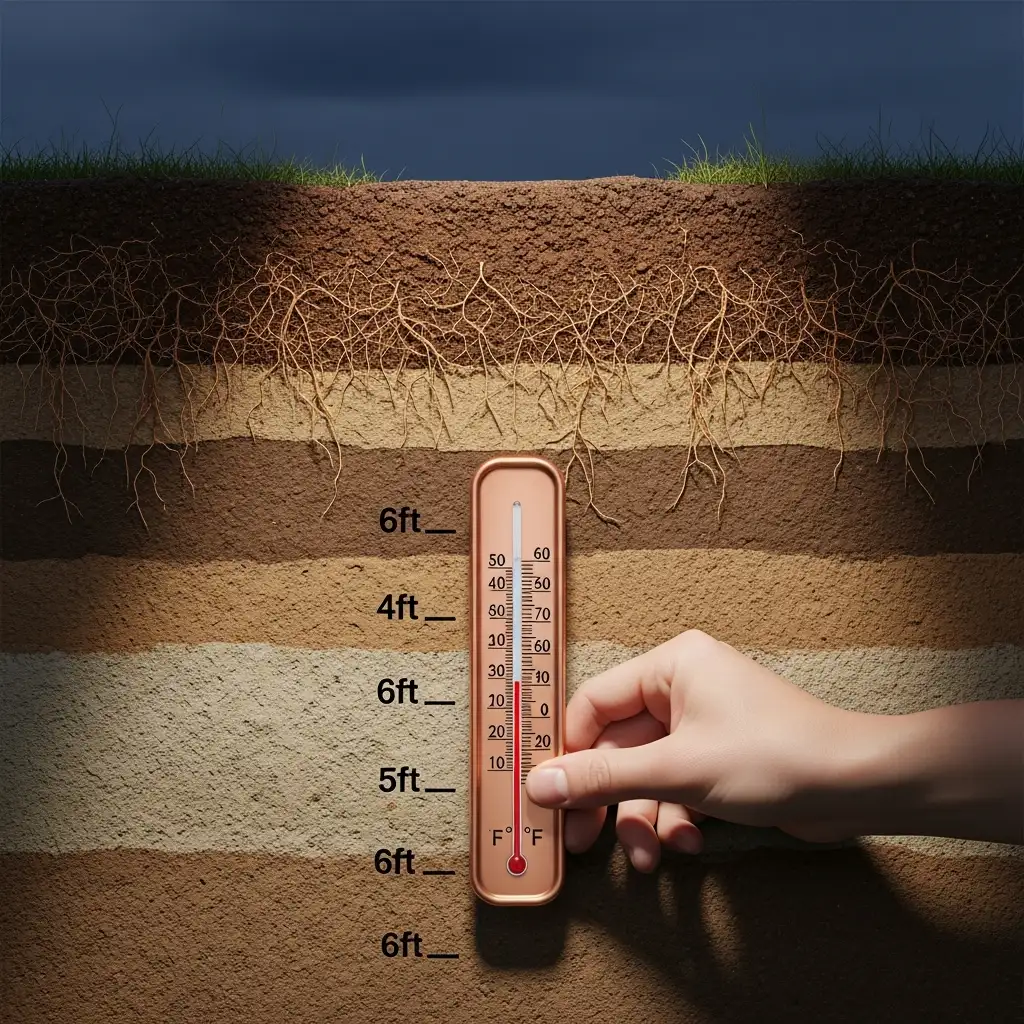
Ground-temperature cutaway
Why six feet changes the temperature
The deeper you go, the less outdoor seasons control the ground temperature.
Seasonal swing zone
Sun, wind, rain and winter cold create large temperature changes near the surface.
Horizontal loop depth
Soil temperature is roughly within ±5°F (3°C) of the local annual air-temperature average.
Vertical bore depth
Ground temperature is essentially constant year-round at typical vertical-loop depths.
Typical U.S. soil at 6 feet
50–60°F10–16°CWarmer than winter air.
Cooler than summer air.
Soil Temperature at 6 Feet by Region
The table below shows how ground temperature at 6 ft depth tracks mean annual air temperature across major U.S. and Canadian regions. Values are estimated from NRCS SCAN shallow-soil monitoring data (sensors at 2–40 inches depth), regional climate models, and Environment and Climate Change Canada records. Six-foot temperatures are modeled from shallower measurements and local annual mean air temperatures.
| Region | States / Province | Mean Annual Air Temp | Soil Temp at 6 ft (range) |
|---|---|---|---|
| Northeast | NY, PA | 48°F (9°C) | 47–53°F (8–12°C) |
| Upper Midwest | MN, WI | 42°F (6°C) | 41–46°F (5–8°C) |
| Lower Midwest | IL, IN, OH | 52°F (11°C) | 51–57°F (11–14°C) |
| Southeast | GA, FL | 65°F (18°C) | 63–70°F (17–21°C) |
| Southwest | TX, AZ | 65°F (18°C) | 65–72°F (18–22°C) |
| Pacific Northwest | WA, OR | 50°F (10°C) | 49–54°F (9–12°C) |
| California (Central Valley) | CA | 60°F (16°C) | 59–65°F (15–18°C) |
| Mountain West | CO, UT | 48°F (9°C) | 47–53°F (8–12°C) |
| Canada — Ontario | ON | 45°F (7°C) | 44–49°F (7–9°C) |
| Canada — Alberta | AB | 38°F (3°C) | 37–43°F (3–6°C) |
Sources: NRCS Soil Climate Analysis Network (SCAN); Environment and Climate Change Canada — Soil Climate dataset. Values vary ±3°F (2°C) locally based on shading, soil type, and moisture content.
Why Soil Temperature Stabilizes with Depth
At the surface, soil temperature swings dramatically with the seasons. In much of the northern United States, that swing spans 50°F (28°C) or more from January lows to August highs. The ground can freeze solid in winter and bake in summer. But that volatility fades quickly as you dig deeper.
The mechanism is thermal diffusion. Soil and rock conduct heat slowly — far more slowly than air — so the daily and seasonal temperature pulses at the surface take time to penetrate downward. At 6 feet (1.8 m), the seasonal swing narrows to roughly ±5–10°F (3–6°C) compared to the mean. There is also a temporal lag: the peak soil temperature at 6 ft depth arrives one to two months after the summer air-temperature peak, and the winter minimum arrives similarly late.
At around 30 feet (9 m), the seasonal swing effectively disappears. Below that depth, ground temperature is essentially equal to the mean annual surface temperature for that location, year-round. This is the principle behind deep geothermal bores: at 150–400 ft (46–122 m), you encounter a stable thermal reservoir that neither warms in summer nor chills in winter.
The U.S. Department of Energy's Guide to Geothermal Heat Pumps describes shallow ground as maintaining temperatures between 40–70°F (4.5–21°C) across the country — "warmer than the air above it during the winter and cooler than the air in the summer." That temperature differential is the engine geothermal heat pumps exploit. The shallower the loop, the more seasonal variation the system must handle; the deeper the bore, the more stable and consistent the heat source or heat sink.
Below roughly 1,000 feet (300 m), the geothermal gradient becomes the dominant influence on rock temperature. Driven by heat from Earth's interior, the gradient adds about 1°F per 70 ft (2.6°C per 100 m) of depth. For residential heat pump installations, this gradient is a minor factor — what matters for sizing is the near-surface thermal regime at 6–400 ft depth.
What 6 Feet Has to Do with Geothermal Heat Pumps
Six feet is not an arbitrary number. It sits at the intersection of two engineering realities: deep enough to be below the frost line in most of the continental U.S., and shallow enough to reach with a standard excavator or trenching machine in a single pass. That combination makes 4–6 ft the standard burial depth for horizontal ground loops.
Horizontal loops
Horizontal closed-loop systems run pipes through trenches dug 4–6 feet (1.2–1.8 m) deep across a property. The U.S. Department of Energy documents two common configurations: one pipe buried at 6 ft and a second at 4 ft in the same trench, or two pipes placed side by side at 5 ft in a two-foot-wide trench. The fluid circulating through those pipes exchanges heat with the soil at that depth — pulling warmth from the ground in winter and dumping heat into it in summer.
Because soil at 6 ft still carries some seasonal variation (see the table above), horizontal loop performance is slightly better in shoulder seasons and slightly lower at the extremes of winter and summer than a vertical system would deliver. For most heating climates, that variation is small enough that horizontal loops remain the most cost-effective option when a property has sufficient land.
Vertical loops
Where land area is limited, or where a larger, more stable heat source is needed, vertical bores are drilled 150–400 ft (46–122 m) deep. At those depths, ground temperature is essentially constant year-round, matching the local mean annual surface temperature with no seasonal swing. The DOE notes vertical bore spacing of roughly 20 ft apart to prevent thermal interference between bores over time.
Why this matters for efficiency
A geothermal heat pump's efficiency (measured as Coefficient of Performance, or COP) depends directly on the temperature difference between the ground loop and the refrigerant circuit. A stable 50–55°F (10–13°C) source temperature in winter — even from a horizontal loop — is far more favorable than outdoor air at 15°F (−9°C). Ground-source systems typically deliver a COP of 3.5–5.0, meaning 3.5 to 5 units of heat energy for every unit of electricity consumed. Conventional air-source heat pumps, by comparison, see their COP drop to 1.5–2.5 when outdoor air falls below 32°F (0°C), though modern cold-climate models maintain COP 1.5–2.0 at much lower temperatures. This is the temperature range where geothermal systems hold the clearest advantage.
For sizing information specific to your home's load and local soil conditions, see our geothermal loop calculator or browse loop type options explained.
Frost Line: A Related but Different Question
Frost line and 6-foot soil temperature are often confused, but they measure different things. The frost line (also called frost depth) is the maximum depth at which the water-bearing soil can freeze in winter. It is a structural and plumbing concern — building footings, water supply lines, and buried pipes all need to sit below the local frost line to avoid freeze damage.
Frost depth varies sharply by latitude and climate. In the far northern U.S., Minnesota's frost line ranges from a 42-inch code minimum in the south (Zone II) to 60 inches in the north (Zone I), with observed extremes near 80 inches; North Dakota's reaches up to 75 inches in its coldest regions. In the mid-Atlantic and lower Midwest, frost lines run 30–36 inches (2.5–3 ft). In the Deep South — Georgia, Florida, and southern Texas — frost depth is effectively zero to 12 inches.
For geothermal installers, frost line matters because horizontal loops must be buried below it to prevent the circulating fluid from encountering frozen soil. That is a primary reason the standard trench depth is 4–6 ft: it clears the frost line in most of the continental U.S. while staying within reach of standard trenching equipment. In extreme northern climates, installers may go slightly deeper — or switch to vertical bores — to clear an unusually deep frost line.
The frost line is a worst-case structural threshold. The 6-ft soil temperature discussed throughout this article is the year-round thermal condition of the ground at that depth — a different measurement entirely.
Common Questions
How cold is it 6 feet underground in winter?
In winter, soil at 6 ft depth in the northern U.S. typically sits in the 40–50°F (4–10°C) range — well above freezing. In the Upper Midwest (Minnesota, Wisconsin), expect 41–46°F (5–8°C) at the coldest point of the year. In the Northeast (New York, Pennsylvania), 47–50°F (8–10°C) is typical mid-winter. That is 30–50°F warmer than outdoor air on a cold January day.
What is the average ground temperature?
For most of the continental United States, the average ground temperature at 6 ft depth runs between 50–60°F (10–16°C). The specific number tracks closely with the mean annual air temperature for your location — see the regional table above for state-by-state estimates. Southern states push toward the 65–72°F (18–22°C) end; the Upper Midwest and Canadian provinces sit at 37–46°F (3–8°C).
Does underground temperature change in winter?
Yes, but modestly. At 6 ft, the soil temperature does drop from its summer peak to a winter low — typically a swing of 5–12°F (3–7°C) depending on region and soil type. The change arrives one to two months after the surface seasonal extreme because heat conducts through soil slowly. By roughly 30 ft (9 m), the seasonal variation becomes negligible. Vertical geothermal bores at 150–400 ft (46–122 m) encounter essentially zero seasonal change.
How deep do I need to dig for geothermal?
For horizontal loops, the industry standard is 4–6 ft (1.2–1.8 m) — deep enough to clear the frost line in most U.S. climates, reachable with standard trenching equipment. For vertical loops, bores run 150–400 ft (46–122 m) deep, delivering stable ground temperatures year-round regardless of climate. The right choice depends on your lot size, soil conditions, and heating load. Use our loop calculator to compare options for your address.
Bottom Line
Stable subsurface temperature is the physical foundation of geothermal heating and cooling. At 6 ft, the ground holds roughly 50–60°F (10–16°C) year-round in most of the U.S. — warmer than winter air, cooler than summer air, available for free in every state. That thermal stability enables geothermal heat pumps to achieve a coefficient of performance (COP) of 3 to 5, delivering 3 to 5 units of heating or cooling per unit of electricity consumed.
Understanding your local ground temperature is the first step toward sizing a system correctly. From there, the key variables are loop type, soil conductivity, and heating load. For a complete picture of what installation typically costs and what you can expect by state, start with our geothermal heat pump cost guide, run the numbers in our loop calculator, or see what a 2,000 sq ft home typically runs in our 2,000 sq ft cost breakdown. When you're ready to get quotes, find certified installers in your state to get real-world pricing for your soil conditions and climate.
Sources
- USDA Natural Resources Conservation Service — Soil Climate Analysis Network (SCAN): nationwide soil temperature and moisture monitoring at hundreds of stations; primary data source for U.S. shallow-soil temperature measurements. SCAN sensors are installed at standard depths of 2, 4, 8, 20, and 40 inches; six-foot values in this article are estimated from shallower measurements and regional climate data.
- U.S. Department of Energy — Geothermal Heat Pumps (EnergySaver): ground temperature range (40–70°F), horizontal loop burial depth specifications (4 ft / 5 ft / 6 ft configurations), vertical bore depth (100–400 ft).
- U.S. Department of Energy — Guide to Geothermal Heat Pumps (PDF): COP ranges, seasonal efficiency comparison between ground-source and air-source heat pumps.
- National Renewable Energy Laboratory — Geothermal Heat Pumps (NREL/TP-550-24782): thermal performance data and ground loop design principles.
- Environment and Climate Change Canada — Soil Climate Dataset (Open Government Portal): Canadian provincial soil temperature observations used for Ontario and Alberta rows.
- Build It Solar — Ground Temperatures as a Function of Location, Season, and Depth: analysis of ASHRAE and university data on seasonal temperature amplitude at depth; source for the 30 ft stability threshold and seasonal lag discussion.
- IGSHPA — Closed-Loop/Geothermal Heat Pump Systems Design and Installation Standards (2017): industry standards for loop burial depth and frost line clearance requirements.
- NOAA National Centers for Environmental Information — U.S. Climate Normals: 1991–2020 mean annual air temperature normals by state and station, used to anchor regional ground temperature estimates.
Need a Geothermal Contractor?
Search the directory for licensed installers near you. Compare credentials, read reviews, and contact directly.
Find Installers Near YouOwn a Geothermal Business?
Claim your free listing to get more qualified leads, show up in local search, and answer customer questions where they’re already looking.
Claim Your Free Listing