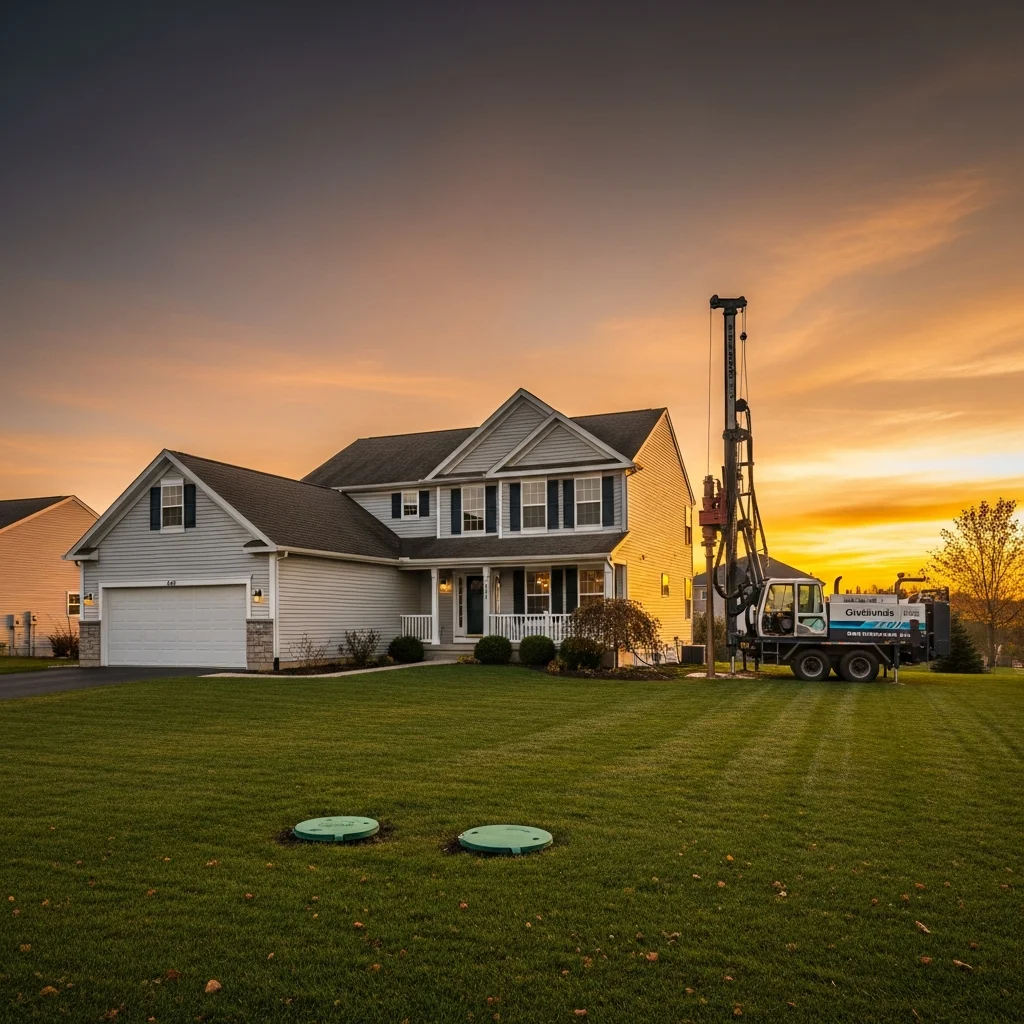

Geothermal Heat Pump for a 2,000 sq ft House: Real Costs & Sizing
A geothermal heat pump system for a 2,000 sq ft house typically costs $24,000–$36,000 installed, with a national average near $25,500 for a standard 3-ton system. That range assumes a new vertical closed-loop field (3 boreholes, ~500 ft each), an air-to-water or forced-air ground-source heat pump unit, and standard ductwork tie-in on a single-zone home. Horizontal loops or open-loop well systems usually land at the lower end of the range.
Why 2,000 Square Feet Is the Universal Example
When people search for geothermal heat pump costs, they almost always anchor on a specific house size. According to the U.S. Census Bureau American Community Survey, the median new single-family home in the United States is close to 2,200 sq ft, and the existing housing stock median sits right around 2,000 sq ft. That convergence makes 2,000 sq ft the de facto reference point—homeowners at that size can scale numbers up or down to their actual situation without much effort.
But square footage is only a rough starting point for sizing a geothermal system. Two 2,000 sq ft houses can have dramatically different heating and cooling loads depending on:
- Climate zone. A Minneapolis home may need twice the heating capacity of an equivalent home in Nashville.
- Envelope quality. A 2010-or-later build with code-compliant insulation and triple-pane windows can cut peak load by 30–40% compared to a 1975 ranch with minimal attic insulation.
- Ceiling height and layout. Open-plan great rooms, vaulted ceilings, and large glass areas all add load beyond what raw floor area suggests.
- Domestic hot water integration. Desuperheater systems that preheat water can shift the economics substantially.
The 2,000 sq ft figure is a useful conversation-starter, not a substitute for a proper Manual J load calculation. A contractor who quotes a system size from square footage alone—without reviewing your insulation levels, window area, and local design temperatures—is skipping a critical step. That said, for a typical post-2000 construction in IECC climate zones 4–6, a 3-ton unit is the most common result for this size home.
What You Will Actually Spend: A Component Breakdown
The $24,000–$36,000 total for a 3-ton vertical-loop system breaks down across five categories. Horizontal loops cost less to install but require more land; the table below shows both.
| Component | Vertical Loop Range | Horizontal Loop Range |
|---|---|---|
| Heat pump unit (3-ton, forced air or hydronic) | $4,000–$8,000 | $4,000–$8,000 |
| Loop field installation (drilling / trenching) | $10,000–$18,000 | $7,000–$12,000 |
| Interior connections and ductwork modifications | $2,000–$5,000 | $2,000–$5,000 |
| Permits and inspections | $300–$700 | $300–$700 |
| Electrical service upgrade (if needed) | $1,500–$3,500 | $1,500–$3,500 |
| Typical total | $24,000–$36,000 | $17,000–$28,000 |
A few notes on each line:
Heat pump unit. Ground-source heat pump units are priced by capacity and efficiency tier. A 3-ton unit from a mainstream manufacturer (Carrier, Bosch, WaterFurnace, ClimateMaster) runs $4,000–$6,000 at the mid-tier efficiency level (around 18–22 EER). Premium variable-capacity units with higher efficiency ratings push toward $7,000–$8,000. The unit itself is usually 20–30% of total project cost; the loop field dominates.
Loop field installation. Vertical drilling is priced per foot of borehole depth, typically $15–$30 per foot depending on your region and local geology. Hard rock formations (granite, basalt) cost more to drill than soft sedimentary layers. A 3-ton vertical system needs roughly 500 ft of borehole—either one 500 ft borehole, two at 250 ft each, or three at approximately 165 ft each. Horizontal trenched loops avoid drilling entirely but need roughly 1,500 ft of pipe and about a half-acre of open ground. Pond or lake loops, where site conditions allow, can cut loop costs significantly.
Interior connections and ductwork. If your home already has forced-air ductwork in reasonable condition, the geothermal air handler ties in relatively simply. Homes converting from radiant heat, boilers, or mini-splits may need more extensive interior work. Adding a desuperheater for domestic hot water preheating typically adds $500–$1,000 to interior costs but can offset electric water heating costs substantially.
Permits and inspections. Most jurisdictions require a mechanical permit and a separate well or borehole permit for the loop field. Budget $300–$700 total; a few states with aggressive renewable-energy permitting streamline this process.
Electrical service upgrade. A 3-ton heat pump draws around 25–30 amps at 240V. If your main panel is already at or near capacity—common in homes built before 1990—you may need a panel upgrade or dedicated circuit. This is not always required; get your contractor to assess the panel early in the quote process.
For geographic comparison and state-level cost data, see our Pillar cost guide with state-by-state breakdowns.
Sizing the System: What 3 Tons Actually Means
Geothermal systems are sized in tons of heating and cooling capacity, where one ton equals 12,000 BTU per hour. The question is how many BTUs your specific 2,000 sq ft house actually needs on the coldest and hottest days of the year.
A common rule of thumb is 28 BTU per square foot for moderate climates. Applied mechanically: 2,000 sq ft × 28 BTU/sqft = 56,000 BTU = 4.67 tons. That number is almost always an overestimate for post-2000 construction. Homes built after 2000 typically have R-38 or better attic insulation, energy-code windows, and tighter construction than homes from earlier decades. A proper Manual J load calculation on a tight 2,000 sq ft home routinely returns 30,000–40,000 BTU (2.5–3.3 tons).
Manual J is the standard ACCA procedure for residential load calculations. It accounts for:
- Local outdoor design temperatures (99% heating and 1% cooling design conditions)
- Insulation R-values for walls, ceiling, floors, and basement
- Window U-factor and solar heat gain coefficient
- Infiltration rate (blower door results if available, or an estimated value)
- Internal heat gains from occupants and appliances
- Duct losses if the air handler and ducts are outside conditioned space
For a 2,000 sq ft home, the Manual J result is the number your contractor should use to select equipment—not square footage alone, not the size of your old system. Oversized units short-cycle (start and stop rapidly), reducing efficiency and comfort. Undersized units run constantly on peak days. Geothermal contractors who do this work well will show you the Manual J printout before proposing equipment.
Loop length per ton. The standard rules of thumb from IGSHPA are roughly 165 ft of vertical borehole per ton and 250 ft of horizontal loop per ton in temperate soil conditions. For a 3-ton system: approximately 500 ft of vertical borehole (three 165 ft holes, or two 250 ft holes) or about 750 ft of horizontal loop pipe in a straight trench. Actual values vary with soil thermal conductivity—wetter soils transfer heat better and need less loop length.
Want to run the numbers for your specific situation? Our geothermal loop calculator computes loop length from your location, soil type, and system size.
Climate Zone Impact on a 2,000 sq ft Installation
Where you live affects both system size and loop field cost, sometimes substantially. The following comparison illustrates how a similar house performs across climate zones:
| Climate Profile | Typical System Size | Estimated Installed Cost | Primary Driver |
|---|---|---|---|
| Cold (Minnesota, Maine, Wisconsin) — Zone 6–7 | 3.5–4 tons | $28,000–$42,000 | Larger loop field + slightly larger unit; longer heating season |
| Mixed-humid (Ohio, Virginia, Missouri) — Zone 4–5 | 3 tons | $24,000–$36,000 | Balanced heating/cooling load; median national cost |
| Hot-humid (Georgia, Texas Gulf Coast) — Zone 2–3 | 3–3.5 tons | $22,000–$32,000 | Cooling dominant; heat pump sized for cooling, loop often shorter |
| Dry/High Desert (Nevada, Arizona interior) — Zone 3B | 2.5–3.5 tons | $20,000–$34,000 | High cooling load; ground temps favorable; water access may constrain loop type |
For state-specific cost data, installation incentive availability, and contractor density by region, see our full cost guide. State utility rebate programs and some state income tax credits remain active even after the federal §25D residential credit ended—those numbers shift frequently, so the guide is updated periodically.
Operating Costs Month to Month
Geothermal heat pumps do not burn fuel. Their only operating cost is electricity to run the compressor, pumps, and air handler. The tradeoff: you eliminate a gas, propane, or oil bill and replace it with a higher electric bill—but the electric increase is smaller than the fuel cost it replaces, because geothermal moves 3–5 units of heat energy for every unit of electrical energy consumed (expressed as a COP of 3.0–5.0).
For a 3-ton geothermal system serving a 2,000 sq ft home in a climate zone 4–5 location, rough operating cost expectations:
- Peak winter months: Added electricity of roughly $80–$140 per month above baseline household consumption (at a $0.12–$0.15/kWh average rate).
- Peak summer months: Cooling-mode electricity cost is typically 30–40% lower than a comparably sized central air conditioner because of the higher EER.
- Shoulder months: The system runs in low-stage or briefly, so energy cost is minimal.
- Annual total HVAC electricity: Typically $900–$1,800 for a 2,000 sq ft home in zone 4–5, depending on rates and usage habits.
Homes converting from oil or propane heating often see the largest savings—those fuels can run $2,000–$4,000 per heating season for a 2,000 sq ft home in the Northeast, compared to $500–$900 in geothermal electric for the same thermal output.
For a state-aware comparison of geothermal operating costs versus gas and electric alternatives, use our geothermal cost estimator.
Federal Tax Credit Reality After OBBBA
The federal residential clean energy credit for geothermal heat pumps (IRC §25D) terminated on December 31, 2025. The termination was enacted as part of P.L. 119-21, the One Big Beautiful Bill Act (OBBBA), signed into law in 2025. Homeowners who installed a qualifying geothermal system before that date could claim the 30% credit on their 2025 tax return. Systems installed in 2026 and after do not qualify for §25D.
Two limited exceptions remain relevant:
- Commercial and income-producing properties. The §48 commercial investment tax credit was not terminated by OBBBA and continues to apply for geothermal systems installed on commercial buildings, rental properties, or under third-party ownership (TPO) lease or power-purchase structures.
- State-level incentives. A number of state utility rebate programs, property tax exemptions, and state income tax credits remain in place. These vary significantly by state and utility territory and are updated frequently.
For a full breakdown of what changed, which states still have active rebate programs, and how to structure a TPO arrangement for the §48 credit, see our dedicated guide: Geothermal tax credit 2026: what changed after OBBBA. State rebate details are in our geothermal rebates by state directory. In eligible states, homeowners may also receive renewable energy credit income — ongoing proceeds from the clean energy a geothermal system produces.
Frequently Asked Questions
How much does it cost to put geothermal in a 2,000 sq ft house?
For a 3-ton vertical closed-loop system, the typical installed cost is $24,000–$36,000, with the national average sitting near $25,500. Horizontal loop systems cost less to drill—typically $17,000–$28,000 installed—but require significantly more land. These figures reflect 2025–2026 contractor pricing and do not include any state incentives, which can reduce out-of-pocket cost by $1,000–$5,000 in some states. The federal §25D residential tax credit terminated December 31, 2025 under OBBBA and is no longer available for new installs.
What size geothermal heat pump do I need for 2,000 sq ft?
Most contractors recommend a 3-ton unit for a well-insulated 2,000 sq ft home, but the correct answer comes from a Manual J load calculation rather than square footage alone. A leaky older home may need 4 tons; a very tight, high-efficiency new build may be comfortable at 2.5 tons. Climate zone matters significantly—Minnesota homes need more heating capacity than Georgia homes of the same size. Always ask your contractor to show you the Manual J output before agreeing on equipment size.
How many tons of geothermal for 2,000 sq ft?
Three tons is the most common result for a 2,000 sq ft home built after 2000 in a temperate U.S. climate zone (IECC zones 4–6). The 28 BTU/sqft rule of thumb implies 4.67 tons for this size, but that estimate dates from older construction standards and consistently oversizes modern homes. Post-2010 construction with R-38 attic insulation and energy-code windows typically lands at 28,000–36,000 BTU total load, which is 2.3–3.0 tons. In cold climate zones 6–7, a 3.5-ton unit is more common.
How long is the geothermal loop for 2,000 sq ft?
For a 3-ton system, plan on approximately 500 ft of vertical borehole (often three boreholes at 165 ft each, or two at 250 ft each) or roughly 1,500 ft of horizontal loop pipe in a trenched field. These figures assume average soil thermal conductivity. Wet, clay-heavy soils transfer heat more efficiently and may need less loop length; dry sandy or rocky soils need more. Our geothermal loop calculator can estimate loop requirements based on your location and soil type.
Is geothermal worth it for a 2,000 sq ft home?
For most homeowners who plan to stay in their home for 10+ years, geothermal tends to compare favorably to propane, oil, or high-electric-rate gas alternatives—particularly in cold climates. The math is tougher in regions with very low natural gas rates or where the upfront cost cannot be offset by remaining state incentives. Without the §25D federal credit (which ended December 31, 2025 under OBBBA), payback periods are longer than they were in 2024. The system itself lasts 25+ years for the heat pump unit and 50+ years for the loop field, so long-horizon cost comparisons tend to favor geothermal over conventional systems.
What is the payback period for geothermal at this size?
Payback period depends on what you are replacing and your local energy rates. For a 2,000 sq ft home in the Northeast replacing oil heat, annual savings of $1,500–$2,500 are realistic, implying a payback of 10–16 years at current oil prices without incentives. Replacing natural gas at $0.80–$1.00/therm typically yields savings of $600–$1,200 per year, stretching payback to 20–30 years in some cases. State rebates and any remaining utility incentives can tighten that considerably. For homes where geothermal also eliminates central air conditioning (replacing a separate system), the combined savings shorten payback by 2–5 years. Our cost estimator can run these numbers with your local utility rates.
Sources
- U.S. Department of Energy — Geothermal Heat Pumps — DOE consumer overview of how ground-source heat pumps work, efficiency ratings, and installation considerations.
- ENERGY STAR — Certified Geothermal Heat Pumps — Product certification database and efficiency specifications for qualifying ground-source heat pump systems.
- National Renewable Energy Laboratory — Ground-Source Heat Pump System Analysis (NREL/TP-5500-51946) — NREL technical report on geothermal system performance, sizing methodology, and cost structures.
- International Ground Source Heat Pump Association (IGSHPA) — Resources — Industry standards body for ground-source heat pump installation, including loop design guidelines and installer certification.
- U.S. Census Bureau — American Community Survey (ACS) — Source for U.S. single-family home size data, including median floor area statistics cited in this article.
Need a Geothermal Contractor?
Search the directory for licensed installers near you. Compare credentials, read reviews, and contact directly.
Find Installers Near YouOwn a Geothermal Business?
Claim your free listing to get more qualified leads, show up in local search, and answer customer questions where they’re already looking.
Claim Your Free Listing