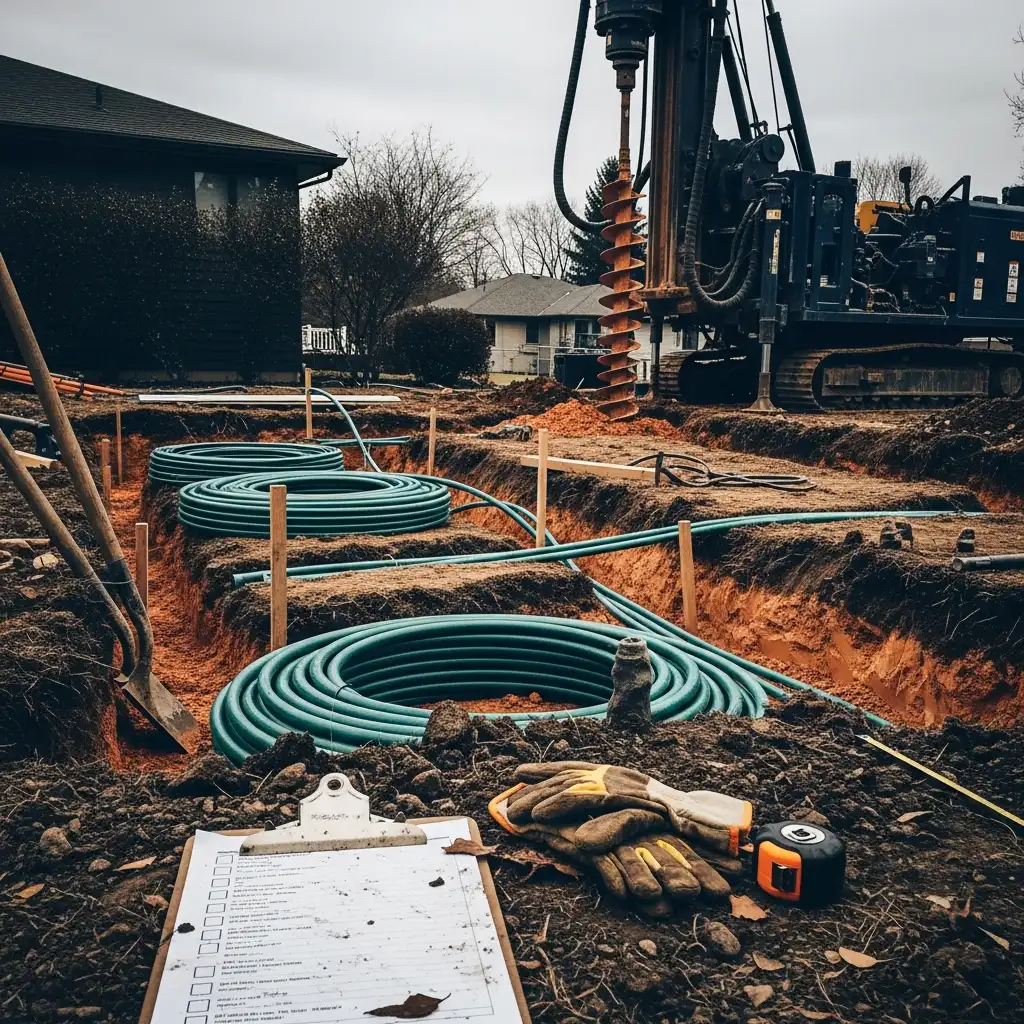

What Are 5 Disadvantages of Geothermal? A 2026 Reality Check
The 5 Main Disadvantages of Geothermal Heating
- High upfront cost. A typical 3-ton residential installation runs $24,000–$36,000 — two to four times more than a gas furnace and central AC combined.
- Site dependence. Vertical loops need a drilling rig on your property; horizontal loops need 400–800 square feet of open yard per ton. Some lots simply can't fit either.
- No federal tax credit in 2026. The §25D residential credit — worth up to 30% of total cost — terminated December 31, 2025 under the One Big Beautiful Bill Act (P.L. 119-21).
- Long payback period. Without the federal credit, most homeowners replacing natural gas are looking at 15–25+ years to break even, though cold-climate oil and propane replacements can still hit 8–12 years.
- Installer scarcity in many regions. Geothermal installation requires driller licensing and specialty certification. Coverage is uneven — some states have fewer than 10 active qualified installers.
Why This List Looks Different in 2026
The five-disadvantages framework has been standard for years — cost, site constraints, long payback, thin installer base. The core issues are structural, not new. Two items shifted materially in 2025–2026, though.
First, the §25D federal residential tax credit — 30% of total installed cost, no dollar cap — was terminated under the One Big Beautiful Bill Act (P.L. 119-21) signed July 2025. That eliminated a $7,200–$10,800 offset on a typical $24,000–$36,000 install and changed the payback math significantly.
Second, air-source heat pumps (ASHPs) are now widely available and installed by mainstream HVAC contractors in every state at $9,400–$16,750. The cost gap between geothermal and the next-best alternative is more exposed than it was before the federal credit disappeared.
Disadvantage #1 — High Upfront Cost
A fully installed 3-ton ground-source heat pump for a 2,000-square-foot house typically runs $24,000–$36,000 in 2026, per contractor data from Angi and EnergySage. Complex installs — difficult soil, longer loop fields — push past $40,000. Equipment alone (the heat pump cabinet) accounts for $7,500–$14,000; drilling or excavation for the ground loop adds $8,000–$18,000.
Compare to alternatives:
- Gas furnace + central AC: $8,000–$14,000 installed
- Air-source heat pump: $9,400–$16,750 installed
Geothermal costs 2–4× more upfront. The §25D federal credit had offset $7,200–$10,800 of that — it expired December 31, 2025 and is not available for 2026 installs. Some utilities offer on-bill financing; Massachusetts, New York, and Vermont run low-interest state loan programs at 0–3% APR. See our state-by-state cost guide for current financing options.
Disadvantage #2 — Site Dependence
Geothermal requires burying a heat exchanger in your property — and that physical constraint eliminates more homes than the industry typically advertises.
Vertical closed loops (most common in suburban and rural installs) need a drilling rig: roughly 12 ft wide × 30 ft long of clear, firm ground access. The rig bores 3–5 boreholes to 150–300 feet per ton. Tight lots, mature trees, steep grades, or subsurface utilities can make this impossible or cost-prohibitive.
Horizontal closed loops skip the drilling rig but require 400–800 square feet of open yard per ton — 1,200–2,400 sq ft for a 3-ton system — trenched to 4–6 feet deep. That yard can't have trees, structures, or hardscape over it. Most compact suburban lots can't spare it.
Pond/lake loops are the cheapest option when available, but the water body needs 8+ feet of depth and year-round flow. Most homeowners don't have one. A qualified local installer can assess your lot before you spend anything on design or quotes.
Disadvantage #3 — The Federal Tax Credit Is Gone
The One Big Beautiful Bill Act (P.L. 119-21), signed July 4, 2025, terminated the §25D residential clean energy credit for systems placed in service after December 31, 2025. The 30% credit — worth $9,000 on a $30,000 install — did not phase down gradually as originally scheduled through 2034. It dropped directly from 30% to 0% on January 1, 2026.
What still exists:
- State and utility rebates: The DSIRE database lists roughly 80 active geothermal-eligible programs in 2026. New York's Clean Heat program, Massachusetts heat pump incentives, Vermont's Efficiency Vermont, and Illinois programs can reach $5,000–$8,500 for qualifying installs. Most states offer $1,500–$3,000 or nothing.
- IRA home efficiency rebates (HEEHRA): Geothermal qualifies in states that have activated their programs. Coverage is uneven — check your state's status.
- §48 commercial ITC: Income-producing properties (rentals, commercial) can still claim a 6–30% investment tax credit through 2034. Third-party ownership (TPO) structures are possible. See our full 2026 incentive breakdown for details.
Disadvantage #4 — Long Payback Period
Payback period depends almost entirely on what you're replacing and where you live. Industry promises of "8–10 year payback" are often based on pre-OBBBA economics with the federal credit included. In 2026:
- Replacing oil or propane in cold-climate Northeast: Best case. A 2,000 sq ft home burning 800–1,200 gallons of heating oil per year at $3.50–$4.50/gallon can save $1,500–$3,000 annually by switching. Post-OBBBA payback: 8–14 years.
- Replacing electric resistance heat: Strong case. Geothermal is 3–4× more efficient than resistance heating, generating $1,000–$2,000 in typical annual savings. Payback: 10–15 years.
- Replacing cheap natural gas in a mild climate (Texas, Georgia): Weak case. Low gas prices ($1.00–$1.50/therm) and mild winters push payback to 18–25+ years — beyond most equipment lifespans.
The underground loop lasts 50+ years; the indoor unit runs 20–25 years, longer than any gas furnace. Long-term operating cost predictability matters, but the upfront check is real. Use our cost estimator to model your specific fuel type, climate, and available rebates.
Disadvantage #5 — Installer Scarcity in Many Regions
Geothermal installation requires two skill sets that don't always come together: a licensed driller for the loop field and an HVAC technician trained on ground-source systems. IGSHPA accreditation is the industry benchmark, but it isn't universally required and not every state licenses geothermal drillers separately from water well contractors.
The contractor base is thin and unevenly distributed. IGSHPA has trained over 7,000 individuals historically, but active practicing installers are a fraction of that. Geographic clustering is pronounced — Midwest and mid-Atlantic states where geothermal has deep roots have strong coverage; coastal and Sun Belt markets often don't:
- Pennsylvania: 100+ active installers
- New York, Ohio, Indiana, Illinois: strong coverage
- Texas: ~50 or fewer statewide
- Hawaii, Alaska, Rhode Island, North Dakota: typically fewer than 10
Thin installer markets mean two things: less pricing competition (one or two contractors in your radius gives you little leverage) and higher quality risk. An undersized loop field or a skipped soil conductivity test produces a system that runs backup heat strips constantly, negating efficiency gains. When searching our installer finder, prioritize contractors with current IGSHPA accreditation and who perform Manual J load calculations.
Are These 5 Dealbreakers? The Verdict
Honest answer: for some homeowners, yes. For others, no.
The case where geothermal still makes sense in 2026: You're in a cold climate (Zone 5 or higher), currently heating with oil or propane, have enough yard or lot access for a loop field, and your state has a meaningful rebate program (New York, Massachusetts, Vermont, Illinois are the standouts). In that scenario, the 8–14 year payback remains achievable, and you're trading decades of volatile fossil-fuel pricing for predictable electricity costs with a system that outlasts any gas furnace by 15–20 years.
The case where it's a hard sell post-OBBBA: Mild-climate homeowners on cheap natural gas, urban lots without drilling access, or homeowners in thin-installer markets where quality and pricing are uncertain. For those situations, an air-source heat pump is often the more practical path, and a qualified contractor can give you a realistic alternative quote for comparison.
The five disadvantages are real. None of them are reasons to dismiss geothermal outright — but none of them should be glossed over either. Do the fuel-type math for your home, check your state's current rebate landscape, and have your lot assessed before committing. Use our cost estimator and state-by-state cost guide as starting points.
Common Questions About Geothermal Disadvantages
What is the biggest problem when using geothermal energy?
For residential homeowners in 2026, it's the upfront cost compounded by the loss of the federal credit. A 3-ton install runs $24,000–$36,000, and the §25D credit that previously returned $7,200–$10,800 of that expired December 31, 2025. Whether geothermal still pencils out depends almost entirely on which fuel you're replacing and what state rebates remain available in your area.
Why is my electric bill so high with geothermal?
Almost always: backup electric resistance heat strips running more than they should. Geothermal compressors use 3–5 kW; auxiliary heat strips use 10–15 kW. They activate during extreme cold or when you raise the thermostat more than 5°F at once. An undersized system or a poorly designed loop field will trigger strips constantly, erasing efficiency gains. A properly sized, correctly installed system should run strips rarely. If yours runs them often, have the system inspected.
What is the downside of geothermal home heating?
The downsides are front-loaded: high install cost, site constraints that disqualify some lots, and a thin installer base in many regions. Once running, the system is reliable — no outdoor components exposed to weather, 50-year loop life, 20–25-year indoor unit. The ongoing exposure is electricity-price risk: if local rates rise sharply, operating economics worsen. Pairing geothermal with rooftop solar partially hedges that.
Are geothermal heat pumps worth it despite the disadvantages?
For cold-climate homeowners replacing oil or propane in states with meaningful rebates (New York, Massachusetts, Vermont, Illinois), yes — $1,500–$3,000 in annual savings against a rebate-reduced net cost can still produce a 10–14 year payback on equipment that runs 20–25 years. For mild-climate natural-gas users in states with no rebates and thin installer coverage, the math rarely works post-OBBBA. Use our cost estimator to run your specific numbers before deciding.
Sources
- EnergySage — Ground Source Heat Pump Cost and Benefits — installation cost ranges, DOE payback estimates, comparison to air-source heat pumps
- Dandelion Energy — Geothermal Ground Loop FAQs — horizontal loop footage requirements, borehole spacing
- Instead Financial — §25D Termination Under OBBBA — credit termination effective date and mechanics
- Smith + Howard — OBBBA Energy Credit Breakdown — §48 commercial ITC status, credit rates, geothermal exceptions
- DSIRE — Database of State Incentives for Renewables & Efficiency — state and utility rebate programs by state
- IGSHPA — Training & Certification — accredited installer program and professional directory
- Geothermal Exchange Organization — Find a Pro Directory — installer distribution data
- Dandelion Energy — Geothermal Heat Pump Electricity Usage — auxiliary heat strip consumption and electric bill causes
- U.S. Department of Energy — Tax Credits & Incentives for Geothermal Heat Pumps — overview of federal and state programs
Need a Geothermal Contractor?
Search the directory for licensed installers near you. Compare credentials, read reviews, and contact directly.
Find Installers Near YouOwn a Geothermal Business?
Claim your free listing to get more qualified leads, show up in local search, and answer customer questions where they’re already looking.
Claim Your Free Listing