
Geothermal vs Heat Pump: When Each Wins (2026 Update)
Quick answer: When "heat pump" means air-source, geothermal beats it on long-term efficiency in cold climates but loses on upfront cost by $16,000–$21,000. When the question is geothermal vs. air-source vs. mini-split, the right choice depends on your climate zone, lot size, what fuel you're replacing, and how long you plan to stay in the house. The sections below give you a structured way to decide.
First: "Heat Pump" Means Three Different Things
Most of the confusion in this comparison starts with the word "heat pump" itself. It covers three distinct technologies with very different price tags and use cases:
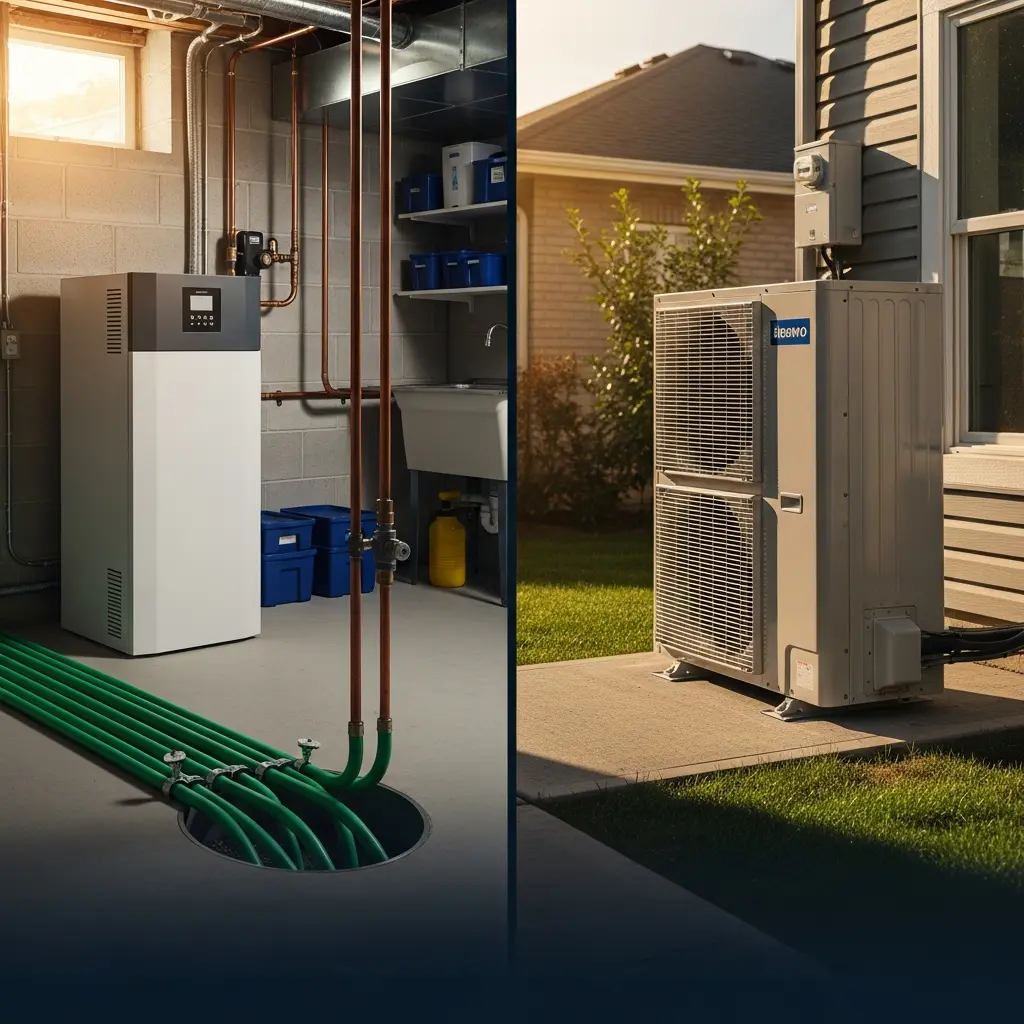
- Air-source heat pump (ASHP): An outdoor unit moves heat between outdoor air and your duct system. Installed cost typically runs $8,000–$15,000 for a 3-ton ducted system. Coefficient of performance (COP) ranges from 1.5–3.5 depending on outdoor temperature.
- Ground-source heat pump (geothermal): A loop field buried in the ground or sunk into a well exchanges heat with soil or groundwater, which stays near 50–60°F year-round. Installed cost is $24,000–$36,000 for a 3-ton system. COP ranges from 3.5–5.0 regardless of outdoor air temperature.
- Mini-split heat pump: A ductless air-source variant with one outdoor unit connected to wall-mounted indoor air handlers. Good for zone-by-zone control. Installed cost: $4,000–$10,000 per zone. COP mirrors standard ASHP performance.
This page compares geothermal (ground-source) against air-source heat pumps — the most common interpretation of "geothermal vs. heat pump." For a deeper technical look at how the two systems work, see our geothermal vs. air-source explainer.
Side-by-Side: Geothermal vs. Air-Source vs. Mini-Split
| Category | Geothermal | Air-Source HP | Mini-Split |
|---|---|---|---|
| Upfront cost (3-ton installed) | $24,000–$36,000 | $8,000–$15,000 | $4,000–$10,000 per zone |
| 25-year operating cost (NE, replacing oil/propane) | $18,000–$24,000 | $26,000–$36,000 | $24,000–$32,000 |
| COP at 0°F outdoor temp | 3.5–4.5 | 1.5–2.5 | 1.5–2.0 |
| Equipment lifespan | 20–25 yrs (loop: 50+ yrs) | 15–20 yrs | 12–18 yrs |
| Install complexity | High (drilling + loop field) | Medium (outdoor unit pad) | Low (wall-mount + lineset) |
Sources: Angi, HomeGuide, EnergySage, DOE Energy Saver — 2025–2026 installed cost data. Operating cost estimates assume EIA AEO 2026 fuel-price trajectory with 2% annual energy inflation.
When Geothermal Wins
Geothermal has a clear advantage in specific situations. The math shifts decisively in its favor when several of these factors line up at once.
Cold climates (zones 5–8)
Below 30°F, air-source heat pumps lose efficiency sharply because there's less heat in the outdoor air to extract. A standard ASHP at 0°F might deliver a COP of 1.8–2.2. A geothermal system at the same outdoor temperature is still pulling heat from 50°F ground — its COP stays at 3.5–4.5. That gap compounds over a Northern heating season. If you're in Massachusetts, Minnesota, Wisconsin, Michigan, or upstate New York, geothermal's stable COP is not a marginal benefit — it's the core of the economic case.
Modern cold-climate air-source units from Mitsubishi, Daikin, and Bosch do operate to −13°F or below. But they do so at sharply reduced capacity and efficiency, often requiring a backup heat strip that erodes the savings.
Heating-dominant load (>60% heating)
If your annual energy bill is dominated by heating rather than cooling, geothermal's high heating COP delivers the biggest operating savings. A home spending $3,500/year on propane heat might drop to $900–$1,200/year in electricity costs running geothermal — a savings rate that produces payback in 10–14 years even without any federal tax credit.
Long ownership horizon (15+ years)
Geothermal's higher upfront cost is a fixed investment. The operating savings accrue every year you own the home. A 25-year net present value analysis consistently favors geothermal in cold and mixed climates once you stay past the 12–15 year mark. The ground loop itself lasts 50+ years, so a second compressor unit (typically $5,000–$10,000) gives you another full system lifespan without redrilling. For full state-by-state cost numbers, see our geothermal cost guide.
Lot accommodates a loop field
Horizontal loop systems need roughly 1,500–2,000 sq ft of yard per ton of capacity. A 3-ton system needs about 4,500–6,000 sq ft of open land. Vertical systems (drilled wells) need far less surface area — a 10 ft × 10 ft pad — but drilling costs more. If your lot can fit the loops or a driller can access it, installation is feasible. Use our geothermal cost estimator to model your specific lot situation.
Replacing oil, propane, or electric resistance
This is the single strongest economic trigger for geothermal. Oil and propane are volatile, expensive, and inefficient to burn. Replacing a $4,000–$6,000/year oil or propane bill with $1,000–$1,500/year in electricity to run a geothermal system produces payback periods of 8–14 years — without any federal subsidy. Electric resistance baseboard heat is similarly favorable: geothermal uses 65–70% less electricity to deliver the same heat output. For a fuller look at the pros and cons, see geothermal heat pump pros and cons.
When Air-Source Heat Pump Wins
Air-source heat pumps are not a consolation prize. In the right conditions, they are the smarter financial choice.
Mild climates (zones 1–4)
In Georgia, Florida, Texas, the Carolinas, and the Pacific Coast, winter temperatures rarely force an air-source heat pump into its low-efficiency range. A cold-climate ASHP in Atlanta might achieve a seasonal COP of 3.0–3.6 — within 15–25% of what geothermal would deliver. That gap doesn't justify paying an extra $15,000–$20,000 upfront. Air-source wins the ROI math in mild climates.
Cooling-dominant load (>60% cooling)
Both systems handle cooling well — geothermal is actually more efficient at cooling too, but the margin narrows compared to heating. In Florida or Texas, where you run AC eight months a year and heat for two months, the geothermal efficiency premium on the heating side contributes less to total annual savings. Air-source or mini-split ROI is higher in these cases once the upfront cost gap is factored in.
Tight lot or no driller access
If you own a row house, a condo with a small yard, an urban property, or a lot with bedrock or regulatory restrictions on drilling, geothermal may simply not be physically possible. Air-source heat pumps need only an exterior pad and a refrigerant lineset. No yard access required.
Short ownership horizon (<10 years)
Geothermal's payback period runs 10–15 years in most scenarios. If you plan to sell in under a decade, you'll likely exit before breaking even on the premium. Air-source heat pumps are cheaper, and their lower upfront cost means faster amortization in the years you're actually there. The home's appraised value may or may not recover geothermal's premium at sale — this varies by market.
Natural gas is your alternative
The economics of geothermal look least compelling when the alternative is cheap, stable natural gas. At $1.00–$1.30/therm, gas is hard to beat on operating cost alone. Geothermal can still win on a 25-year NPV basis in cold climates, but the margin shrinks, and payback periods stretch to 14–20 years in gas-served Midwest homes. This doesn't make geothermal wrong — it just means the pencil needs to be sharper.
The 25-Year NPV by Region
The table below uses EIA AEO 2026 fuel-price projections with a 2% annual energy inflation assumption, a 3-ton system in a 2,200 sq ft home, and a 4% discount rate. "NPV savings" is the net present value of energy cost savings over 25 years, minus the installed cost premium over a baseline gas furnace/AC or existing system. It is not a guarantee — your utility rates, ground temperature, and contractor costs will vary.
| Region | Replacing | Geothermal NPV (25 yr) | Air-Source NPV (25 yr) | Winner |
|---|---|---|---|---|
| Northeast (NY, PA, MA) | Oil / propane | $18,000–$28,000 savings | $10,000–$16,000 savings | Geothermal (clear) |
| Midwest (OH, MI, IN) | Natural gas | $4,000–$10,000 savings | $2,000–$8,000 savings | Geothermal (marginal) |
| Southeast (GA, FL, NC) | AC + electric heat | $6,000–$12,000 savings | $8,000–$14,000 savings | Air-source (lower upfront) |
These estimates assume no federal tax credit (§25D expired December 31, 2025 under P.L. 119-21). State rebates, where available, would improve both columns — but geothermal programs in NY, MA, and VT tend to offer larger per-ton incentives, widening the Northeast gap further.
The Midwest row deserves a close read. Geothermal edges out air-source in Ohio and Michigan, but the margin is narrow enough that gas price volatility, a short ownership period, or a difficult drilling site could flip the result. Run your numbers before committing.
A Note on Cooling-Dominant Homes
For homes in Florida, South Texas, or coastal Georgia where air conditioning accounts for 70% or more of annual HVAC energy use, the efficiency advantage of geothermal on the heating side barely moves the needle. Yes, geothermal is also more efficient at cooling — ground temperatures in summer are cooler than outdoor air, which improves condenser efficiency. But a well-sized air-source heat pump or mini-split in a mild-winter climate can achieve a seasonal cooling COP competitive enough that the $15,000–$20,000 upfront premium for geothermal simply does not pay back within a reasonable ownership horizon.
In pure cooling-dominant scenarios, air-source heat pumps combined with an electric heat strip for the short heating season often produce the best total-cost outcome. This is a situation where the honest answer is that geothermal is not the right tool — even though it's technically more efficient.
Post-OBBBA Tax Credit Reality (2026)
Both geothermal and air-source heat pumps lost their 30% federal residential clean energy credit at the end of 2025. Under P.L. 119-21 (the One Big Beautiful Bill Act, enacted July 4, 2025), Section 25D expenditures placed in service after December 31, 2025 are ineligible for the credit. There is no phase-down — the credit dropped from 30% to 0% on January 1, 2026, with no grace period for projects in progress.
What remains for 2026 installations:
- New York (NYS Clean Heat Program): Utility-administered rebates for ground-source heat pumps, reauthorized through 2030 with $5.36 billion in program funding. Per-ton rebates vary by utility and income tier.
- Massachusetts (Mass Save): Ground-source heat pump rebates remain available through the utility-funded Mass Save program. Specific per-ton rates are set annually — check masssave.com for current figures.
- Vermont (Efficiency Vermont): Ducted heat pump rebates up to $2,200; Burlington Electric offers up to $7,950. HEAR federal program funds are frozen as of early 2026 — do not plan on them for current projects.
- Illinois and others: State-level programs vary. The Section 48 commercial investment tax credit remains available for qualifying commercial installations.
Air-source heat pumps often have better utility rebate parity in mild-climate states where geothermal programs are thinner. For a full post-OBBBA breakdown by state, see our 2026 geothermal tax credit guide.
Decision Framework: Which System Fits Your Home?
Work through these questions in order. Each one narrows the field.
1. Do you have a driller who can access your lot, or 1,500+ sq ft of open yard?
If no to both: air-source heat pump is likely your only practical option. Geothermal requires either horizontal trenching or vertical drilling — neither works on a paved urban lot or a dense row-house block. If yes: continue to the next question.
2. Are you in climate zone 5 or colder?
Zone 5 covers Ohio, Pennsylvania, New York, New England, and most of the Midwest north of St. Louis. If yes: lean toward geothermal — the efficiency premium at low outdoor temperatures is real and compounds over a heating season. If no (zones 1–4): either system can work financially; the next two questions tip the balance.
3. Are you replacing oil, propane, or electric resistance heat?
If yes: geothermal's economic case is strongest here. Annual savings of $1,500–$3,000 versus oil or propane can produce payback in 10–14 years even without any federal credit. If you're replacing natural gas: geothermal still wins on a 25-year NPV in cold climates, but the margin is narrower. Run the numbers with our cost estimator before deciding.
4. Will you be in this home 15 or more years?
If yes: geothermal's NPV advantage is substantial over the full 25-year system life, especially in the Northeast and Midwest. If no: air-source amortizes faster. A $10,000–$12,000 air-source system that saves you $600/year in operating costs pays back in under a decade and doesn't leave you selling a house mid-payback on a $30,000 investment.
If you answered yes to at least three of the four questions above, geothermal is almost certainly the better long-term investment for your home. Find certified installers in your state on our installer directory.
Frequently Asked Questions
Which is better, a heat pump or a geothermal heat pump?
A geothermal heat pump is a type of heat pump — the question is really geothermal (ground-source) versus air-source. Geothermal wins on efficiency and long-term operating cost, particularly in cold climates. Air-source wins on upfront cost, installation simplicity, and ROI in mild-climate or short-ownership situations. Neither is categorically "better." The right answer depends on your climate zone, lot, existing fuel type, and how long you'll own the home.
Are geothermal heat pumps worth it in 2026?
Yes — in the right conditions. With the federal §25D credit gone after December 31, 2025, the economics are less forgiving than they were in 2023–2025. But in cold climates replacing oil or propane, the operating savings alone can produce payback in 10–14 years without any federal incentive. State programs in NY, MA, and VT provide meaningful rebates. For homeowners in zones 5+ with adequate lot access and a 15+ year ownership horizon, geothermal remains a strong investment in 2026.
What are two disadvantages of geothermal vs. air-source?
First, upfront cost. A geothermal system costs $24,000–$36,000 installed versus $8,000–$15,000 for a comparable air-source unit — a gap of $16,000–$21,000 that must be recovered through operating savings, typically over 10–15 years. Second, installation constraints. Geothermal requires either substantial yard space for horizontal loops or driller access for vertical wells. Homes on small urban lots, bedrock-heavy sites, or properties with regulatory restrictions may not be geothermal candidates at all, regardless of how strong the economics look on paper.
How much does geothermal cost vs. a heat pump?
A 3-ton geothermal system runs $24,000–$36,000 fully installed in most U.S. markets, with costs varying significantly based on drilling difficulty, loop configuration, and ductwork condition. A comparable 3-ton air-source heat pump runs $8,000–$15,000 installed. Mini-split systems start around $4,000–$10,000 per zone but costs grow quickly with multiple zones. The geothermal premium is typically $16,000–$21,000 upfront for a 3-ton whole-home system. Operating cost savings in cold climates can recover that premium in 10–14 years.
Can I have both geothermal and an air-source heat pump?
Yes, though it's rare and almost always unnecessary. Some commercial properties use a hybrid setup — a geothermal system handles baseline heating load, and an air-source unit handles peak loads or cooling. For residential homes, a properly sized geothermal system handles both heating and cooling without any assist. A more common hybrid: pairing geothermal with a dedicated outdoor reset or desuperheater for domestic hot water, which recovers waste heat from the refrigerant cycle and reduces water heating costs by 30–50%.
Sources
- U.S. Department of Energy — Geothermal Heat Pumps
- U.S. Energy Information Administration — Annual Energy Outlook 2026
- EnergySage — Ground Source Heat Pump Costs and Benefits
- IRS — FAQs: §25D Modifications Under P.L. 119-21 (OBBBA)
- IGSHPA — International Ground Source Heat Pump Association
- WBDG / NREL — Geothermal Heat Pumps (Whole Building Design Guide)
- Mass Save — Ground Source Heat Pump Rebates
- EnergySage — Air Source Heat Pump Costs
Need a Geothermal Contractor?
Search the directory for licensed installers near you. Compare credentials, read reviews, and contact directly.
Find Installers Near YouOwn a Geothermal Business?
Claim your free listing to get more qualified leads, show up in local search, and answer customer questions where they’re already looking.
Claim Your Free Listing