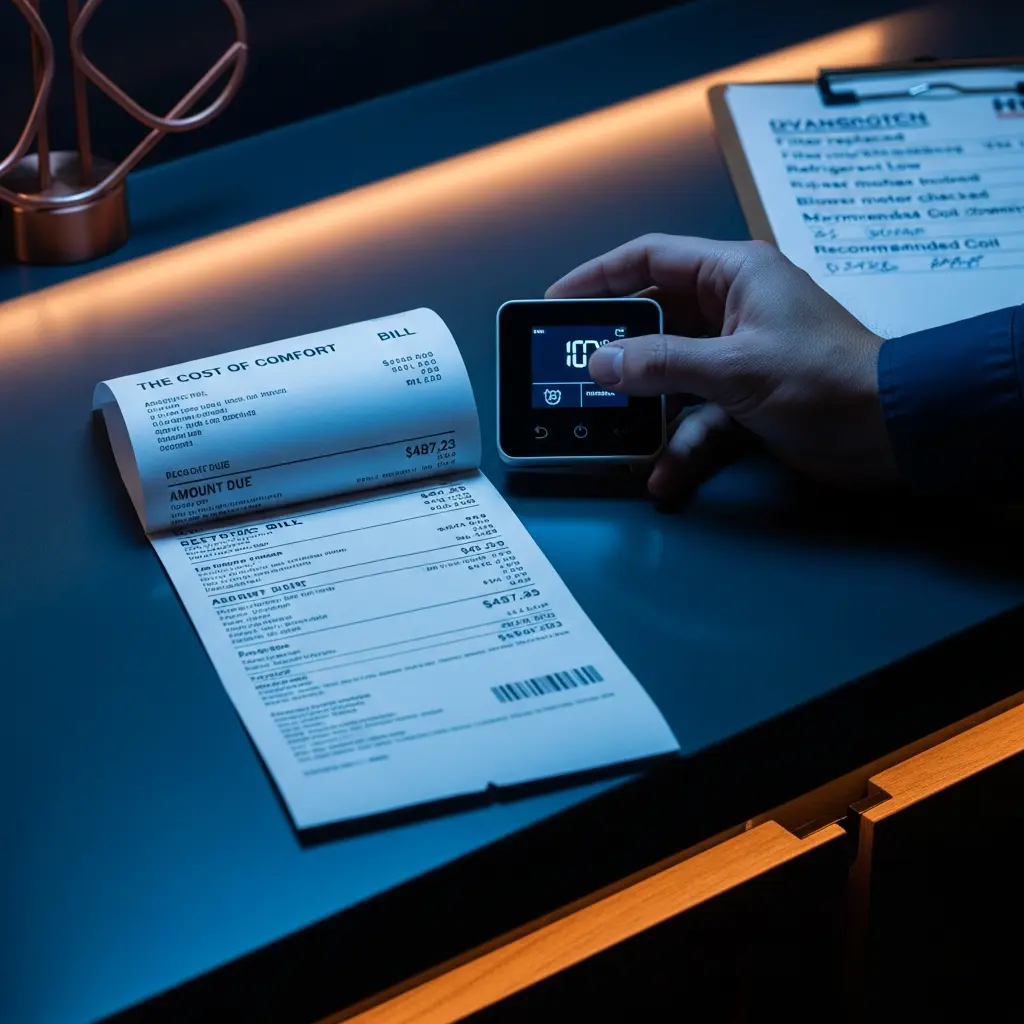

Why Is My Electric Bill So High With Geothermal? 7 Causes & Fixes
Geothermal heating should cut total heating and cooling costs by 40–70% compared to gas, oil, or electric resistance systems. So when the electric bill climbs instead of falls, something is wrong. The cause almost always traces to one of seven issues: backup heat strips running constantly, an undersized ground loop, a dirty filter, a refrigerant leak, the wrong antifreeze ratio, a worn blower or pump motor, or an unrelated new load like an EV charger. Most are diagnosable in a single service call.
Cause #1: Backup Heat Strips Running Constantly
Every ground-source heat pump includes an auxiliary electric resistance heat strip, typically rated at 5, 7.5, 10, or 15 kilowatts. These strips exist as a safety net — they work, but they are expensive to run.
The comparison is stark. The geothermal compressor pulls roughly 2–5 kW while delivering three to five times that in heat energy (a COP of 3–5). The backup strip draws 5–15 kW as pure resistive heat — one watt in, one watt of heat out, no multiplication. An hour of strip heat can cost as much as five hours of compressor-only operation.
In a correctly sized system, auxiliary strips should run roughly 50–150 hours per year at most. When they run continuously for days or weeks, the bill reflects it — and it signals an underlying problem, not normal operation.
Common triggers: raising the thermostat setpoint more than 4–5°F at once; thermostat accidentally set to "Emergency Heat" mode; undersized loop (Cause #2); or refrigerant issue (Cause #4).
Fix: Check your thermostat for an "AUX" or "EM" indicator light. If it is on continuously during normal cold weather, call an IGSHPA-certified technician to measure loop entering and leaving water temperatures and confirm compressor performance. Raise setpoints gradually — no more than 2°F at a time — to reduce strip activation while the root cause is investigated. See our geothermal maintenance guide for seasonal thermostat best practices.
Cause #2: Undersized Ground Loop
The ground loop is the buried piping network that exchanges heat with the earth. If it was sized incorrectly at installation — or if your home's heating load grew (addition, insulation removal, layout changes) — the loop cannot extract enough heat during cold winters.
Loop designers target a minimum entering water temperature of about 30°F under peak conditions. When an undersized loop breaches that threshold, the heat pump's efficiency drops sharply, the compressor runs longer, and backup strips compensate. An undersized loop is widely cited as the most common installation defect in residential geothermal. Homeowners often notice the problem only in their second or third winter, as surrounding soil slowly loses its thermal reserve.
Symptoms: bill spikes only in the coldest two months; loop entering water temperature below 30°F; system performed better its first winter; original installer used rules-of-thumb instead of a full Manual J load calculation.
Fix: A certified contractor can extend the loop field by adding boreholes or horizontal trenching. Costs typically run $3,000–$8,000 depending on soil and loop type. See the installation process guide for what a proper loop design requires.
Cause #3: Dirty Filter or Blocked Airflow
Airflow restriction is a genuine efficiency killer, and the fix takes two minutes. When the air filter is clogged, the blower works against higher static pressure. Modern geothermal units use electronically commutated (ECM) motors that automatically increase speed to compensate — but that compensation draws more watts. A severely restricted filter can increase blower electricity consumption by 20–30% while simultaneously reducing heat delivery because airflow across the heat exchanger drops.
Restricted airflow also forces the refrigerant circuit outside its design range. If return airflow falls far enough, the heat exchanger ices over, triggering defrost cycles and further cutting efficiency. Chronic restriction also accelerates motor wear (Cause #6).
ENERGY STAR recommends checking your filter monthly and replacing it at least every three months, or more often with pets or high dust levels.
Fix: Pull the filter and hold it to light. If it is visibly gray or blocks light, replace it now. Match the MERV rating to your system's specification — most residential geothermal units call for MERV 8–11. Higher ratings can restrict airflow in systems not designed for them. Full maintenance schedule at our geothermal maintenance service guide.
Cause #4: Refrigerant Leak
Geothermal heat pumps use a refrigerant circuit to transfer heat between the ground loop and your home's air. A slow leak degrades this process quietly over months: when refrigerant charge is low, the compressor runs longer for the same output. A 15% refrigerant deficit can drop a system's COP from 4.0 to 2.5 — translating directly to a 37% increase in electricity per unit of heat delivered. The compressor also runs hotter, accelerating wear and risking early failure.
Geothermal refrigerant leaks are less common than in air-source systems because the circuit is enclosed inside the cabinet rather than exposed to weather. But brazed joints, coil seams, and valve fittings can develop leaks over years of use.
Signs: reduced heating or cooling output; ice on the indoor coil; compressor running almost continuously but not meeting setpoint; hissing or bubbling sounds near the unit.
Fix: Only an EPA Section 608-certified technician may legally handle refrigerant. The technician locates and repairs the leak, then recharges to manufacturer specification. Expect $400–$1,500 depending on leak location, refrigerant type, and local labor rates. Details on service call costs in our geothermal heat pump repair guide.
Cause #5: Wrong Antifreeze Ratio in the Ground Loop
Closed ground loops almost always contain antifreeze — typically propylene glycol — to prevent freezing during winter operation. The ratio matters, and both extremes hurt efficiency.
Too little: A 20% propylene glycol solution protects only to about 19°F. In a cold climate with a marginal loop, that threshold can be breached. Partial freezing reduces flow, cuts heat extraction, and can damage the circulator pump.
Too much: Glycol is more viscous than water. A high-concentration mix is dramatically harder to pump, the circulator draws more watts, and heat transfer efficiency drops because glycol transfers heat less effectively than water. Some contractors who "play it safe" with excess glycol inadvertently create a lasting efficiency penalty.
Ratio also drifts over time when the system is partially drained and refilled without testing, or when water is added to compensate for a minor leak without re-mixing to spec.
Fix: A technician tests loop fluid with a refractometer or hydrometer, confirms the freeze point fits your climate's design requirement, and re-mixes to specification. Service typically costs $300–$600 including fluid, and is a standard item on an IGSHPA annual maintenance checklist.
Cause #6: Worn Blower or Circulator Pump Motor
Motors degrade over years of use. As bearings wear and capacitors weaken, they draw progressively more current for the same work. A blower motor with worn bearings may pull 15–30% more amperage than a new unit. Multiply that across thousands of operating hours per year, and the annual electricity cost difference is measurable.
A failing capacitor — the component that helps the motor start at correct torque — is often the first failure mode. It causes the motor to start slowly, run inefficiently, and generate excess heat that further shortens motor life.
Modern ECM blower motors use up to 75% less electricity than older permanent-split-capacitor (PSC) motors. If your system is 15+ years old with a PSC motor, replacement with an ECM during a routine service visit meaningfully reduces ongoing operating costs.
Fix: A technician measures motor amperage and compares it to nameplate ratings. Capacitor replacement runs $100–$400. Full blower motor replacement typically costs $300–$800; ECM motor-and-controller assemblies run $600–$1,500. See the heat pump repair cost guide for a full breakdown.
Cause #7: Unrelated Electric Load Growth in Your Home
Electric bills reflect your entire home's consumption, not just your HVAC. This is the cause homeowners most often misattribute to the geothermal system.
| New Load | Typical Annual kWh Added |
|---|---|
| Level 2 EV charger (12,000 miles/yr) | 3,500–5,000 kWh |
| Heat pump water heater | 800–1,500 kWh |
| Electric dryer replacing gas | 500–700 kWh |
| Hot tub or swim spa | 1,500–3,000 kWh |
| Second refrigerator or chest freezer | 400–600 kWh |
A household that installs an EV charger and a heat pump water heater the same year it goes geothermal may see total bills stay flat or rise — not because geothermal is underperforming, but because two large new loads offset the HVAC savings. Without separating HVAC consumption from total consumption, the geothermal system takes the blame for something it didn't cause.
Fix: Install a smart submetering device on the HVAC circuit ($100–$300 plus electrician time). Products like Emporia Energy or Sense show exactly how many kWh the geothermal system uses versus the rest of the home. Compare current winter HVAC consumption to your pre-geothermal gas or oil bills (converted to equivalent kWh) before concluding the system is underperforming.
How to Diagnose Which Cause Applies
Work through this checklist before scheduling a service call. The more data you bring, the faster and cheaper the diagnosis:
- Pull 12 months of electric bills. Track kWh by month, not just the dollar total. Bills uniformly high year-round point to Causes #3, #6, or #7. Bills that spike only in winter point to Causes #1, #2, #4, or #5.
- Check the thermostat for AUX or EM HEAT. If the indicator runs continuously on normal cold days, Cause #1 is active and usually points back to Causes #2 or #4.
- Inspect the filter. A visibly gray or blocked filter is Cause #3 — replace it now and compare the next bill.
- List new appliances or vehicles added in the past 18 months. A substantial list makes Cause #7 the likely primary driver.
- Note system symptoms. Ice on the indoor coil, hissing, or rooms not reaching setpoint despite long runtimes points to Cause #4 (refrigerant) or #2 (loop).
- Schedule a diagnostic visit. An IGSHPA-certified technician measures loop entering and leaving water temperatures, checks refrigerant charge, tests motor amperage, and reviews thermostat runtime. Budget $100–$200 for the diagnostic — worthwhile if it identifies a cause costing hundreds per month.
Find a certified geothermal contractor near you at geothermalfinder.com/find/geothermal-contractor/. For a full picture of what annual maintenance should cover, see our geothermal maintenance service manual. For typical electricity consumption benchmarks by system size and climate zone, see the geothermal cost guide.
Frequently Asked Questions
Why is my electric bill so high with geothermal?
A high electric bill on a geothermal system almost always traces to one of seven causes: backup heat strips running excessively, an undersized ground loop forcing the compressor and strips to overwork, a clogged air filter cutting airflow, a refrigerant leak reducing compressor efficiency, an incorrect antifreeze ratio increasing circulator pump workload, a worn blower or pump motor drawing excess current, or an unrelated new electric load — such as an EV charger — being mistakenly attributed to the HVAC system. A diagnostic service visit ($100–$200) by an IGSHPA-certified technician can identify the cause. Most issues are correctable without replacing the system.
What are 5 disadvantages of geothermal?
The five most cited disadvantages are: (1) high upfront installation cost ($15,000–$35,000+ before incentives), driven primarily by drilling or trenching the ground loop; (2) site dependency — rocky soil, limited yard space, or poor water availability complicates installation on some properties; (3) still requires electricity to operate, so bill savings depend heavily on local electricity rates versus the fuel being replaced; (4) landscaping disruption during ground loop installation; and (5) limited qualified installer availability in some regions, making service harder to find than for conventional HVAC. For a full discussion, see our article on the 5 disadvantages of geothermal heat pumps.
How much electricity does geothermal use?
A residential geothermal heat pump for an average U.S. home typically consumes 6,000–12,000 kWh per year for combined heating and cooling, depending on home size, climate, and system efficiency. The efficiency advantage comes from the compressor's heat-pump effect: roughly 1 kWh of electricity delivers 3–5 kWh of heating or cooling energy (a COP of 3–5), versus electric resistance heat which delivers 1 kWh of heat for every 1 kWh consumed. That multiplication ratio is what produces the 40–70% cost savings cited by the U.S. Department of Energy.
Why isn't my geothermal cooling well?
Poor cooling performance usually traces to the same issues as a high electric bill: a clogged air filter blocking airflow, low refrigerant charge reducing heat transfer efficiency, or a loop that has been thermally saturated during a long cooling season due to inadequate loop field size. Additionally, verify the system is set to cooling mode and that all supply vents are open. If the unit runs continuously but rooms stay warm, a refrigerant or loop issue is the most likely culprit. Ask your technician to measure entering and leaving loop water temperatures at steady-state operation to confirm loop performance.
Sources
Need a Geothermal Contractor?
Search the directory for licensed installers near you. Compare credentials, read reviews, and contact directly.
Find Installers Near YouOwn a Geothermal Business?
Claim your free listing to get more qualified leads, show up in local search, and answer customer questions where they’re already looking.
Claim Your Free Listing