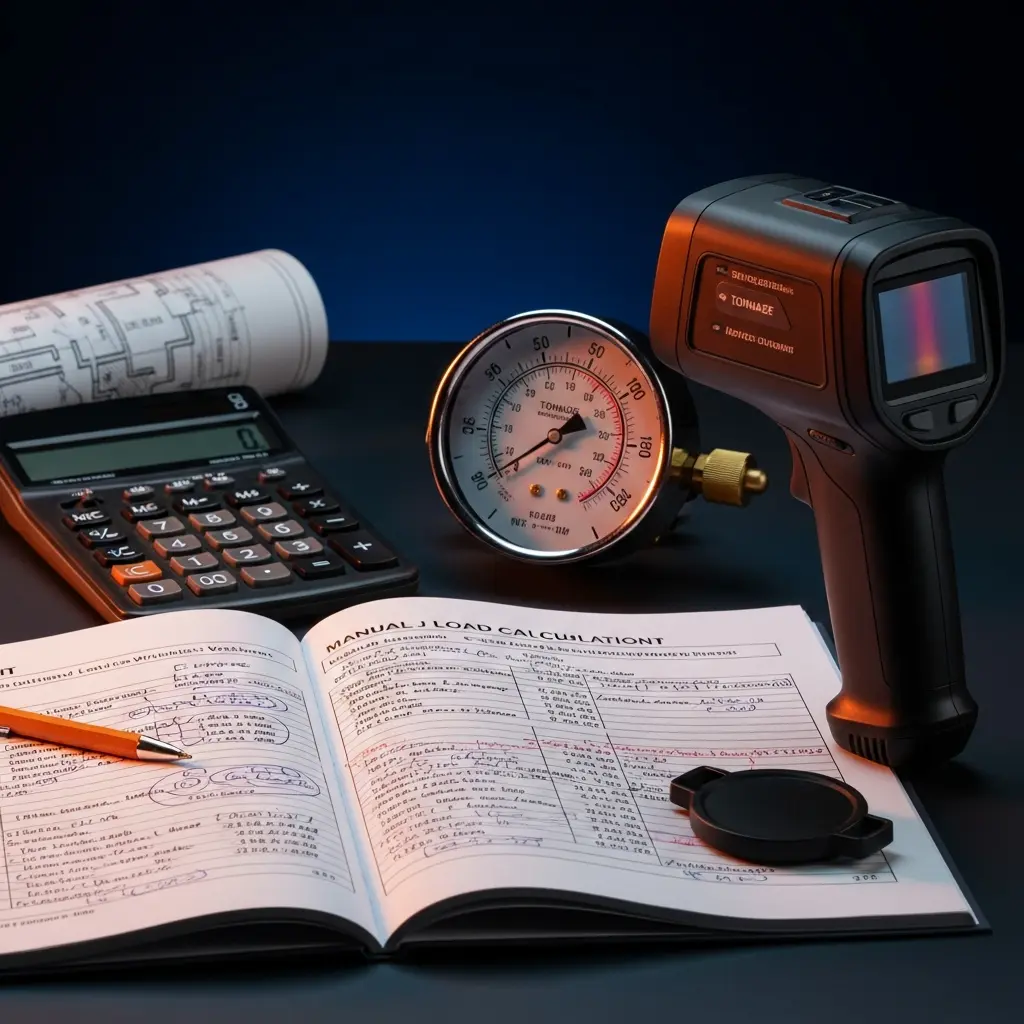

Geothermal Heat Pump Sizing: How to Calculate the Right Tonnage
Geothermal heat pump sizing means matching the unit's BTU/hr capacity to your home's heating and cooling load. The common starting point is 1 ton (12,000 BTU/hr) per 400–600 sq ft of conditioned space — but that rule of thumb is rarely accurate enough to use on its own. Properly sized systems are based on a Manual J load calculation, which accounts for climate zone, envelope quality, window orientation, and air-leakage rate. A 2,000 sq ft modern home typically needs 2.5–3.5 tons; an older, drafty 2,000 sq ft home may need 4–5 tons.
Why Sizing Matters More for Geothermal Than for Gas
A gas furnace tolerates oversizing reasonably well. If the contractor guessed high, the unit fires, overshoots the setpoint, and shuts off early. You pay a little more in fuel and wear, but the system works. Geothermal does not forgive the same error — and the consequences compound across every component of the system.
When a geothermal heat pump is oversized, it short-cycles: the compressor starts, rapidly satisfies the thermostat, and shuts down before completing a full run. A geothermal compressor takes roughly 10 minutes to reach 95% of its rated efficiency (COP). Cut cycles short and the system spends most of its runtime in the low-efficiency startup phase, never reaching the steady-state performance listed on the ENERGY STAR label. An oversized unit that should achieve COP 4.0 may deliver COP 2.5–3.0 in practice because of short cycling alone.
Compressor wear is the more immediate cost. Each compressor startup involves momentary metal-on-metal contact before oil pressure builds. Modern hermetic compressors are rated for roughly one million starts. A correctly sized system running 2–3 cycles per hour uses that budget over 15–20 years. A short-cycling oversized system burning through 6–8 starts per hour can exhaust the same budget in 7–10 years — or less. Geothermal compressors are not inexpensive to replace.
Oversizing wastes loop investment just as directly. Ground loop cost runs roughly $3,000–$8,000 per ton for vertical systems and $1,500–$4,000 per ton for horizontal. Oversizing by even half a ton means thousands of dollars of unused loop capacity sitting in the ground. That money cannot be recovered.
Undersizing carries its own penalty. A geothermal system sized too small will hit its capacity limit during design-day cold snaps and trigger its backup electric resistance heat strips. Those strips operate at COP 1.0 — no better than a baseboard heater — versus the geothermal's COP 3.5–5.0. Homeowners who expected 70% savings on heating bills discover 40% when backup heat runs every cold morning.
The short version: a 10% sizing error typically costs roughly 5% in annual operating efficiency, and a 10% oversized unit may last half as long as a correctly sized one, per data from practitioners who have tracked geothermal system lifecycles.
The Manual J Load Calculation Explained
The industry standard for residential heating and cooling load calculations is ACCA Manual J, 8th Edition (2016) — an ANSI-recognized standard required by most state and local building codes for HVAC system design. Every legitimate geothermal sizing starts here.
Manual J calculates two numbers: the peak heating load and the peak cooling load, both in BTU/hr. The geothermal heat pump is then sized to the larger of the two values. In cold-climate (Zone 5–7) homes, heating load usually controls. In warm-climate (Zone 2–4) homes, cooling load may control instead.
Manual J Inputs
- Conditioned floor area and ceiling height — total volume of air the system must condition
- Climate zone and design temperatures — local winter design temp (e.g., -5°F in Minneapolis) and summer design temp/humidity
- Wall, attic, and floor insulation R-values — conductive heat loss through the envelope
- Window U-factor and SHGC — U-factor governs conductive loss; solar heat gain coefficient governs summer solar gain
- Infiltration rate (CFM50) — air leakage measured by blower door test; this single input often swings load calculations ±20%
- Window orientation and shading — south-facing glazing adds solar gain in winter; unshaded west glass drives peak cooling load
- Internal gains — occupants (250 BTU/hr each sensible + latent) and appliances
- Duct location — ducts in unconditioned attics or crawlspaces add distribution losses
The output is a room-by-room or whole-house heating and cooling load, expressed in BTU/hr. Converting to tons: divide by 12,000. A 42,000 BTU/hr heating load is 3.5 tons.
ACCA-certified installers run Manual J using approved software — Wrightsoft, CoolCalc, and GLD (Ground Loop Design) are common in the geothermal trade. A thorough room-by-room Manual J takes 1–2 hours of technician time. Standalone third-party Manual J services typically charge $100–$300; many geothermal installers include it in their proposal at no added cost. Be cautious of any "load calc" that takes under 30 minutes — what you usually get is a square-footage lookup table dressed up as engineering.
Ask to see the actual report. A full Manual J printout is several pages and shows inputs for each room. If the contractor cannot or will not share it, treat that as a red flag.
Estimated Tonnage by Home Size and Climate Zone
The table below shows typical ranges for well-insulated post-2010 construction meeting current energy codes. "Modern" means air-sealed, with attic insulation at R-38 to R-60 and walls at R-13 to R-21. Older or leakier homes should add 25–50% to these estimates and require a Manual J, not a table lookup.
| Home Size | Cold Climate (Zones 6–7) | Mild Climate (Zone 5) | Warm Climate (Zones 3–4) |
|---|---|---|---|
| 1,500 sq ft (modern) | 2.0–2.5 tons | 1.5–2.0 tons | 1.5–2.0 tons |
| 2,000 sq ft (modern) | 2.5–3.5 tons | 2.0–3.0 tons | 2.0–2.5 tons |
| 2,500 sq ft (modern) | 3.0–4.0 tons | 2.5–3.5 tons | 2.5–3.0 tons |
| 3,000 sq ft (modern) | 3.5–4.5 tons | 3.0–4.0 tons | 3.0–3.5 tons |
| 4,000 sq ft (modern) | 4.5–5.5 tons | 4.0–5.0 tons | 3.5–4.5 tons |
Note: Post-2010 energy-code construction. Pre-2000 homes and those with significant air leakage typically need 25–50% more capacity. These are starting-point ranges only — a Manual J is required for actual equipment selection.
The 28 BTU/Sq Ft Rule of Thumb — and Why It Oversizes Modern Homes
The old industry rule of thumb pegged residential heating loads at 28 BTU per square foot per hour. For a 2,000 sq ft home, that math produces 56,000 BTU/hr — or 4.67 tons. That number was reasonable for the housing stock it came from: 1970s construction with little to no attic insulation, single-pane windows, and no air sealing. The rule has stayed in circulation long after the buildings that justified it stopped being built.
Modern energy-code construction runs 14–22 BTU/sq ft/hr — roughly half the old benchmark. For a 2,000 sq ft code-built home, that means a peak heating load of 28,000–44,000 BTU/hr (2.3–3.7 tons). Applying the 28 BTU/sq ft rule to that same home consistently oversizes the system by 30–50%.
The spread between old and new construction is real and significant. A pre-1980 house with original single-pane windows, no air barrier, and blown-in insulation added later might genuinely need 4–5 tons for 2,000 sq ft. A 2022 house of identical square footage built to IECC 2021 standards might need 2.5 tons. They are not the same load; they should not get the same equipment.
Adding insulation, air sealing, or new windows to an existing home has the same effect — it reduces the load and can render an existing system oversized. If you have done substantial envelope improvements since the geothermal system was installed, the system may be due for a rebalance. See our analysis of what upgrades affect total geothermal costs for a 2,000 sq ft home, including how envelope quality shifts the sizing equation.
Loop Length Sizing — Linked Directly to Tonnage
Once the Manual J determines tonnage, loop sizing follows. The ground loop is how the system exchanges heat with the earth, and its length scales directly with the heat pump capacity — plus soil thermal conductivity, local climate balance, and loop configuration.
Vertical closed-loop systems typically need 150–200 feet of bore depth per ton in moderate soils. Highly conductive bedrock (granite, quartzite) can reduce that to 150 ft/ton or less. Poor conductors — dry sandy soils, certain clays — may push requirements to 200–250 ft/ton. For a 3-ton system in average soil, expect 500–650 feet of total borehole depth, often split across two or three bores.
Horizontal closed-loop systems need more lineal pipe than vertical — roughly 400–600 feet of pipe per ton — but that pipe is installed in shallow trenches (6–8 feet deep) rather than drilled bores. Yard area requirements are significant: plan for roughly 400–500 sq ft of disturbed ground per ton. A 3-ton system on a single-trench horizontal layout needs 1,200–1,800 feet of pipe and roughly 1,200–1,500 sq ft of yard. Slinky or multi-layer trench designs reduce footprint but add installation complexity.
Use our geothermal loop calculator to estimate loop length based on your tonnage, soil type, and loop configuration. It applies IGSHPA-aligned design logic automatically and lets you compare vertical versus horizontal layouts side by side.
For systems at or above 5 tons, an in-situ thermal response test (TRT) is strongly recommended before finalizing loop design. The TRT applies a known heat flux to a test borehole for a minimum of 50 hours (per ASHRAE standards) and measures the soil's actual thermal conductivity rather than estimating from soil type. On a 5-ton system, the difference between assumed and actual conductivity can shift loop cost by $10,000 or more. The TRT costs $1,000–$3,000 and pays for itself on any system of that size.
For cost context on the full system, see our geothermal cost estimator and the complete geothermal cost guide.
Heating-Dominant vs. Cooling-Dominant Homes
Geothermal heat pumps are sized to peak load — the largest single demand the system will face. But the balance between heating and cooling demand also shapes loop design in a way that affects long-term performance.
In heating-dominant climates (Zone 5–7: New England, Upper Midwest, Canada), the system draws far more energy from the ground in winter than it deposits in summer. Over years of operation, soils around the loop field gradually cool if the thermal balance is not restored by summer cooling cycles. Loop designers in cold climates add length to account for this cumulative cooling — or specify hybrid systems with supplemental heat sources to reduce ground draw.
In cooling-dominant climates (Zone 2–3: Southeast, Gulf Coast), the opposite occurs. The system rejects more heat into the ground in summer than it extracts in winter. Soil temperatures around the loop can creep upward over time, raising entering water temperatures in summer and reducing cooling efficiency. Designers address this by increasing loop length, adjusting spacing, or specifying fluid cooler desuperheaters to pre-dump heat.
The IGSHPA design balance ratio formalizes this calculation. Most professional ground-loop design software (GLD, LoopLink, Carmel Software) handles heating-versus-cooling balance automatically when you enter the correct heating and cooling loads. This is another reason Manual J accuracy matters: an inaccurate load imbalance will produce an imbalanced loop design that degrades performance over a 25-year system life. See our deep dive on vertical versus horizontal loop configurations for more on how loop type affects these thermal balance tradeoffs.
Common Sizing Mistakes
These are the errors that show up repeatedly in underperforming geothermal systems:
- Sizing from square footage alone. Square footage tells you the house is big, not how much heat it loses or gains. Two 2,000 sq ft homes in the same ZIP code can have loads that differ by a factor of two based on envelope quality. Sizing from sqft without envelope data produces errors of 35–50%.
- Relying on contractor gut feel. An experienced contractor may have installed hundreds of systems, but human pattern-matching consistently oversizes by 20–40%. This is not malice — oversizing protects against callbacks on cold days. The incentive structure rewards capacity, not accuracy.
- Accepting a 30-minute "load calculation." A real room-by-room Manual J takes 1–2 hours to run. A 30-minute output is almost always a cookbook lookup — square footage times a factor from the contractor's memory — dressed up with software printouts. Ask what software and what inputs.
- Matching the existing furnace size. The furnace the house had before was likely oversized already. The rule of thumb used to size it may have been wrong. Replacing a 5-ton gas system with a 5-ton geothermal unit is not conservative — it likely perpetuates an error while adding loop cost.
- Ignoring recent envelope upgrades. Air sealing, new windows, and added insulation reduce load. A Manual J done before those upgrades is outdated. Geothermal systems sized to pre-improvement loads will short-cycle after the work is done. Redo the calc.
- Skipping the in-situ test on large systems. Estimating soil conductivity from soil type rather than testing it is acceptable for small residential systems (2–4 tons). For systems at 5 tons and above, the uncertainty in soil conductivity assumptions can cause loop undersizing or oversizing worth $10,000 or more. The TRT cost is a fraction of that risk.
What to Ask Your Installer
These six questions separate contractors who size properly from those who guess:
- "Will you run a Manual J load calculation?" The answer must be yes. Any installer who does not do a Manual J — or who says it is not necessary — is not sizing correctly by current ACCA or IGSHPA standards.
- "Can I see the Manual J output report?" A legitimate calculation produces a multi-page report showing inputs and loads for each room or zone. If the answer is no, or if the "report" is a single summary page, ask why.
- "What software do you use?" Wrightsoft, CoolCalc, and GLD are common and ACCA-approved. Generic spreadsheets or proprietary "estimators" that do not publish their methodology are not Manual J.
- "What loop length does your design call for, and how did you arrive at that number?" Compare the answer to the 150–200 ft/ton vertical or 400–600 ft/ton horizontal benchmarks. A number far outside that range needs explanation — it could reflect unusual soil conditions, or it could reflect a design that has not been done correctly.
- "Will you conduct an in-situ thermal conductivity test?" Required for systems 5 tons and above. Optional but worth discussing for 4-ton systems in geologically uncertain areas.
- "How does the heating-versus-cooling load balance affect my loop size?" A designer who cannot explain this — even briefly — has not accounted for long-term loop thermal balance in their design.
For the full picture of what a properly sized geothermal installation involves from first site visit through commissioning, see our geothermal installation process guide.
Frequently Asked Questions
What size geothermal heat pump do I need for my home?
The right size depends on your home's heating and cooling load, not its square footage alone. A Manual J load calculation is the required method — it accounts for climate zone, insulation, windows, air leakage, and orientation to produce a BTU/hr number. As a rough orientation: a well-insulated 2,000 sq ft home in a cold climate (Zone 6) typically needs 2.5–3.5 tons; the same home in a mild climate may need 2.0–3.0 tons. Older, leakier homes of the same size may need 4–5 tons. The only way to know your specific number is a proper load calculation.
How is heat pump tonnage calculated?
Tonnage is calculated by dividing the peak load in BTU/hr by 12,000. If a Manual J shows a peak heating load of 36,000 BTU/hr, that is a 3-ton requirement. In practice, installers size to the larger of the heating or cooling peak load, then select a heat pump model whose rated capacity at design-day entering water temperature meets or slightly exceeds that number — typically within 10–15% of the calculated load. Variable-capacity units have more flexibility and can cover a wider load range with a single unit size.
What is a Manual J load calculation?
Manual J is the ANSI/ACCA standard residential load calculation method, 8th Edition (2016). It calculates peak heating load and peak cooling load in BTU/hr for a specific home by inputting its square footage, ceiling height, wall and attic insulation R-values, window U-factor and SHGC, local climate design temperatures, infiltration rate (typically from a blower door test), occupancy, and duct location. The result drives both equipment sizing and loop sizing. ACCA-certified installers run it with approved software such as Wrightsoft or CoolCalc. It is required by most state and local building codes for new HVAC installations.
Can a geothermal system be oversized?
Yes, and the consequences are worse than for conventional systems. An oversized geothermal unit short-cycles — it satisfies the thermostat quickly, shuts off, and restarts frequently — spending most of its operating time in the low-efficiency startup phase rather than at rated COP. Short cycling accelerates compressor wear: a unit that short-cycles may fail in 7–10 years rather than the expected 15–20. It also wastes loop investment, since the unused loop capacity still had to be drilled or trenched. A 10% oversized geothermal heat pump has been shown to have roughly half the operational lifespan of a correctly sized unit.
How many feet of loop per ton of geothermal?
It depends on the loop type and soil conditions. Vertical closed-loop systems typically need 150–200 feet of bore depth per ton — more in soils with low thermal conductivity (dry sand, certain clays), less in highly conductive bedrock. Horizontal systems need more total pipe: roughly 400–600 feet of pipe per ton, installed in trenches 6–8 feet deep. Actual numbers should come from a loop designer using IGSHPA-standard methods and local soil data, not from a rule of thumb. For systems at 5 tons and above, an in-situ thermal response test (TRT) measured to ASHRAE standards is recommended to confirm actual soil conductivity before finalizing loop length.
Sources
- ACCA Manual J 8th Edition — Residential Load Calculation, ANSI/ACCA Standard (2016). acca.org
- IGSHPA — Closed-Loop/Geothermal Heat Pump Systems Design and Installation Standards (2017). igshpa.org
- ASHRAE — HVAC Applications Handbook: Ground-Source Heat Pump Systems chapter. ashrae.org
- U.S. DOE — Geothermal Heat Pumps, Energy Saver Buyers Guide. energy.gov
- ENERGY STAR — Certified Ground Source Heat Pumps. energystar.gov
- HeatSpring Magazine — "4-Step Guide to Designing Geothermal Systems." blog.heatspring.com
- Energy Vanguard — "How to Read Manual J Load Calculation Reports." energyvanguard.com
Need a Geothermal Contractor?
Search the directory for licensed installers near you. Compare credentials, read reviews, and contact directly.
Find Installers Near YouOwn a Geothermal Business?
Claim your free listing to get more qualified leads, show up in local search, and answer customer questions where they’re already looking.
Claim Your Free Listing