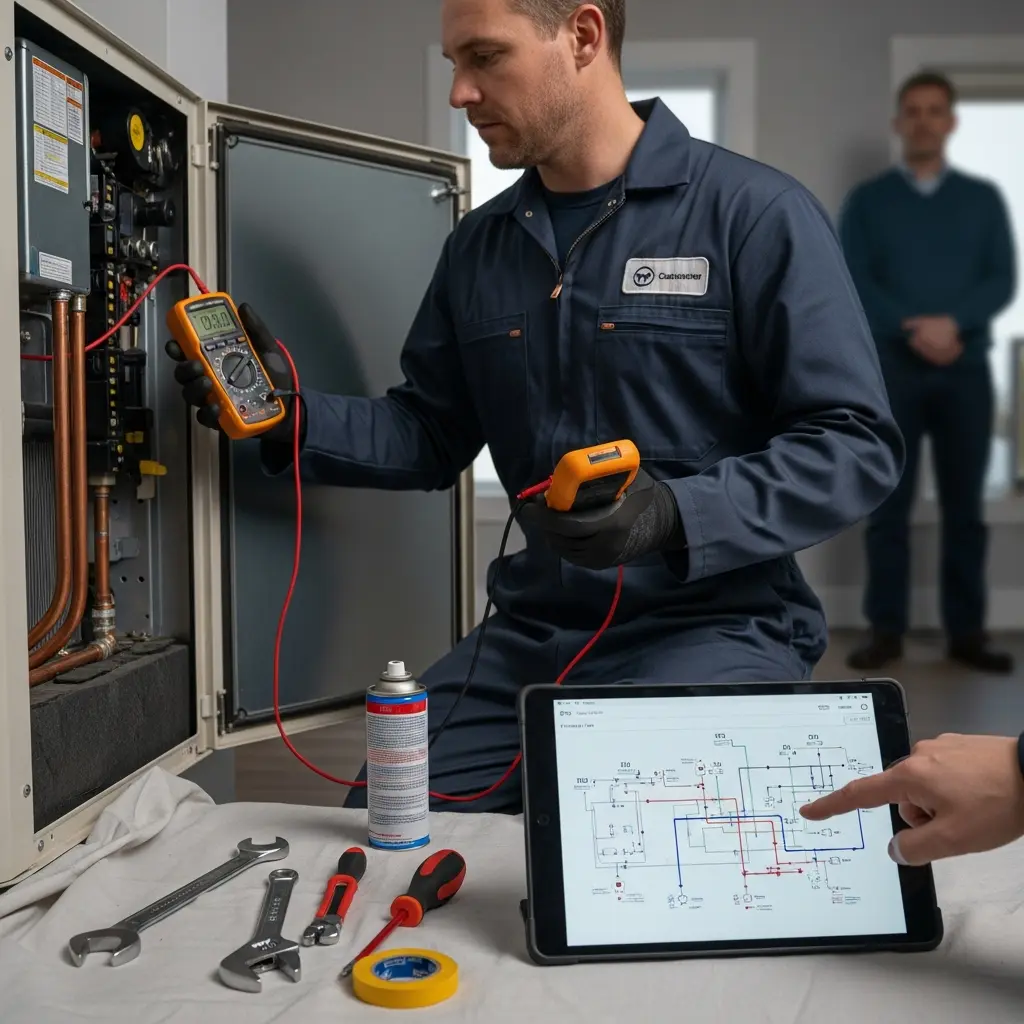

Geothermal Heat Pump Repair: Common Problems, Costs & Fix Timelines
Geothermal heat pump repairs typically cost $200–$2,500 depending on the component. Most-common: capacitor ($200–$400), contactor ($250–$450), refrigerant top-off ($150–$400). Less-common but pricier: compressor replacement ($1,500–$3,500), heat exchanger ($1,200–$2,500). Loop leaks — rare — require excavation: $2,500–$6,000. Most issues trace back to low refrigerant, dirty filters, or worn capacitors — the same parts every air-source heat pump shares. The underground loop itself almost never fails before 50 years.
Why Geothermal Repairs Are Often Simpler Than Expected
A geothermal heat pump is two machines in one cabinet: an indoor refrigerant circuit nearly identical to a standard air-source heat pump, and an underground loop that circulates water or antifreeze through stable-temperature earth. The DOE estimates indoor components last up to 24 years; the ground loop is warranted for 50+ years by most manufacturers.
Most repair calls never touch the loop. Technicians replace a capacitor, check refrigerant charge, clean the heat exchanger, or swap a contactor — the same work as any heat pump. Genuine loop failures account for roughly 1–2% of service calls over a 25-year system life. The bigger risk is misdiagnosis: HVAC companies without geothermal experience sometimes recommend loop excavation when the actual problem is a low refrigerant charge or a worn capacitor. Understanding the cost breakdown helps you evaluate quotes before authorizing expensive digging.
For a broader look at annual service tasks, see our Geothermal Maintenance & Service Manual.
Most Common Repairs: Frequency, Cost, and Who Does the Work
The eight repairs below cover the majority of geothermal service calls, ranked roughly from most to least frequent. Costs include parts and labor at prevailing U.S. rates; rates vary by region.
| Repair | Typical Cost | Interval / Trigger | DIY or Pro? |
|---|---|---|---|
| Air filter replacement | $20–$40 | Every 3 months (DOE recommendation) | DIY |
| Capacitor replacement | $200–$400 | 5–10 years; fails with short-cycling or no-start | Pro |
| Contactor replacement | $250–$450 | 8–12 years; pitted contacts cause intermittent no-start | Pro |
| Refrigerant top-off | $150–$400 | As needed; system should hold charge indefinitely if no leak | Pro (EPA 608 cert required) |
| Loop fluid sample / antifreeze test | $150–$300 | Every 5 years per IGSHPA CSA/ANSI/IGSHPA C448 standard | Pro |
| Loop pump replacement | $400–$1,200 | 10–15 years; signs are low flow alarm or high loop pressure drop | Pro |
| Heat exchanger cleaning | $300–$600 | Every 10 years in hard-water areas; sooner if COP drops | Pro |
| Thermostat replacement | $200–$500 | 8–12 years; or when upgrading to smart controls | Pro or competent DIY |
Filter replacement
The most overlooked geothermal maintenance item. A clogged filter forces the blower to work harder and reduces heat transfer across the coil. The DOE recommends filter checks every three months — restricted airflow is a leading cause of compressor short-cycling and the more expensive repairs below.
Capacitor replacement
A failing capacitor is the single most common cause of a geothermal compressor that won't start. Symptoms include clicking noises, a compressor that hums but won't run, or a tripped breaker. The part itself costs $15–$50; labor and diagnostic fee bring the total to $200–$400. Most techs carry capacitors on the truck, so same-day repair is typical.
Contactor replacement
Contactors are electromechanical relays that switch high-voltage power to the compressor and fan motor. Contacts pit over years of switching. Signs include intermittent no-heat or a chattering noise from the equipment cabinet. Like capacitors, these are truck-stock parts — repair is usually same-day at $250–$450 total.
Refrigerant top-off
A properly sealed refrigerant circuit does not consume refrigerant. If a system needs a top-off, there is a leak somewhere. EPA Section 608 requires technicians to hold Type II or Universal certification before opening any refrigerant circuit. A top-off without finding and fixing the leak will recur within 6–18 months. See the scams section below.
Loop fluid sample and antifreeze test
IGSHPA's CSA/ANSI/IGSHPA C448:25 standard recommends sampling loop fluid every five years to check pH balance and inhibitor concentration. Degraded antifreeze allows corrosion of the loop pump and heat exchanger. Catching degraded glycol early prevents $1,000+ in downstream damage.
Loop pump replacement
The circulator pump moves antifreeze through the underground loop. The pump motor wears like any residential circulator — 10–15 years of reliable service is typical. Signs of impending failure include flow-alarm faults on the control board or reduced heating capacity. Common OEM suppliers include Grundfos and Bell & Gossett.
Heat exchanger cleaning
Mineral scale deposits on the coaxial or plate heat exchanger and reduces efficiency. The first symptom is usually a gradual rise in electric bills rather than a comfort complaint. Chemical descaling restores performance; a sediment filter on the loop supply line extends cleaning intervals in hard-water areas.
Thermostat replacement
Two-stage and variable-capacity geothermal units need a compatible communicating thermostat to use their efficiency staging. A smart thermostat upgrade ($150–$350 unit, $50–$150 labor) often improves comfort immediately.
Less Common but Expensive Repairs
These repairs arise infrequently — typically after 15+ years of service or from corrosion, scaling, or a refrigerant system failure — but they can be the point where repair-vs-replace math becomes genuinely close.
Compressor replacement ($1,500–$3,500)
Well-maintained geothermal compressors typically last 20–25 years — longer than air-source compressors because they never see extreme outdoor temperatures. Before authorizing replacement, check two things: (1) warranty status — most manufacturers cover the compressor body for 5–10 years, though labor is rarely covered after year 1; (2) refrigerant circuit integrity — if the failure was caused by undetected refrigerant loss, a replacement compressor will fail the same way unless the leak is also fixed. Large tonnage units (4–6 tons) can reach $3,500+ due to part availability.
Heat exchanger replacement ($1,200–$2,500)
Replacement is necessary when descaling cannot restore performance, when corrosion has caused refrigerant to cross-leak into loop fluid (detectable by an oily sheen in the fluid sample), or when the exchanger is physically damaged. Only worthwhile if the compressor, controls, and loop are otherwise healthy. Systems over 18 years old requiring a heat exchanger should run the repair-vs-replace numbers first.
Loop fluid full replacement ($1,500–$3,000)
Propylene glycol degrades over time, losing its corrosion inhibitor package. IGSHPA guidelines recommend full-fluid replacement on a 10–15 year interval in systems without regular sampling. The process is a flush-and-recharge — no excavation needed unless there is also a physical leak. Plan it alongside other service work to minimize labor costs.
Refrigerant leak repair ($400–$1,500)
Locating a refrigerant leak in a geothermal system takes longer than in an automotive AC — the coil is enclosed, and dye or electronic detectors require a methodical search through fittings, valves, and the coaxial exchanger. Total cost covers detection, repair, pull-down, recharge, and refrigerant. R-454B supply constraints through 2025–2026 have elevated refrigerant cost on large recharges. Full refrigerant transition context is in the Geothermal Cost Guide.
Loop leak repair ($2,500–$6,000)
HDPE loop pipes rarely fail from material fatigue — when leaks occur, the cause is usually physical damage (ground settling, root intrusion). Repair requires excavating above the leak, cutting and splicing the pipe, pressure-testing, and recharging the loop. In expansive soil or under hardscape, costs can reach $6,000. Full diagnosis and repair guidance: Geothermal Loop Leak: Diagnosis, Repair & Cost.
Warning Signs and Diagnostic Flow
Most geothermal problems announce themselves gradually through comfort changes or energy bill shifts before a full failure. The table below maps common symptoms to the most likely causes and immediate actions.
| Symptom | Likely Cause | Action | Approximate Cost |
|---|---|---|---|
| Cold air in heating mode | Low antifreeze, low refrigerant charge, or reversing valve stuck in cooling position | Check loop antifreeze concentration; call tech for refrigerant and valve check | $150–$1,500 |
| Compressor short-cycling (starts and stops frequently) | Low refrigerant, dirty filter, or system oversized for the load | Replace filter first; call tech if short-cycling continues | $20–$400 |
| Electric bill significantly higher than prior years | Backup electric resistance strips running constantly (loop or refrigerant problem) | Confirm loop entering water temperature; refrigerant check | $150–$2,000 |
| No heat or cooling at all | Tripped breaker, failed contactor, control board fault | Check breaker; schedule diagnostic visit | $150–$450 |
| Loud grinding or rattling noises | Fan motor bearing failure, capacitor, or loose loop pump coupling | Shut down, call tech — running a failing motor causes secondary damage | $200–$1,200 |
| Water pooling near indoor unit | Condensate drain clog (~95% of cases) or loop fluid leak from pump/fitting (~5%) | Check and clear condensate drain; inspect loop pump connections | $150–$6,000 |
Tip: Before calling for service, check two things yourself: the air filter (replace if gray or clogged) and the circuit breaker. A clogged filter or a tripped breaker accounts for a notable percentage of no-heat calls that otherwise result in a diagnostic fee for no repair work done.
Repair vs. Replace: A Four-Factor Decision
Geothermal systems are expensive to install and expensive to replace — which means the repair-vs-replace math is different from a standard gas furnace or window AC. The four factors below give a consistent framework. For more context on system longevity, see How Long Does a Geothermal System Last?
Factor 1: System age
Under 15 years: repair almost always makes sense. Between 15 and 20 years: evaluate case-by-case, weighing repair cost against the efficiency gain of a new system. Over 20 years: price replacement seriously, especially if the system uses R-22 (see Factor 4) or is a pre-2005 single-speed unit at 13 SEER versus modern equipment at 20–30+ EER.
Factor 2: Annual repair cost trend
Below $500/year: repair. $500–$1,500/year: case-by-case depending on age and efficiency. Above $1,500/year for two or more consecutive years: replacement math typically wins — particularly where state or utility incentives still apply. Note: the federal §25C credit (up to $2,000 for qualifying heat pumps) applied only to property placed in service before December 31, 2025, and the §25D residential geothermal credit was terminated December 31, 2025 under P.L. 119-21 and no longer applies to new installs.
Factor 3: Efficiency degradation
Post-2010 systems at 16–20 EER typically degrade only 5–10% over 20 years with normal maintenance — efficiency alone is rarely a compelling replacement argument. Pre-2008 units at 12–14 EER are now 25–35% behind modern variable-speed equipment (28–32 EER). If bills have crept upward and the system is pre-2008, quantify the efficiency gap against replacement cost.
Factor 4: Refrigerant type
R-22 systems (pre-2010) face escalating recharge costs — R-22 is available only as reclaimed stock and prices continue rising. A refrigerant top-off on an R-22 system is a strong signal to price replacement. R-410A systems (2010–2024) can continue to be serviced with reclaimed stock. New equipment (post-2025) uses R-454B or R-32 and is not backward-compatible. For what's legal to do yourself on refrigerant, see DIY Geothermal Heat Pump Work: What's Legal and Safe.
How to Find a Qualified Geothermal Repair Technician
Not every HVAC company has geothermal experience. A technician trained only on air-source systems can misread a geothermal control board, misinterpret normal loop-pressure readings, or recommend unnecessary excavation when the fault is actually a low refrigerant charge. Key credentials to verify:
- IGSHPA GRST (GSHP Residential Service Technician): The most geothermal-specific service credential. Based on CSA/ANSI/IGSHPA C448:25; renews every three years. Best choice for loop fluid, loop pump, or refrigerant work.
- IGSHPA Accredited Installer (AI): Installation-focused, but most experienced installers also perform service. More common in the field than GRST.
- NATE — Heat Pump Service or Ground Source Heat Pump Installer: Adequate for indoor-unit work — capacitor, contactor, thermostat replacements.
- EPA Section 608 (Type II or Universal): Federally required before opening any refrigerant circuit. Non-negotiable for any refrigerant work.
Get 2–3 quotes for any repair above $500. For compressor or heat exchanger replacement, confirm whether manufacturer authorized-dealer warranty applies — some brands require it for labor coverage. Find IGSHPA-credentialed contractors through our Find a Geothermal Contractor directory or search by state, e.g. geothermal contractors in Pennsylvania. WaterFurnace, Bosch, ClimateMaster, Carrier, and Trane each maintain authorized-dealer locators on their brand pages.
Repair Scams and Red Flags
"Your whole loop needs replacement" — without a leak test
A legitimate loop leak diagnosis requires a nitrogen pressure test: the contractor pressurizes the loop to 100–150 psi and monitors for pressure drop over 15–30 minutes. Any recommendation for loop replacement ($15,000–$35,000+) without a documented pressure test is either uninformed or a deliberate upsell. Get a second opinion with a documented test before proceeding.
Refrigerant top-off without leak diagnosis
A properly sealed system does not lose refrigerant. A top-off without finding the source leak will recur in 6–18 months. EPA regulations require technicians to attempt leak repair on systems over 50 lbs of charge before recharging. If a quote mentions top-off but not leak detection, ask directly: "Where is the refrigerant going, and how will we find and fix it?"
"Inverter compressor upgrade" upsell on a functional system
Retrofitting a variable-speed compressor into a single-stage system is almost never feasible without replacing the entire indoor unit and controls. A quote for an "inverter upgrade" on a working system is effectively a new-system sale.
Quotes significantly above manufacturer replacement cost
Before authorizing a compressor or heat exchanger swap, look up the OEM part number and list price. Labor markups of 40–60% above part cost are normal. Quotes more than double the part cost, or citing parts you cannot verify as OEM-compatible, warrant a second opinion.
Frequently Asked Questions
How much does it cost to repair a geothermal heating system?
Most geothermal repairs fall between $150 and $1,500. Common fixes — capacitor ($200–$400), contactor ($250–$450), refrigerant top-off ($150–$400), thermostat ($200–$500) — stay at the lower end. Major repairs such as compressor ($1,500–$3,500) or heat exchanger replacement ($1,200–$2,500) arise less often, typically after 15+ years. Loop excavation at $2,500–$6,000 is the costliest scenario and also the rarest — genuine loop failures affect roughly 1–2% of systems over 25 years. Average annual spend for a 5–15 year old system is $300–$600, per HomeAdvisor and Angi cost data (2025–2026).
What is the lifespan of a geothermal well?
The DOE estimates ground loop life at 50 years or more; most manufacturers warrant the HDPE loop piping for 50 years. The indoor heat pump unit has a shorter service life — typically 20–25 years for compressor and refrigerant components. Most homeowners will replace the indoor unit at least once during the life of the original loop. Because the loop is the largest share of initial cost, that replacement is far less expensive than a full new system installation.
What is the biggest problem when using geothermal energy?
For residential systems, the most common operational problem is homeowners discovering high electric bills and assuming the system is failing — when the real cause is a clogged filter, degraded loop antifreeze, or a low refrigerant charge forcing backup electric resistance strips to run constantly. Deferred maintenance, not equipment failure, drives most complaints. At a structural level, the two biggest challenges are high upfront installation cost and the limited availability of qualified service technicians in rural areas.
What are common geothermal heat pump problems?
In rough order of frequency: dirty filters causing short-cycling; capacitor failure causing a no-start compressor; contactor failure causing intermittent operation; low refrigerant charge from a slow leak; degraded loop antifreeze reducing heat transfer; loop pump wear triggering low-flow alarms; mineral scale on the heat exchanger cutting COP; and thermostat incompatibility after a controls upgrade. True loop failures — leaks, pipe damage — are uncommon. Geothermal systems typically have fewer repair incidents than air-source heat pumps of the same age because there is no outdoor unit exposed to weather.
Why is my geothermal heat pump not heating?
Check three things before calling a technician: (1) the circuit breaker — a trip accounts for a meaningful share of no-heat calls; (2) the air filter — a fully clogged filter can trigger a safety lockout; (3) thermostat settings and batteries. If none of those are the issue, likely culprits in order are a failed contactor or capacitor ($250–$450), low refrigerant charge causing a low-pressure lockout ($150–$400), or a loop-side problem such as low antifreeze concentration or an air-bound pump preventing heat extraction from the ground. A qualified technician can distinguish between these in a single diagnostic visit, typically $75–$150.
Sources
- IGSHPA — Training & Certification (GRST credential, CSA/ANSI/IGSHPA C448:25 standard)
- U.S. EPA — Section 608 Technician Certification Requirements
- U.S. DOE Energy Saver — Geothermal Heat Pumps (loop life, indoor component life)
- U.S. DOE Energy Saver — Operating and Maintaining Your Heat Pump (filter intervals, maintenance tasks)
- HomeAdvisor — Geothermal Heating System Repair Costs (2026 data)
- Angi — Heat Pump Repair Cost Guide (2026 data)
- NATE — Professional Certification Exams (Heat Pump Service and Ground Source Heat Pump Installer)
- Bosch Home Comfort — R-454B Refrigerant Transition
Need a Geothermal Contractor?
Search the directory for licensed installers near you. Compare credentials, read reviews, and contact directly.
Find Installers Near YouOwn a Geothermal Business?
Claim your free listing to get more qualified leads, show up in local search, and answer customer questions where they’re already looking.
Claim Your Free Listing