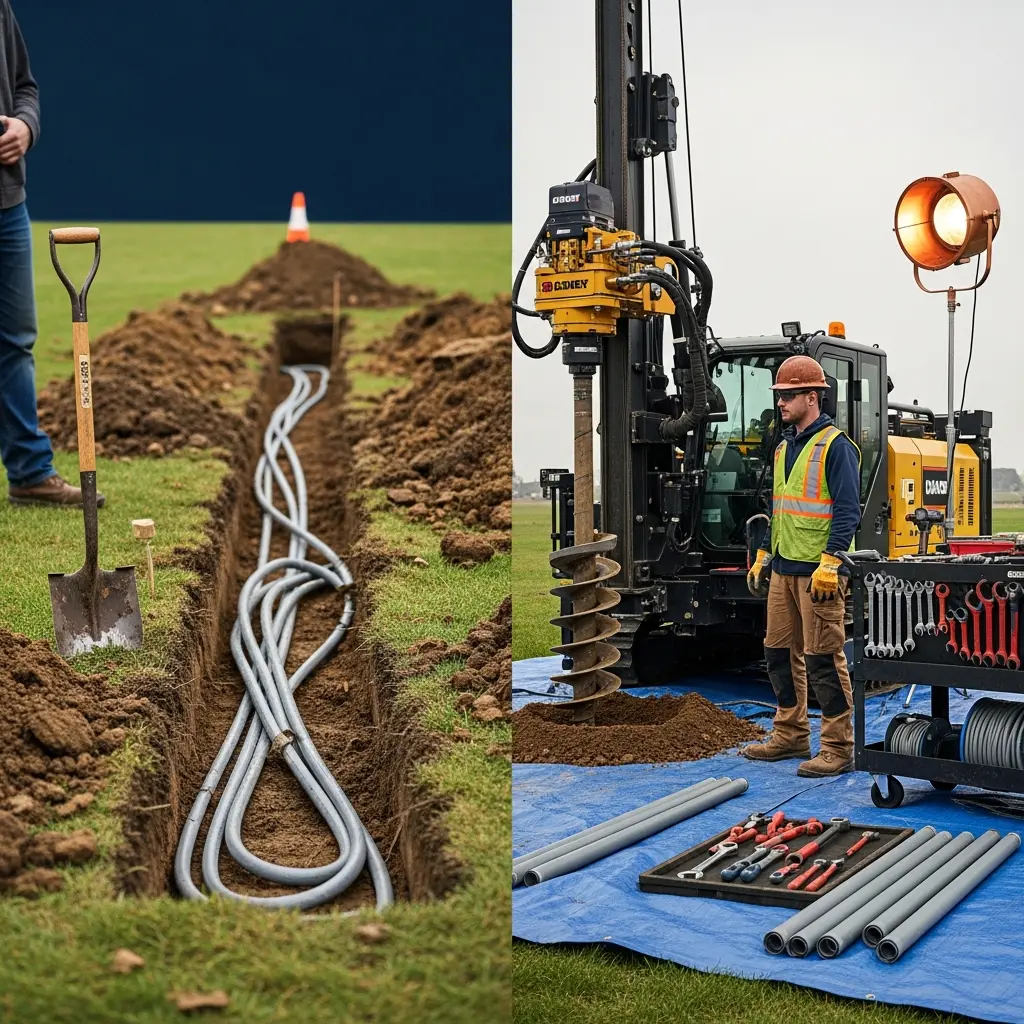

DIY Geothermal Heat Pump: What's Possible vs What Requires a Pro
Short answer: Most of a geothermal heat pump installation legally requires licensed professionals. Drilling, refrigerant handling, antifreeze charging, electrical work, and system commissioning all require permits and specific certifications under federal and state law. What homeowners can do themselves — with the right installer's blessing — is limited to site preparation, trenching for horizontal loops, and post-install monitoring. A complete DIY install is essentially impossible to do legally in the United States without simultaneously holding an HVAC license, a plumbing license, a well-driller license, and an electrical license.
What "DIY Geothermal" Actually Means Online
Search "DIY geothermal heat pump" and you'll find YouTube videos of homeowners digging trenches, forum threads about bulk HDPE pipe, and companies selling "DIY kits" for $8,000–$15,000. Almost none of it describes a true full DIY install. What it actually describes is partial-DIY: the homeowner handles excavation while a licensed installer does everything requiring a license. The gap between "I dug my own trenches" and "I installed my own geothermal system" is enormous — legally, technically, and financially.
Genuine full-DIY installs do exist online, mostly from rural properties with thin code enforcement, homeowners who hold relevant licenses already, or systems installed before current refrigerant rules took effect. None of those situations is a template. EPA Section 608 refrigerant rules are federal law — they apply whether or not your county inspector ever shows up. And most DIY content skips commissioning entirely: a system running without verified loop pressure, confirmed refrigerant charge, and correct antifreeze concentration is running outside design spec. That's how compressors fail at year four instead of year twenty-four.
What the Law Actually Requires
A geothermal ground source heat pump installation touches four separate regulated trades, each with its own licensing regime.
EPA Section 608 Certification — Refrigerant Handling
Under the Clean Air Act (40 CFR Part 82, Subpart F), anyone who maintains, services, or disposes of refrigerant-containing HVAC equipment must hold EPA Section 608 Technician Certification. This is federal law — it applies everywhere regardless of local enforcement. As of January 2025, new geothermal units ship with A2L refrigerants (R-454B or R-32) under the AIM Act phase-down; handling these requires Section 608 Universal or Type II certification. Penalties run up to $44,539 per day per violation, with criminal exposure for willful violations. There is no homeowner exemption for stationary equipment.
Plumbing License — Water-Source Connections
Most states require a licensed plumber for hydronic connections — the water side of a water-to-water heat pump or the coaxial heat exchanger connections on an air handler. Some states fold this into the HVAC contractor's scope; others require a separate license. Check your state licensing board to confirm coverage.
Well-Driller License — Vertical Borehole Drilling
Vertical loop drilling is regulated as water-well drilling in the vast majority of states. Tennessee, Washington, Wisconsin, and South Dakota all require a state well-driller license for geothermal bores. IGSHPA maintains a state-by-state reference at igshpa.org/state-codes-and-regulations/. New York is one notable exception — the NY DEC does not currently require well-driller registration for closed-loop geothermal wells, though the overall project still requires a licensed contractor.
Electrical License and Building Permit
A geothermal heat pump requires a dedicated 240V circuit (typically 40–60 amps), which requires a licensed electrician in every US jurisdiction. Some states allow homeowners to pull a homeowner electrical permit for work on their own residence, but that is still a permit with inspections — not a way to skip permitting. An HVAC building permit is also required in every US municipality; it triggers inspections covering electrical, refrigerant line sets, and loop installation where applicable. Look up your state contractor license requirements through your state's Department of Consumer Affairs or Department of Labor.
What You CAN Legally Do Yourself
The good news: there is real money to be saved in the homeowner-legitimate portion of a geothermal project. The key is being upfront with your installer from the first conversation about what you want to self-perform, and getting their explicit sign-off before you touch anything.
Site Preparation and Utility Locating
Before any excavation begins — by you or your installer — you must call 811, the national "Call Before You Dig" service. This is legally required in all 50 states and is something you can handle entirely. The locator crews mark underground utilities within a few days. You can also clear the work zone: removing shrubs, staking out the footprint, and making the area accessible for equipment. This is unregulated labor, and doing it yourself costs nothing.
Horizontal Loop Trenching
For horizontal loop systems — common on larger rural properties with adequate land — some installers will allow homeowners to dig their own trenches to the installer's specified dimensions, depth, and layout. Savings here range from $1,500 to $4,000 depending on trench length and local excavation rates. Many installers, however, prefer to control trenching themselves to ensure the trench bottom is level, the depth consistent, and the bed material suitable for the pipe.
If you pursue this, get the spec in writing before renting equipment: exact depth (typically 4–6 feet, at or below frost line), width, bed-material requirements, and backfill staging. A trench dug to the wrong depth or with rocky bed material can void the installer's workmanship warranty on the loop.
HDPE Loop Pipe Purchase
Some installers will accept owner-supplied HDPE loop pipe purchased directly from a wholesale supplier, cutting out the material markup. Not all will — liability for material quality is the usual reason — so ask explicitly. The installer still does all fusion welding, pressure testing, and loop work regardless of who bought the pipe.
Post-Install Monitoring and Maintenance
Once the system is commissioned, routine upkeep is entirely homeowner territory: filter changes every 1–3 months, thermostat programming, visual checks for unusual sounds or moisture, and maintaining an annual maintenance log (required by most manufacturers for warranty compliance). A geothermal system with a documented service history also sells better at resale than one with gaps.
What You Absolutely Cannot DIY
Refrigerant Line Connections, Charging, and Recovery
Every step involving refrigerant requires EPA Section 608 certification. Connecting the line set from the loop to the heat pump unit, brazing copper connections, pulling a vacuum to remove moisture, verifying charge by subcooling measurement, recovering refrigerant before service — all of it. Attempting this without certification exposes you to fines of up to $44,539 per day per violation. This is not a gray area.
Vertical Borehole Drilling
Drilling rigs for geothermal bores are typically rented only to licensed operators, and operating one for a geothermal bore requires a state well-driller license in most states. Improper technique — wrong grout mix, inadequate casing depth, poor borehole spacing — permanently degrades thermal performance and can contaminate groundwater. These are irreversible errors in a system designed to last 25+ years.
Loop Pressure Testing and Heat Fusion Welding
IGSHPA standards require closed-loop systems to be pressure-tested to at least 100 psi before backfill. Heat fusion welding of HDPE pipe requires equipment calibrated to the pipe's PE grade and proper training — a bad joint 6 feet underground means excavating and replacing the loop years later. The IGSHPA Accredited Installer program covers these techniques specifically because they are failure-prone without hands-on training.
Antifreeze Charging
Propylene glycol concentration must match the design spec exactly — typically 15–25% by volume. Too little risks freeze damage; too much cuts heat-transfer efficiency. Getting it right requires accurate loop-volume data, and most manufacturers require documented concentration as part of the commissioning report.
System Commissioning
Most manufacturers — WaterFurnace, ClimateMaster, Bosch, Carrier — require a commissioning report from a certified installer to activate the equipment warranty. Without that paperwork, the warranty typically does not apply regardless of cause.
DIY Kits — An Honest Assessment
DIY kit suppliers bundle a heat pump unit, HDPE loop pipe, and a flow center for $8,000–$15,000, versus $20,000–$40,000 for a full professional install. The implied savings look large. What the kit price leaves out: refrigerant line installation, loop fusion and pressure testing, electrical connection, permitting, and commissioning — all of which still require licensed professionals. Realistic net savings over a full-service install using comparable equipment: $2,000–$4,000, not the 50% implied in marketing.
Additional risks:
- Warranty: Most manufacturers require a commissioning report from a certified installer. Equipment installed without that documentation may face warranty denial even for manufacturing defects.
- No accountability: If a kit-based system underperforms, there is no contractor to call back. Troubleshooting falls to you.
- Rebate eligibility: Many PACE financing programs and utility rebates require professional installation by a listed contractor. Kit installs may disqualify you.
- Tax credit: The federal §25D residential tax credit (30%, uncapped) ended December 31, 2025 under the One Big Beautiful Bill Act; only systems placed in service in 2025 or earlier can still claim it. State and utility incentives remain available. Consult a tax professional about credit eligibility for owner-assembled systems.
Permitting Consequences of Unlicensed Work
Skipping permits doesn't create abstract regulatory risk — it creates concrete, discoverable liability at the worst moment: home sale.
Home sale disclosure: Most states require sellers to disclose known unpermitted work in writing. Home inspectors routinely flag unpermitted HVAC systems, and buyers' lenders often require permit documentation before financing. Discovery can kill a sale or force a large price concession.
Forced rip-out: If a building department discovers an unpermitted install — through a complaint, an insurance inspection, or a permit audit — they can require the work be torn out and redone correctly. You pay for the same job twice.
Insurance denial: Homeowner's insurance typically excludes damage caused by unpermitted work. A fire from an unlicensed electrical connection, or water damage from a failed loop joint, may result in a denied claim.
EPA refrigerant penalties: Federal, no local exemption. Up to $44,539 per day per violation for handling refrigerant without Section 608 certification. EPA enforcement actions against individuals do occur.
Appraisal impact: Unpermitted HVAC improvements typically receive zero credit in a formal appraisal — the $25,000+ you spent may add nothing to your appraised value while simultaneously flagging the property as higher-risk.
The Smart Owner-Savings Model
The most cost-effective approach is owner labor on tasks that don't require licenses, with a licensed installer handling everything that does. A realistic framework:
- Get three quotes from licensed or IGSHPA-accredited installers — use our contractor directory. Prices vary widely by region.
- Ask upfront which site-prep or excavation work each installer will allow you to self-perform, and document it in the contract. Those who agree typically deduct actual labor cost.
- Call 811 yourself, clear the work zone, and stake the loop field to the installer's layout — zero-cost tasks that save the installer setup time.
- Ask about owner-supplied pipe if the installer accepts it. Some will; many won't due to material liability.
- Check permit requirements before your first installer meeting at /tools/geothermal-permits/, and run a cost estimate at /tools/geothermal-cost-estimator/ so you know what range is reasonable.
Realistic savings from this model: $2,000–$5,000 on a $20,000–$40,000 install — roughly 10%, not the 50% kit marketing implies. Any installer who volunteers to let you handle refrigerant work, loop fusion, or commissioning is cutting corners that will cost you later. That's a red flag.
For a full walkthrough of what a professional install involves, see the geothermal installation process guide. For cost benchmarks by loop type and region, see the geothermal heat pump cost guide.
Frequently Asked Questions
Can you DIY a geothermal heat pump?
Not legally in full. A complete install requires EPA Section 608 certification for refrigerant work, a well-driller license for vertical boring in most states, an electrical license for the dedicated circuit, and a building permit in all jurisdictions. What homeowners can do without certification: site clearing, utility locating (call 811), and horizontal loop trenching if their installer approves it. Anything touching refrigerant, the borehole, panel connections, or commissioning requires a licensed professional.
What parts of a geothermal install can I do myself?
Site preparation is the main category — clearing vegetation, calling 811, and staging equipment access. Some installers allow homeowners to dig horizontal loop trenches per the installer's spec, saving $1,500–$4,000. Owner-supplied HDPE pipe is sometimes accepted as well. Post-install, filter changes, thermostat programming, and maintenance records are entirely homeowner territory. Everything involving refrigerant, electrical connections, loop fusion, or commissioning requires your licensed installer.
Is a DIY geothermal kit worth it?
Only partially. Kits ($8,000–$15,000) still require licensed professionals for refrigerant work, loop fusion and pressure testing, electrical connection, and commissioning. Net savings over a full-service install using comparable equipment run $2,000–$4,000 — not the 50% marketing implies. Risks include warranty complications without commissioning documentation, rebate ineligibility, and no contractor accountability if the system underperforms.
Do I need a permit for DIY geothermal work?
Yes. A building permit is required in every US jurisdiction for HVAC installation. The licensed contractor you hire for the regulated portions typically pulls the permit as part of their contract. Skipping it is not an option — unpermitted geothermal systems are discoverable at home sale, can trigger forced rip-out orders, and may void homeowner's insurance coverage for related damage.
Sources
- EPA — Section 608 Technician Certification Requirements
- EPA — Section 608 of the Clean Air Act (full regulation text)
- IGSHPA — Training & Certification (Accredited Installer)
- IGSHPA — Drilling & HVAC Licensing by State
- NY DEC — Water Well Contractor Program
- Tennessee TDEC — Well Driller or Installer License
- U.S. DOE — Geothermal Heat Pumps (Energy Saver Buyer's Guide)
- NGWA — Certified Vertical Closed Loop Driller (CVCLD) Certification
Need a Geothermal Contractor?
Search the directory for licensed installers near you. Compare credentials, read reviews, and contact directly.
Find Installers Near YouOwn a Geothermal Business?
Claim your free listing to get more qualified leads, show up in local search, and answer customer questions where they’re already looking.
Claim Your Free Listing