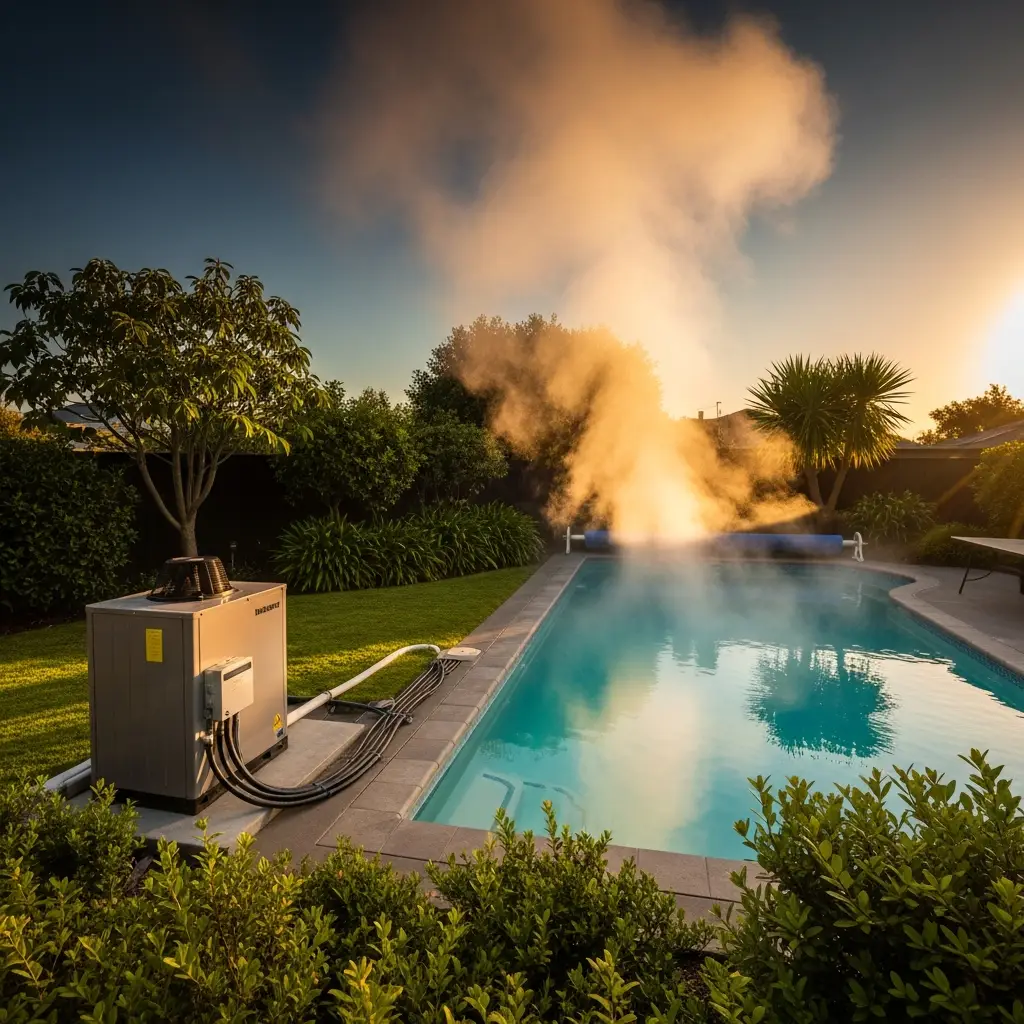

Geothermal Pool Heating: Cost, Sizing & ROI for Backyard Pools
Geothermal pool heating uses a water-to-water heat pump — or a dedicated geothermal coil tapped from an existing ground loop — to maintain residential pool water at 78–88°F with a coefficient of performance (COP) of 4–6. That makes it 4–6× more efficient than electric resistance and 2–3× more efficient than a gas pool heater. Installed cost runs $8,000–$18,000 when extending an existing home geothermal loop, or $20,000–$35,000 for a standalone pool-only system. Payback is typically 4–8 years compared with propane pool heaters in cold climates.
How Geothermal Pool Heating Works
A conventional gas or air-source pool heater pulls heat from the atmosphere or burns fuel directly. A geothermal pool heater takes a different path: it moves heat that already exists in the ground.
The heart of the system is a water-to-water heat pump. A ground loop circulates a water-antifreeze mixture through buried pipes, absorbing the earth’s stable sub-surface temperature (50–60°F in most of the U.S.). A refrigerant circuit inside the heat pump unit concentrates that heat, then transfers it through a dedicated titanium or cupro-nickel heat exchanger into your pool water. The pool water never contacts the ground loop directly; the two circuits exchange heat but remain physically separate.
Two Integration Paths
1. Loop extension from an existing geothermal home system. If your house already has a ground-source heat pump for heating and cooling, the most cost-effective approach is extending that loop with additional bore footage dedicated to pool load. The existing manifold, pump, and well infrastructure are already in place. You add a water-to-water heat pump module sized specifically for the pool, plumb it to the extended loop, and connect it to pool plumbing. This is the path that puts installation cost in the $8,000–$18,000 range.
2. Standalone pool-only geothermal system. If your home does not have geothermal, a dedicated pool system requires drilling its own closed vertical loops or installing a horizontal loop field. All the excavation, pipe, grouting, and surface equipment is new. That drives cost to $20,000–$35,000 but still delivers dramatically lower operating costs than propane or natural gas over the system’s 15–20 year life.
Loop Sizing for Pool Load
Pool heating imposes a significant seasonal heat extraction demand on a ground loop. In northern U.S. climates, incorporating a pool can require doubling the ground loop footage compared to a home-only system; in southern climates, the same loop may actually benefit from the pool acting as a heat sink in summer, and loop lengths may be reduced by up to 20%. As a practical planning estimate, budget 150–250 additional vertical bore-feet per ton of pool heating capacity required. A typical 25,000-gallon residential pool in a Zone 4–5 climate needs a 3-ton pool-dedicated heat pump, which translates to roughly 200–300 feet of additional vertical bore when extending an existing system.
Water-to-water heat pumps operate at a COP of 4–6 under normal ground temperatures, meaning they deliver four to six units of heat to the pool for every one unit of electricity consumed by the compressor. This compares favorably with air-source pool heat pumps (COP 3–5, weather-dependent) and far exceeds gas (COP ~0.85) or electric resistance (COP 1.0).
Geothermal Pool Heating Cost Breakdown
The table below covers typical installed cost ranges for the major components of a residential geothermal pool heating system as of 2026. Costs vary by region, soil type, pool size, and whether an existing geothermal loop is present.
| Component | Typical Cost Range |
|---|---|
| Water-to-water heat pump unit (3–5 ton) | $4,000–$8,000 |
| Loop extension from existing geothermal home system | $3,000–$6,000 |
| Standalone ground loop (pool-only system) | $12,000–$22,000 |
| Plumbing connections & heat exchanger | $1,000–$3,000 |
| Permits & commissioning | $300–$700 |
The largest variable is whether you can share an existing loop. Homeowners who already have a residential geothermal heat pump and need only a loop extension plus a pool module will land near the lower end. Those starting from scratch on a pool-only basis will land at the higher end.
Note that the heat exchanger material matters if your pool uses high chlorine concentrations. Cupro-nickel or titanium alloy heat exchangers are required for chlorinated pools; standard copper is susceptible to corrosion in high-chlorine water and will fail prematurely.
Operating Cost: Geothermal vs. Gas, Propane, and Heat Pump
Operating cost is where geothermal pool heating makes its economic case. The comparison below is based on a typical 25,000-gallon in-ground pool in the Northeast (Zone 5), heated from mid-May through mid-September — approximately a five-month season. Pool surface area is assumed at 450 sq ft (roughly 18×25 ft), maintained at 80°F.
| Heating Method | Seasonal Operating Cost (Northeast, 5-month season) |
|---|---|
| Propane pool heater (~80% eff.) | $2,500–$5,000 |
| Natural gas pool heater (~82% eff.) | $1,500–$3,500 |
| Air-source pool heat pump (COP 3–5) | $400–$900 |
| Geothermal pool heating (COP 4–6) | $200–$500 |
The Department of Energy’s Energy Saver program confirms that heat pump pool heaters achieve COPs of 3.0–7.0 — 300% to 700% efficiency — compared to roughly 85% for a natural gas heater. Geothermal water-source units sit at the top of that efficiency band because ground temperature remains far more stable than outdoor air, especially in spring and fall when an air-source heat pump begins to lose efficiency as ambient temperatures drop below 50°F.
Using a pool cover consistently reduces operating cost by 50–70% for any heating technology, since evaporation accounts for the majority of heat loss from an outdoor pool. A geothermal pool with a good cover can operate for as little as $100–$200 per season in mild climates.
For comparison with a full heat pump sizing analysis, the seasonal savings gap between geothermal and propane in a cold-climate pool application typically runs $2,000–$4,500 per year — the primary driver of the payback calculation.
Climate Suitability by Zone
Not every climate treats a geothermal pool investment equally. The economically rational case depends heavily on how long your pool season is and what fuels you would otherwise use.
Zone 1–3 (Florida, Texas, Gulf Coast, Southern California). This is where geothermal pool heating delivers maximum value. Ground temperatures are higher, the pool season runs 8–10 months, and the alternative is often propane (expensive) or keeping the pool at 85°F year-round with gas. A geothermal system in Florida can replace $3,000–$6,000 of annual propane spend and reaches payback in 3–5 years. The loop may also carry some cooling benefit in summer, offloading heat to the pool rather than the ground. Pool-state directories like Florida geothermal installers and Texas geothermal installers list contractors experienced with pool integration.
Zone 4–5 (Mid-Atlantic, Midwest, Pacific Northwest). A typical pool season runs May through September — five months. Geothermal extends usable swim time by 2–4 weeks at each end of the season by reaching target temperature faster and holding it cheaply. The payback is longer (6–10 years) but the system still delivers meaningful savings, especially against propane. Ground loops in these climates must account for the full winter heating load of the home as primary, with pool load as secondary; careful sizing is essential.
Zone 6 (Northern New England, Upper Midwest). The pool season shortens to 10–12 weeks. Geothermal pool heating can still work economically if your home already has a geothermal system and adding pool capacity is incremental. A standalone pool-only system in Zone 6 rarely pencils out given the short season and the added loop footage required by the cold climate.
Zone 7+ (Minnesota, Montana, Northern Canada border). Diminishing returns. The pool season may be only 8–10 weeks, and the ground loop requirements for pool integration in this climate are severe. We do not recommend standalone geothermal pool systems at this latitude; focus on an efficient air-source pool heat pump for short-season applications instead.
California straddles zones 2–5 depending on county; coastal communities can achieve 8–9 month seasons with geothermal pool heating.
Sizing Geothermal Pool Heating for Your Pool Dimensions
Sizing a pool heat pump starts with BTU per hour output, not tons. The commonly used rule for zone 4–5 climates:
100,000 BTU/hr per 10,000 gallons of pool water to reach a 78°F target temperature.
This accounts for typical heat losses from evaporation, convection, and radiation under moderate wind exposure and overnight temperature swings. In warmer climates (Zone 2–3), the requirement drops to roughly 75,000–80,000 BTU/hr per 10,000 gallons because the delta between air temperature and pool target temperature is smaller.
| Pool Size | Approximate Volume | Heat Pump Size Needed (Zone 4–5) | Heat Pump Size Needed (Zone 2–3) |
|---|---|---|---|
| Small (12×24 ft) | ~10,000 gal | 2 ton / 100,000 BTU | 1.5 ton / 75,000 BTU |
| Medium (16×32 ft) | ~18,000–22,000 gal | 2.5–3 ton / 110,000–130,000 BTU | 2 ton / 90,000 BTU |
| Standard (18×36 ft) | ~25,000 gal | 3 ton / 130,000–150,000 BTU | 2.5 ton / 110,000 BTU |
| Large (20×40 ft) | ~35,000 gal | 4–5 ton / 150,000–175,000 BTU | 3–4 ton / 130,000–150,000 BTU |
| Lap pool (75 ft × 8 ft) | ~18,000–20,000 gal | 2.5–3 ton | 2 ton |
Add one ton to the above estimates if you want to heat the pool from cold start in under 48 hours, or if you frequently host guests who require the pool at 84–88°F. For the detailed sizing methodology including heat loss calculations and design day temperatures, see the full geothermal heat pump sizing guide.
To plan your geothermal installation, bring pool BTU requirements to your contractor alongside home heating and cooling loads so the ground loop is sized for the combined peak demand.
ROI and Payback vs. Alternative Pool Heaters
Payback period depends on three variables: installation cost, annual fuel savings, and the cost of money (financing). The table below uses common real-world scenarios. All scenarios assume a 25,000-gallon Northeast pool on a five-month season, with pool cover used 60% of nights.
| Scenario | Install Cost | Savings vs. Propane ($/yr) | Est. Payback |
|---|---|---|---|
| Loop extension, existing geo home (Northeast) | $10,000–$14,000 | $2,000–$4,000/yr | 4–7 years |
| Standalone pool system (Northeast, vs. propane) | $25,000–$35,000 | $2,000–$4,000/yr | 7–14 years |
| Loop extension, existing geo home (Southeast) | $8,000–$12,000 | $3,000–$5,500/yr | 2–4 years |
| Standalone pool system (Southeast, vs. propane) | $20,000–$28,000 | $3,000–$5,500/yr | 4–8 years |
Several secondary factors improve the true ROI beyond simple fuel savings:
- Equipment longevity. Water-to-water heat pumps typically last 15–20 years. Propane pool heaters average 5–10 years and cost $1,500–$3,500 to replace. Over a 20-year horizon, you avoid 1–3 replacement cycles.
- Propane price volatility. Propane prices swung 30–60% in both directions between 2019 and 2024. A fixed ground loop eliminates exposure to that volatility.
- IRA tax incentives (Section 25D, note). The federal residential clean energy credit for qualified geothermal heat pumps was terminated effective December 31, 2025, under P.L. 119-21. Confirm current federal and state incentive status with your installer — some utility rebates and state programs remain active.
For a quick estimate of total system cost, use the geothermal cost estimator tool. For the full economics of a whole-home geothermal investment with pool integration, see the geothermal heat pump cost guide.
What Can Go Wrong
Geothermal pool heating is reliable when properly designed, but three failure modes account for most service calls.
Undersized ground loop. If the contractor does not add sufficient bore footage for the pool load on top of the home load, the system’s entering water temperature to the heat pump falls too low during peak summer demand. The heat pump still runs, but at a reduced COP and potentially with nuisance fault trips. In northern climates, this is the most common mistake. Always require the contractor to show you a combined heat-of-extraction calculation that includes both home and pool peak loads.
Heat exchanger fouling. Mineral deposits and biofilm accumulate on heat exchanger surfaces over time, reducing heat transfer efficiency. Most manufacturers recommend an annual flush and inspection. Symptoms: longer time to reach target pool temperature despite the heat pump running. Budget $150–$300 per year for a pool system service call on top of your annual geothermal tune-up.
Pool chemistry incompatibility. Standard copper heat exchangers corrode rapidly in high-chlorine pool water. Verify that your water-to-water heat pump uses a titanium or cupro-nickel heat exchanger rated for pool chemistry before purchasing. Some units designed for general water-source applications use copper and are not suitable for chlorinated pools without a secondary isolation heat exchanger. This is a detail that a specialist geothermal pool contractor will catch — a generalist HVAC contractor may not.
For the broader world of geothermal water heating, the desuperheater guide covers how excess heat pump capacity can offset domestic water heating costs as well.
Frequently Asked Questions
How much does it cost to heat a pool with geothermal?
Operating costs run $200–$500 per season for a typical 25,000-gallon Northeast pool on a five-month season, compared with $2,500–$5,000 for propane. In warmer climates with longer seasons, annual operating costs may be higher in absolute terms but the savings over propane or gas are proportionally larger. Installation cost ranges from $8,000–$18,000 when extending an existing geothermal loop, or $20,000–$35,000 for a standalone system starting from bare ground.
Can geothermal heat a pool?
Yes. Water-to-water geothermal heat pumps are specifically designed to transfer heat from a ground loop into pool or spa water via an isolated heat exchanger. ClimateMaster, AquaCal (WaterSource series), and several other manufacturers make pool-rated units. The system works at ground temperatures of 50–60°F, which are stable year-round regardless of outdoor air temperature, giving geothermal an efficiency advantage over air-source pool heat pumps in cold or shoulder-season conditions.
How long does it take to heat a pool with geothermal?
Initial heat-up from a cold start depends on pool volume and the temperature delta. A 25,000-gallon pool starting at 60°F and targeting 80°F requires approximately 500,000 BTU of delivered heat. A 3-ton geothermal water-to-water unit producing 130,000–150,000 BTU/hr (net to pool) will reach target in 30–40 hours of continuous run time. In practice, most pool owners allow 36–48 hours for initial spring heat-up, then the system maintains temperature with 4–8 hours of daily run time at peak summer load. Using a pool cover cuts daily maintenance run time roughly in half.
Is geothermal worth it for pool heating only?
A standalone geothermal system used exclusively for pool heating is financially viable primarily in warm climates (Zone 1–3) where the pool season exceeds eight months and propane or electric resistance is the alternative. In Zone 4–5 with a five-month season, a standalone pool-only system typically reaches payback in 8–14 years — acceptable if you also value the reduced maintenance burden and price stability, but a tighter case than loop integration from an existing home system. If you are heating a home without geothermal and building a new pool, asking your geothermal contractor to size the whole-home system to include pool capacity is the most cost-effective path.
Sources
- U.S. Department of Energy — Heat Pump Swimming Pool Heaters (energy.gov/energysaver)
- ENERGY STAR — Geothermal Heat Pumps Key Product Criteria (energystar.gov)
- Oregon Institute of Technology / Geo-Heat Center — Residential Swimming Pool Heating with Geothermal Heat Pump Systems (TP-117)
- IGSHPA — Ground Source Heat Pump Residential and Light Commercial Design and Installation Guide
- ClimateMaster — Pool Sizing Methodology and Loop Length Guidelines
- Symbiont Service — Geothermal Pool Heating Case Study: Six Lakes Country Club (2022)
Need a Geothermal Contractor?
Search the directory for licensed installers near you. Compare credentials, read reviews, and contact directly.
Find Installers Near YouOwn a Geothermal Business?
Claim your free listing to get more qualified leads, show up in local search, and answer customer questions where they’re already looking.
Claim Your Free Listing