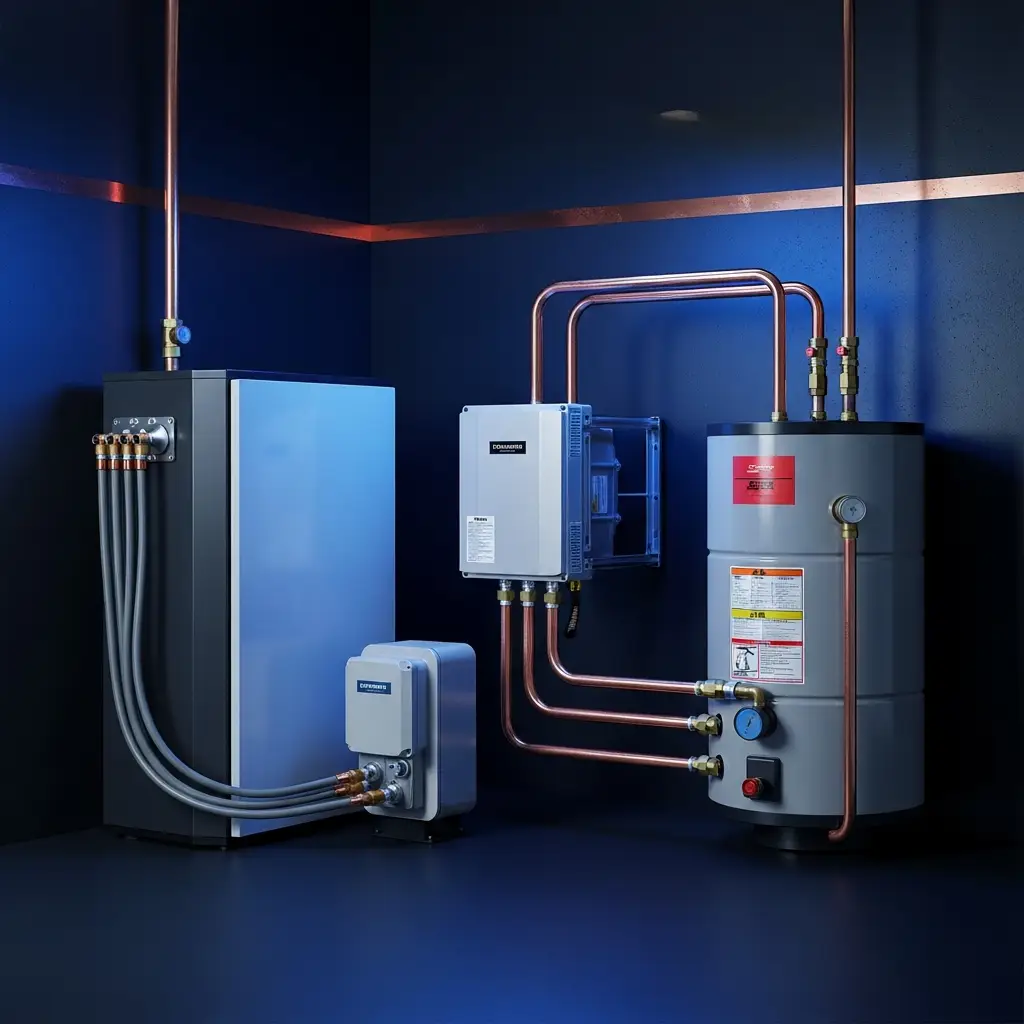

Geothermal Water Heater: How a Desuperheater Works (& Saves $)
Most homeowners are surprised to learn that their geothermal heat pump can heat their domestic hot water at little or no extra cost. Nearly all modern geothermal units include a component called a desuperheater — a small heat exchanger that captures waste heat from the compressor and transfers it directly to your hot water tank. In cooling mode it is essentially free hot water: heat pulled from your home that would otherwise be rejected to the ground loop is redirected into your tank instead. In heating mode it still diverts residual compressor heat, pre-warming water before the backup element finishes the job. The result: a typical household saves 30–60% on annual water heating costs with no additional equipment cost when the desuperheater is ordered with the system.
What Is a Desuperheater?
A desuperheater is a refrigerant-to-water heat exchanger — a compact coil assembly installed between the compressor outlet and the main condenser inside your geothermal heat pump cabinet. Understanding why it exists requires a short detour into refrigeration basics.
When refrigerant exits the compressor it is in a "superheated" vapor state — hotter than its condensing temperature by a margin of 20–40°F or more. In a standard refrigeration cycle this superheat must be removed before the refrigerant can condense and release its useful heat. In a conventional system that energy is simply dumped into the ground loop or the condenser coil with nothing to show for it. A desuperheater captures that superheat first, routing cold water from the bottom of your storage tank through a small counterflow heat exchanger. The refrigerant sheds its superheat into the water; the cooled refrigerant then continues to the main condenser as normal.
The physical installation is straightforward. A small circulating pump (typically 1/25 HP) moves water from your existing tank through a dedicated supply-and-return line to the desuperheater coil inside the heat pump. The pump runs only when the heat pump is running — it draws less than 50 watts and adds virtually nothing to operating costs. The plumbing connection uses standard 3/4-inch fittings and taps into the cold-inlet and hot-outlet ports of your existing electric or gas tank. No dedicated storage tank is required for the desuperheater itself; your existing tank serves as the buffer.
Manufacturers including WaterFurnace, ClimateMaster, Bosch, Trane, and Carrier offer desuperheaters on virtually all current residential lines. ClimateMaster's Tranquility and WaterFurnace's 7-Series include it as a standard or commonly bundled option. In areas with hard water, the heat exchanger coil should be inspected annually and may need occasional acid flushing to prevent scale buildup — a maintenance point worth discussing with your installer at the outset.
Cooling Mode vs. Heating Mode Operation
The desuperheater's performance depends heavily on which mode the heat pump is running, and the difference is significant.
Cooling Mode: Essentially Free Hot Water
During summer, your heat pump is extracting heat from inside your home and rejecting it to the ground loop. The desuperheater simply redirects the superheat portion of that rejected heat — energy that was going to be discarded anyway — into your water tank. Your ground loop still receives the bulk of the condenser heat; the desuperheater only captures the relatively small superheat fraction. The net efficiency penalty to the cooling cycle is negligible.
In cooling-dominated climates, studies and manufacturer data consistently show that domestic water heating costs drop by 80–95% compared to a conventional electric resistance water heater running alone. With the heat pump running frequently through long, warm summers, the desuperheater can cover the majority of a household's hot water demand for months at a stretch. The DOE's Energy Saver program confirms that in cooling-dominated regions geothermal desuperheaters come close to eliminating the water heating bill for the summer season entirely.
Heating Mode: Pre-Heat with a Small Efficiency Trade-Off
In winter, the heat pump is extracting heat from the ground and delivering it to your home. The desuperheater still captures the refrigerant superheat during this cycle, but now every BTU diverted to the water tank is a BTU not delivered to space heating. This creates a small efficiency penalty — roughly 5–10% reduction in heating COP — but the arithmetic still strongly favors running the desuperheater. Pre-heating water from a cold 50°F inlet to 90–105°F costs far less in compressor work than raising it to 120°F with an electric resistance element at 100% efficiency loss.
In heating-dominated climates, the savings are approximately 80% less than an electric water heater would cost annually. At current natural gas prices the advantage narrows, with savings of roughly 15% over gas, but as gas prices rise the geothermal desuperheater advantage increases. Across a mixed climate with both meaningful heating and cooling seasons, the combined annual savings on water heating land in the 30–60% range for most four-person households — the figure most installers and the DOE cite as a practical expectation.
Hot Water Output: What to Expect
The desuperheater is a pre-heat system, not a standalone water heater. Setting realistic expectations matters for both satisfaction and system sizing.
Output is proportional to heat pump runtime. ClimateMaster's technical documentation specifies desuperheater capacity at approximately 0.4 GPM flow per nominal ton of unit capacity at 90°F entering water temperature. A 3-ton unit therefore moves about 1.2 GPM through the coil while running. At moderate inlet-to-outlet temperature rise (15–20°F), this translates to roughly 12–20 gallons of meaningfully pre-heated water per hour of heat pump operation.
In summer, when the heat pump may run 8–12 hours per day in a warm climate, the desuperheater can produce 100–240 gallons of pre-heated water in a single day — more than enough for a family of four whose typical daily demand is 60–80 gallons. The tank will reach setpoint primarily on desuperheater input; the backup element may not fire at all on peak cooling days.
In winter, runtime patterns are different. A cold-climate home may run the heat pump continuously at low speeds, but heating mode superheat yield is lower than cooling mode. Expect the desuperheater to raise tank temperature to 90–105°F; the backup element finishes to 120°F. Annual coverage for a typical four-person family across the full year ranges from 25–50% of total hot water demand according to DOE Energy Saver data and IGSHPA design guidance, with higher percentages in mixed or cooling-dominant climates and lower in extreme heating climates.
If your household has high hot water demand — large family, frequent laundry, soaking tub — consider asking your installer about a slightly larger tank (80 gallons instead of 50) to maximize the thermal storage benefit between heat pump cycles. This is a common recommendation in IGSHPA-certified installation practice. See our geothermal installation process guide for more on sizing conversations with your contractor.
Installation: Standard vs. Add-On
For most new geothermal installations the desuperheater question is simple: ask for it upfront and confirm it is included in the quote. Nearly all residential geothermal units produced since roughly 2010 have the desuperheater coil factory-installed in the cabinet. What varies is whether the circulating pump and plumbing labor are included or priced separately.
Typical add-on cost if not bundled with the system: $800–$1,500 for the pump, fittings, and labor to connect to the existing water heater. This is a one-time cost with no moving parts to fail except the small circulating pump, which runs cool and typically lasts 10–15 years. Payback on the add-on cost alone — based on $150–$350 annual savings — is 3–7 years, making it one of the most clear-cut upgrades available to a geothermal system.
For older geothermal units without a factory-installed desuperheater coil, retrofit kits are available from most manufacturers, typically priced at $400–$700 for the heat exchanger coil plus installation labor. Feasibility depends on the specific unit model and cabinet configuration — ask your service technician whether the compressor discharge port is accessible for a retrofit.
Plumbing configuration: The standard setup connects the cold water inlet of your existing tank to the desuperheater supply, and the desuperheater return to a mid-tank port or the hot outlet. The existing backup element (electric or gas) remains fully functional and fires whenever the tank drops below setpoint — typically 120°F — regardless of whether the desuperheater is running. No additional thermostat, controller, or zone valve is required. For a full picture of what the installation process involves, see our geothermal installation process guide and our maintenance and service manual.
Beyond the Desuperheater: Full Geothermal Water Heating
The desuperheater handles hot water as a byproduct of space conditioning. A separate, increasingly popular approach goes further: a dedicated water-to-water geothermal heat pump that uses the ground loop exclusively to produce domestic hot water, radiant floor heat, or both.
In a water-to-water system, a dedicated unit pulls heat from the same ground loop (or a separate loop) and delivers it to a large hydronic storage tank at a COP of 3.0–5.0 depending on loop temperature and delivery temperature. For domestic hot water alone, the unit heats water to 120–140°F directly, with no backup element required except in extreme cold snaps. For combined space and water heating, a water-to-water unit feeding a buffer tank and radiant floor circuit is the design most commonly specified by IGSHPA-certified designers for high-performance new construction.
Cost for a dedicated water-to-water domestic hot water system: $8,000–$15,000 above the cost of a standard ground-loop installation, including the water-to-water unit, storage tank, heat exchanger, and additional plumbing. This is not a common retrofit for existing homes with conventional water heaters, but it is increasingly popular for new construction where the ground loop is being installed anyway and radiant heating is part of the design. The federal §25D residential tax credit — which previously covered 30% of costs — ended December 31, 2025 under the One Big Beautiful Bill Act; new residential water-to-water installs no longer qualify federally, though state and utility incentives remain, and commercial-use systems may qualify under §48.
For homeowners considering combining pool heating with domestic water heating from a single geothermal system, see our guide on geothermal pool heating — the system design overlaps considerably. Use our cost estimator tool to model total system costs including water heating options for your specific home.
Operating Cost Savings: The Numbers
The DOE reports that the average U.S. household spends $400–$600 per year heating water with a conventional electric resistance water heater — roughly 13% of total home energy spending. For a four-person family at the higher end of that range, the math on geothermal water heating looks like this:
| Scenario | Annual Water Heating Cost | vs. Electric Baseline | Annual Savings |
|---|---|---|---|
| Electric resistance (baseline) | $500 | — | — |
| Geothermal desuperheater (heating climate) | $100–$200 | 60–80% reduction | $300–$400/yr |
| Geothermal desuperheater (cooling climate) | $25–$75 | 85–95% reduction | $425–$475/yr |
| Full water-to-water geothermal | $75–$150 | 70–85% reduction | $350–$425/yr |
Payback timeline for the desuperheater add-on (assuming $1,200 installed cost and $300/year savings): 4 years. For a system where the desuperheater is included at no separate charge — which is the norm for new installs — the payback is immediate; it is pure savings from day one.
For the dedicated water-to-water system at $10,000 additional cost and $400/year savings, the simple payback is 25 years — more borderline, and, for systems placed in service in 2025 or earlier, was improved by the now-ended federal §25D credit; for 2026+ installs, payback instead hinges on state/utility incentives and the combined space-and-water-heating efficiency if radiant floors are part of the design. Refer to our geothermal heat pump cost guide for a full cost breakdown and payback analysis across system types.
What to Ask Your Installer
Before signing a geothermal installation contract, ask these questions specifically about water heating integration:
- "Is the desuperheater coil included in the unit, and does this quote include the circulating pump and plumbing labor?" Many quotes include the coil but not the pump hookup. Confirm the complete installed cost upfront.
- "Will the desuperheater connect to my existing water heater tank, or do I need a new or larger tank?" Most installs use the existing tank. If your tank is older than 8–10 years, replacing it at install time is worth considering.
- "What annual hot water coverage should I expect given my climate zone and typical usage?" A knowledgeable installer can give you a seasonal breakdown. IGSHPA-certified designers can model this precisely.
- "Is a water-to-water unit worth considering given my house plans?" If you are building new with radiant floors, the answer may be yes. For a retrofit on an existing forced-air home, the desuperheater is almost always the right call.
- "What maintenance does the desuperheater require?" In hard-water areas, annual inspection and possible coil flushing should be in your service plan. See our maintenance guide for a full service checklist.
Frequently Asked Questions
What is a geothermal desuperheater?
A desuperheater is a small refrigerant-to-water heat exchanger installed inside a geothermal heat pump. It captures the superheat — the extra heat energy in the refrigerant immediately after the compressor — and transfers it to your domestic hot water tank before the refrigerant reaches the main condenser. Because it recovers heat that would otherwise be wasted, it adds hot water production with little to no efficiency cost to the main heating or cooling cycle.
Can geothermal heat my water?
Yes, in two ways. A desuperheater (included in most modern geothermal systems) pre-heats your existing tank as a byproduct of space conditioning, typically covering 25–50% of annual hot water demand — and up to 80–95% in cooling-dominated climates. For full domestic hot water coverage, a dedicated water-to-water geothermal heat pump pulls heat directly from the ground loop and delivers it to a storage tank at 3–5 times the efficiency of electric resistance heating.
How much hot water does a desuperheater make?
Output depends on heat pump runtime and unit size. A typical 3-ton residential unit circulates approximately 1.2 GPM through the desuperheater coil, raising water temperature by 15–20°F per pass. Running 8–10 hours per day in cooling mode, this can produce 100–200 gallons of pre-heated water daily — more than enough for a family of four. In heating-only winter months, output is lower; the desuperheater typically pre-heats tank water to 90–105°F, with the backup element finishing to 120°F.
Is a geothermal water heater worth it?
For the desuperheater specifically: almost always yes, especially when included with a new geothermal install at no separate charge. Savings of $150–$450 per year on water heating with essentially zero added equipment cost makes it one of the highest-ROI features in residential HVAC. For a full water-to-water geothermal system, the payback is longer (15–25 years standalone), but the economics improve significantly when combined with radiant floor heating; the federal §25D residential tax credit ended December 31, 2025 under the One Big Beautiful Bill Act, so state and utility incentives are now the primary lever for new installs. Find a qualified installer through our geothermal contractor directory to get a site-specific assessment.
Need a Geothermal Contractor?
Search the directory for licensed installers near you. Compare credentials, read reviews, and contact directly.
Find Installers Near YouOwn a Geothermal Business?
Claim your free listing to get more qualified leads, show up in local search, and answer customer questions where they’re already looking.
Claim Your Free Listing