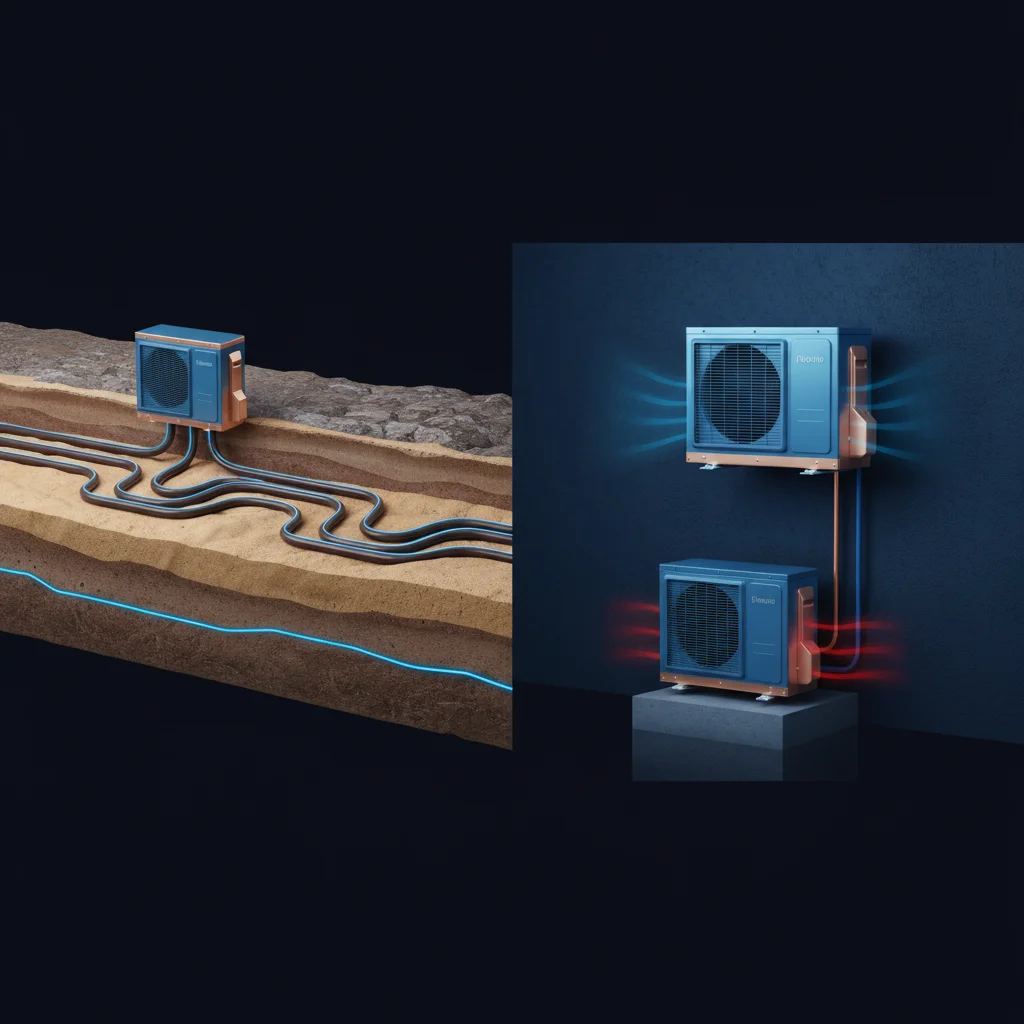

Geothermal vs Mini-Split Heat Pumps: Cost & Efficiency
Mini-split heat pumps and ground-source (geothermal) heat pumps are both efficient electric options for residential heating and cooling. They differ substantially in upfront cost, performance under temperature extremes, equipment lifespan, and installation complexity. This comparison summarizes the published technical and cost evidence so US homeowners can decide which fits their property, climate zone, and ownership timeline. Compare a property-specific geothermal price with the cost calculator, then review geothermal versus a whole-home air-source heat pump if ductless zoning is not the main requirement.
How Each System Works: A Quick Technical Overview
Both systems move heat rather than generate it, which makes them inherently more efficient than combustion-based heating. The difference is where each one sources or rejects that heat.
Mini-split heat pumps, also called ductless mini-splits or air-source heat pumps (ASHPs), exchange heat with outdoor air. A typical system has an outdoor compressor/condenser unit connected to one or more indoor air-handling units via refrigerant lines. Because they don't require ductwork, they are common in retrofits, additions, and homes where running ducts would be impractical. Modern inverter-driven units modulate output continuously to match load. Cold-climate variants now operate down to roughly -15°F to -22°F, though efficiency declines as outdoor air temperature drops. See ENERGY STAR's air-source heat pump guidance at energystar.gov.
Geothermal heat pumps (ground-source heat pumps, or GSHPs) exchange heat with the earth instead of with outdoor air. Below the frost line, soil temperatures stay relatively stable year-round, generally between 45°F and 75°F depending on location. A water-based fluid circulates through buried loops — horizontal trenches or vertical boreholes — absorbing or rejecting heat before returning to the indoor heat pump unit. The unit then distributes conditioned air through ductwork or supplies hydronic radiant systems. The U.S. Department of Energy's overview of GSHPs is at energy.gov/energysaver/geothermal-heat-pumps. For a property-fit walkthrough, see our guide on determining if geothermal is right for your home.
Cost Comparison
The two systems sit at very different price points. Geothermal carries a much larger upfront installation cost, mainly because of ground-loop drilling and trenching. Mini-splits are far cheaper per zone but accumulate higher operating and replacement costs over decades.
| Factor | Geothermal Heat Pump | Mini-Split Heat Pump |
|---|---|---|
| Typical 2026 installed cost | 3-ton national average $25,500 (range $20,000-$27,000 standard soil; $35,000-$50,000+ in granite / New England terrain) | $4,000-$8,000 per zone (single-zone); whole-home multi-zone systems often $8,000-$20,000 depending on number of indoor heads |
| Per-ton installed cost | $8,500/ton average (range $4,500-$12,500+) | Varies widely by zone count and head type |
| Drilling / loop share | 50-70% of total project cost for vertical loops | Not applicable |
| Indoor heat pump unit lifespan | 20-25 years | 12-15 years (outdoor unit); 15-20 years (indoor heads) |
| Ground loop lifespan | 50+ years | Not applicable |
| Annual maintenance | Filter changes, periodic coil cleaning ($100-$200) | Filter cleaning each season, periodic refrigerant check ($150-$300) |
| Efficiency rating range | COP 3.6-5.3; EER 17-41 (rated under ISO 13256-1, not HSPF2/SEER2) | COP ~2.2 (at 5°F) to ~4.5 (at 47°F); HSPF2 9-14 |
Cost ranges above reflect 2026 RSMeans-derived estimates; specialized labor wage inflation has driven GSHP installed cost up by 4%+ year-over-year for three consecutive years. Mini-split per-zone pricing is sensitive to brand, BTU sizing, and ducted vs. ductless head configuration. Use our geothermal cost estimator for a property-specific breakdown.
Federal Tax Treatment in 2026
The framing many older articles still use — "30% federal credit through 2032" — no longer matches federal law for new residential installs. The One Big Beautiful Bill Act (P.L. 119-21, signed July 4, 2025) terminated the Section 25D Residential Clean Energy Credit for residential geothermal expenditures made after December 31, 2025. The IRS treats "expenditure made" as installation completed, not contract signed or deposit paid. Public Law text: congress.gov, H.R.1, P.L. 119-21.
Two practical implications for 2026 buyers:
- Carryforward still works. Homeowners who had qualifying installations completed by December 31, 2025 and could not absorb the full credit against 2025 tax liability can still carry the unused balance forward via IRS Form 5695. Form and instructions: irs.gov/forms-pubs/about-form-5695.
- Section 48 commercial credit still applies. The Section 48 Investment Tax Credit for commercial geothermal systems remains active, with a phase-down schedule running through 2034. Third-party-ownership leasing structures, where a corporate lessor claims the credit and passes savings through to the homeowner via reduced lease payments, are now a common path that preserves the federal incentive value for residential occupants.
Mini-splits were never eligible for §25D. Their federal incentive was the §25C Energy Efficient Home Improvement Credit (30% of cost, capped at $2,000/year for qualifying ENERGY STAR heat pumps), which OBBBA also terminated for property placed in service after December 31, 2025. Neither system qualifies for a federal residential credit on a 2026 install.
State and Utility Incentives
State and utility programs partially offset the loss of the federal credit, but several program details widely cited online are now stale or were never accurate. Verified 2026 figures:
- New York: $10,000 cap (raised from $5,000 effective July 1, 2025 per S4882; NY Tax Law §606(g-4)). 25% of installed cost, primary residence only. Source: tax.ny.gov.
- Massachusetts (Mass Save): $13,500 whole-home GSHP rebate in 2026 (down from $15,000 in 2025); up to $25,000 enhanced rebate for moderate-income households (61-80% of State Median Income; for a household of four in the 2025-26 heating season that is $99,574-$132,764). Households at or below 60% SMI go through Mass Save's income-eligible program, which can cover the install at no cost. The Mass Save HEAT Loan is a separate 0% APR financing product, not a rebate.
- Connecticut: Smart-E Heat Pump Special at 1.99% APR through December 31, 2026 (five-year term, up to $25,000; not 0%; standard Smart-E rate is 6.99-7.99%). Source: ctgreenbank.com/smart-e-heat-pump-special.
- Federal HEEHRA / HEAR (§50122): Up to $8,000 per household for heat pumps including GSHP, income-tiered (full benefit at <80% AMI, 50% at 80-150% AMI). Important 2026 change: DOE guidance issued May 29, 2026 limits heat pump rebates to new construction or to replacing existing electric heating equipment — homes switching from a gas, oil, or propane furnace no longer qualify. ASHPs and ductless mini-splits are subject to the same rule. State-administered; rollout dates and program names vary by state.
"25% state tax credits" sometimes attributed to Illinois and Vermont do not exist in statute; the real programs in those states are utility rebates (ComEd geothermal rebate of up to $6,000 per home, loop included; Ameren Illinois $1,350-$5,400 per geothermal system plus $500 for a desuperheater; Efficiency Vermont and GMP utility rebates in VT). Always verify with your state energy office or utility directly.
Efficiency Across Climate Zones
Both systems are rated by Coefficient of Performance (COP) — units of heat delivered per unit of electricity consumed. Mini-splits also carry seasonal ratings, HSPF2 (heating) and SEER2 (cooling); geothermal units are instead rated by EER (cooling) and COP (heating) at fixed entering-water temperatures under ISO 13256-1. The performance gap between the two technologies grows as outdoor air temperatures move away from the 50-60°F band where mini-splits perform near peak.
Mini-splits draw heat from outdoor air, so as that air gets colder, less thermal energy is available to extract and the unit must run longer cycles or rely on supplementary electric resistance heat. Even cold-climate-rated mini-splits lose efficiency as temperatures fall — a typical unit's COP drops from about 4.5 at 47°F to roughly 2.2 at 5°F — although leading models now hold 100% of rated heating capacity down to 5°F, and some to -5°F or -15°F. Ground-source heat pumps draw from soil temperatures that stay near 50°F year-round below the frost line, so heating-mode COP remains closer to its rated value through cold snaps. Summer cooling shows a parallel pattern: when outdoor air exceeds 95°F, ASHPs lose efficiency rejecting heat into hot air, while GSHPs reject into cooler ground.
A 2025 field study of more than 1,000 installed units found that 17% of air-source units but only 2% of ground-source units failed to meet the European minimum seasonal-efficiency standard — a regulatory floor set by EU efficiency rules, not manufacturers' rated performance — evidence that installed ground-source systems clear the required efficiency bar far more consistently than air-source systems do.
Published Savings Ranges
The U.S. Department of Energy reports that geothermal systems use 25-50% less energy than air-source heat pumps, and industry sources commonly cite 30-70% heating-cost and 20-50% cooling-cost savings versus conventional systems. The actual figure depends on the displaced fuel and climate zone. Homes currently heated by oil or electric resistance see the highest savings; homes with a modern 95%+ AFUE gas furnace see the smallest savings, since gas is already efficient. Source: energy.gov, Guide to Geothermal Heat Pumps (DOE/EE-0385, PDF).
Understanding Your Climate Zone
The Department of Energy divides the United States into eight climate zones with distinct heating and cooling demands. Zones 1-3 (hot/warm) see minimal winter heating loads, narrowing the GSHP advantage on heating. Zones 5-8 (cold/very cold) see extended periods below 20°F where GSHP's stable performance produces the largest lifetime savings differential. Zone 4 (mixed) requires careful analysis of local degree-day data. For comprehensive research on heating options, see our research library.
Mini-Splits: When They're the Better Choice
Despite the efficiency gap, mini-splits are often the more economical choice. Five common scenarios:
1. You expect to move within 5-7 years. Geothermal's higher upfront cost requires time to recoup through energy savings. Without long-term ownership, mini-splits deliver immediate efficiency gains with shorter payback. Some of the GSHP premium typically translates to home value, but no national resale study exists for geothermal. The closest data points are NAHB buyer surveys (buyers report being willing to pay roughly $9,000 more upfront for a home that saves $1,000 a year on utilities) and the Appraisal Institute's Residential Green and Energy Efficient Addendum, which lets appraisers credit the system. Expect a partial premium, rarely the full installed cost.
2. Your climate is mild. In ASHRAE Zones 3 and 4 — coastal California, the Pacific Northwest, the mid-Atlantic — air temperatures rarely fall low enough for the GSHP advantage to dominate annual energy use. The longer payback may not justify the loop investment.
3. Your property has installation constraints. Small lots, rocky soil, protected wetlands, mature landscaping, or buried utilities can make ground-loop installation costly or impossible. Vertical boring through solid rock can add $10,000 or more. Mini-splits need only a small outdoor pad.
4. You're conditioning a single zone or addition. A finished basement, garage apartment, or detached studio is well served by a single-zone mini-split at $4,000-$8,000 installed — far cheaper than extending a geothermal system to limited square footage.
5. Your current HVAC failed and capital is constrained. When a furnace or AC has died and you need conditioning quickly, a mini-split solves the problem within days. You can install geothermal later as a planned project, with the mini-split repurposed for backup or zone control.
Geothermal: When It Clearly Wins
For homeowners whose situation matches GSHP's strengths, the system delivers the lowest total cost of ownership and the most stable comfort. Five scenarios:
1. Cold climate (Zones 5-8) plus long-term ownership. Heating-dominated regions with 5,000+ heating degree days per year and a 15-year+ ownership horizon give GSHP's efficiency advantage time to compound. The combination of stable winter COP and long equipment lifespan typically yields the largest lifetime savings.
2. New construction. Trenches and bores can be cut while excavation equipment is already on site, and HVAC infrastructure can be designed around the system from the start. The marginal cost over conventional HVAC drops materially in new builds compared to retrofits.
3. High-cost displaced fuel. Homes currently heated with propane, fuel oil, or electric resistance see the largest annual operating-cost reductions — often at the upper end of the commonly cited 30-70% heating-cost savings range. Homes with modern 95%+ AFUE gas furnaces see smaller savings.
4. Resilience and durability priorities. No outdoor unit means no exposure to hail, ice storms, hurricanes, or sun degradation. The buried loop is essentially maintenance-free for 50+ years. The indoor heat pump unit is a single mechanical component to maintain, replaced once every 20-25 years.
5. Domestic hot water assist. Many GSHP units accept a desuperheater that captures waste heat from the cooling cycle to preheat domestic hot water, reducing water-heating energy use during cooling-dominated months. Mini-splits do not offer this integration.
Installation: Disruption and Property Impact
The two systems differ sharply in installation footprint.
Mini-split installation is fast and minimally invasive. A typical single-zone install takes one day; a multi-zone whole-home system runs two to three days. Work consists of mounting indoor air handlers, placing the outdoor condenser on a pad, and drilling 3-inch holes for refrigerant lines. Landscaping disruption is minor.
Geothermal installation is a larger project. Ground-loop installation typically takes three to five days. Horizontal loops require trenches 4-6 feet deep across roughly 1,500-3,000 square feet of yard per ton of capacity — about 4,500-9,000 square feet for a typical 3-ton home, which is why installers usually want at least half an acre. Vertical loops use drilling rigs that bore 150-400 feet deep in multiple holes. Either approach turns the yard into a temporary construction site.
Context matters: if the property is already undergoing major landscaping, an addition, or new construction, the marginal disruption is small. Once the loop is buried it is invisible; turfgrass typically recovers in one growing season.
Visually, post-install, geothermal is unobtrusive — no outdoor unit, the indoor heat pump lives in a utility space. Mini-splits leave a permanent outdoor condenser plus visible wall-mounted air handlers in each conditioned zone. Modern designs have improved appearance, but the indoor heads remain a visible feature in finished rooms.
Noise, Aesthetics, and Day-to-Day Experience
Beyond efficiency and economics, the two systems produce different lived experiences.
Noise. Geothermal systems have no outdoor unit; the indoor heat pump runs at sound levels comparable to a refrigerator (around 40-45 dB). Mini-splits are quiet relative to traditional HVAC, but the outdoor compressor produces 50-60 dB during operation — roughly normal conversation volume. For bedrooms next to outdoor pads, or for rural properties where outdoor quiet is valued, the difference is noticeable.
Aesthetics. GSHP equipment is largely invisible: ground loops are buried and the indoor unit sits in a utility room or basement. Mini-split indoor heads are wall-mounted in each zone — a visual feature that some homeowners accept as functional, others find intrusive in formal or historic interiors.
| Lifestyle Factor | Geothermal | Mini-Split |
|---|---|---|
| Outdoor noise | None (no outdoor unit) | Moderate (50-60 dB compressor) |
| Indoor noise | Low (40-45 dB) | Low (25-45 dB per head) |
| Visual impact (exterior) | None visible | Outdoor condenser visible |
| Visual impact (interior) | Hidden (registers only) | Wall units in each zone |
| Humidity control | Excellent (with proper duct design) | Good to excellent (zone-dependent) |
| Air filtration | Whole-house filtration possible | Per-head filtration only |
| Temperature consistency | Consistent across the home | Strong zone control, more between-zone variation |
| Hot water integration | Desuperheater available | Not available |
| Smart-home integration | Varies by manufacturer | Broad, most major brands |
| Fossil fuel independence | Complete (all-electric) | Complete (all-electric) |
Whole-home temperature consistency typically favors GSHP when paired with a properly designed duct system, because the constant-temperature ground source allows steady output without large capacity swings. Mini-splits favor zone control: different rooms can hold different setpoints, which suits households with mixed comfort preferences.
Combined Strategies: Geothermal Plus Mini-Split
For some homes, the best answer is both, used for what each does well.
Scenario 1: Geothermal base load, mini-split supplementation. A right-sized GSHP handles 80-90% of heating and cooling at peak efficiency. One or two mini-splits cover high-use zones during extreme conditions and provide independent zone control. This can reduce the GSHP design tonnage and total install cost while preserving most of the efficiency advantage.
Scenario 2: Phased install for budget management. Install a quality mini-split system now to address immediate comfort and replace failing equipment. Plan for GSHP in 3-5 years when budget allows. The mini-split then becomes backup or zone control after the GSHP is in.
Scenario 3: Mixed-system retrofits. Older homes with a working hydronic boiler the homeowner wants to preserve can pair GSHP for primary loads with mini-splits in additions or converted spaces that lack hydronic infrastructure.
Getting Comparative Quotes: What to Request
Ask each contractor to quote both mini-split and geothermal options for your home. Each quote should include total installed cost, projected annual operating cost based on your local utility rates, projected 15-year total cost of ownership, and any recommended hybrid configurations. Side-by-side quotes from the same contractor make for more honest comparisons. Be cautious of installers who dismiss either technology without analyzing your specific property.
Frequently Asked Questions
Which system adds more value to my home?
Some of the GSHP premium typically translates to home value, but no national resale study exists for geothermal. The closest data points are NAHB buyer surveys (buyers report being willing to pay roughly $9,000 more upfront for a home that saves $1,000 a year on utilities) and the Appraisal Institute's Residential Green and Energy Efficient Addendum, which lets appraisers credit the system. Expect a partial premium, rarely the full installed cost. Mini-splits add modest value, particularly in regions where they're already common. The premium an appraiser will recognize varies by local market familiarity with each technology.
Can either system fully replace my existing furnace?
In Zones 1-4, either can typically handle full heating load. In Zones 5-8, GSHP can usually serve as the sole heat source. Cold-climate mini-splits rated to roughly -15°F can serve as primary heat in most northern climates, but most installs include backup electric resistance strips for the coldest snaps, when ASHP capacity drops. Either way, sizing requires a Manual J heat-loss calculation, not square-footage rules of thumb.
What happens to geothermal performance on a small lot?
Small lots usually require vertical boring instead of horizontal trenching. This adds $3,000-$10,000 to install cost but does not reduce system efficiency. Vertical loops actually deliver slightly more stable temperatures than horizontal loops because they reach deeper, where soil temperatures are most consistent. Lots genuinely too small for any GSHP configuration are rare.
How do maintenance requirements compare over 20 years?
GSHP has the maintenance edge. The buried loop is sealed, has no moving parts, and is rated for 50+ years. The indoor heat pump unit needs annual filter changes and periodic coil cleaning. Mini-splits need outdoor coil clearing, periodic refrigerant verification, and indoor filter cleaning. Over 20 years, expect roughly $2,000-$4,000 in GSHP maintenance versus $3,000-$6,000 for mini-splits, with one mid-life ASHP replacement on top if ownership runs that long.
Which system is better for the environment?
Both substantially outperform fossil-fuel heating, especially as the grid decarbonizes. GSHP has a lifetime efficiency edge (less electricity per unit of heat) and longer equipment life (less manufacturing and disposal impact), partially offset by larger excavation footprint at install. Cold-climate analyses typically put GSHP at roughly 10-20% lower lifetime emissions than ASHP; the gap narrows in mild climates. EIA's residential energy data is at eia.gov/consumption/residential.
Bottom Line
Mini-splits make sense for short ownership horizons, mild climates, single-zone applications, properties where ground-loop installation is impractical, and cases where capital is constrained. Geothermal makes sense for long ownership horizons in heating-dominated climates, new construction, homes displacing high-cost fuels, and households that prioritize equipment durability and quiet operation. Both are fully electric paths away from fossil-fuel heating; the right choice depends on climate zone, displaced fuel, ownership timeline, and property characteristics. Get multiple quotes, ask each contractor for both options, and weigh the 15-year total cost of ownership rather than upfront price alone.
Need a Geothermal Contractor?
Search the directory for licensed installers near you. Compare credentials, read reviews, and contact directly.
Find Installers Near YouOwn a Geothermal Business?
Claim your free listing to get more qualified leads, show up in local search, and answer customer questions where they’re already looking.
Claim Your Free Listing