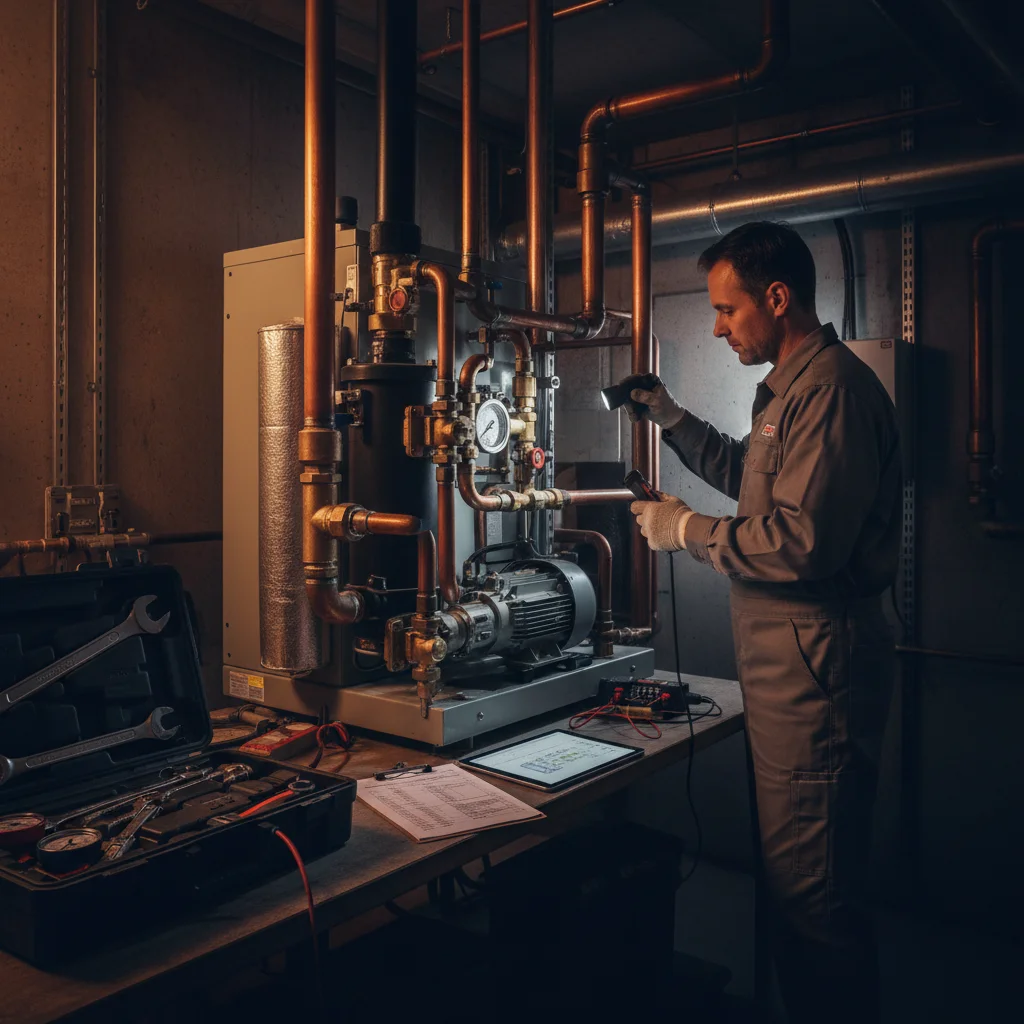

Geothermal Heat Pump Maintenance: The Annual Homeowner Checklist (With Costs)
Geothermal heat pump systems are among the most efficient and durable heating and cooling technologies available to homeowners. Per the U.S. EPA's ENERGY STAR program, ground-source heat pumps (GSHPs) reduce heating energy use by 30-70% and cooling energy use by 20-50% compared to conventional HVAC, depending on climate zone and the fuel they displace. Indoor heat pump units typically last 20-25 years, and properly installed ground loops are engineered for 50+ years. Geothermal systems are not maintenance-free, however. Understanding what upkeep your system requires — and budgeting for it — keeps the unit operating at rated efficiency, preserves manufacturer warranty coverage, and prevents avoidable component damage. This guide covers monthly homeowner checks, annual professional service, ground-loop fluid testing, warning signs that require prompt attention, and realistic cost expectations sourced from the U.S. Department of Energy and the International Ground Source Heat Pump Association (IGSHPA).
Why Geothermal Systems Require Less Maintenance Than Conventional HVAC
Geothermal systems differ from conventional heating and cooling equipment in several mechanically meaningful ways. Traditional split-system HVAC relies on outdoor condensing units exposed to weather, combustion processes that introduce safety inspections, and mechanical components that operate across wide temperature swings. GSHPs eliminate most of those wear factors.
The ground loop — the heat exchanger that distinguishes geothermal from air-source equipment — is buried below the local frost line, where soil temperatures stay roughly between 45°F and 75°F year-round. The buried portion is not exposed to rain, ice, debris, or vandalism. There are no outdoor fans to clean and no condenser coils to comb out.
The indoor heat pump unit operates in a conditioned mechanical space — typically a basement, utility room, or mechanical closet. GSHPs do not burn fossil fuels on-site, so there is no flue, no combustion air supply to inspect, no heat exchanger to scope for cracks, and no carbon monoxide risk associated with the appliance itself.
The compressor in a water-source heat pump operates against a relatively narrow source-fluid temperature range supplied by the ground loop, rather than against ambient air that can swing from -20°F to 105°F. That stable source-side condition is the principal reason GSHPs achieve more consistent real-world efficiency than air-source equipment. A 2025 field study of more than 1,000 installed units found that GSHPs missed predicted seasonal efficiency by approximately 2%, compared with roughly 17% for ASHPs. Most of the residual underperformance is attributable to improper system sizing rather than mechanical wear, per IGSHPA and ASHRAE installation guidance.
Mechanically, a typical residential GSHP has fewer moving parts than the gas-furnace-plus-air-conditioner pairing it replaces: one compressor, internal circulator(s), and the blower motor. A combustion furnace plus a split-system AC adds an inducer motor, gas valve, igniter, condenser fan motor, and outdoor compressor — each a discrete failure point.
The Three-Part System: What Needs Maintenance
A residential GSHP has three distinct subsystems with different service intervals.
The Ground Loop
The ground loop is a closed circuit of high-density polyethylene (HDPE) piping filled with water or a water-and-antifreeze mix. The fluid carries heat from the soil to the heat pump in winter and rejects heat back to the soil in summer. Loops are configured horizontally (in trenches), vertically (in boreholes), or submerged in a pond. Properly installed HDPE ground loops are designed for 50+ years of service. The HDPE itself is the same material class used for natural gas distribution and municipal water mains, and IGSHPA-trained installers heat-fuse joints to specifications that exceed pipe-wall strength. The loop has no moving parts in the buried section. For more on loop configurations, see our geothermal overview.
The Heat Pump Unit
The indoor heat pump unit houses the compressor, refrigerant-side and water-side heat exchangers, expansion device, internal circulator(s), blower, and controls. Per DOE EERE, the indoor heat pump portion typically lasts 20-25 years with annual service. This is the subsystem that needs scheduled professional attention.
The Distribution System
The heat pump connects to either forced-air ductwork or a hydronic distribution system (radiant floors, fan coils, low-temperature hydronic zones). Ductwork should be checked periodically for sealing, insulation, and balanced airflow. Hydronic systems need inspection of zone valves, circulators, manifolds, and air separators. This subsystem does not differ materially from the distribution side of a non-geothermal system.
Monthly Owner Checks
The most cost-effective maintenance is what the homeowner does. The following checks take a few minutes and prevent the most common avoidable problems:
- Replace air filters as needed — A restricted filter is the single most common cause of efficiency loss and downstream component wear (frozen coils, short cycling, compressor strain). Inspect monthly and replace when visibly loaded; typical service life is 1-3 months depending on pets, dust, and filter MERV rating. Use the size and rating specified on the unit label.
- Listen for unusual sounds — A GSHP is normally quiet. New grinding, squealing, hissing, or gurgling warrants investigation. Hissing on the refrigerant side can indicate a leak; gurgling can indicate air entrained in the loop.
- Verify thermostat operation — Check that setpoint changes produce expected response and that displayed room temperature is reasonable. Connected thermostats should be online and pushing updates.
- Inspect supply and return registers — Confirm registers are open and not blocked by furniture, rugs, or drapes. Closed interior doors can create return-air starvation in some layouts.
- Watch for comfort changes — Uneven room temperatures, unexpected humidity, or longer runtime to reach setpoint can indicate a developing problem.
- Inspect visible loop components — Where loop piping enters the building or terminates at a flow center, look for moisture, staining, or discoloration that could indicate a slow leak.
- Track energy bills — A meaningful, unexplained increase in monthly kWh — controlling for weather and rate changes — is one of the earliest indicators of efficiency loss.
Annual Professional Service
Use our geothermal maintenance schedule guide to track service intervals and costs across your system's lifetime.
Monthly homeowner attention covers airflow and obvious anomalies. Annual professional service covers the items that require instrumentation: refrigerant pressures, compressor amp draw, electrical connections, capacitor health, source-side flow rate, and temperature differentials across the heat exchangers.
Annual service for a residential GSHP typically runs $150-$300 for a single visit on an existing system, depending on regional labor rates and system complexity. Most manufacturers condition the parts warranty on documented annual professional maintenance, so this visit is effectively required to keep coverage in force. IGSHPA publishes service standards that align with this annual cadence.
| Maintenance Task | DIY or Pro | Frequency | Typical Cost | Consequence If Skipped |
|---|---|---|---|---|
| Air filter replacement | DIY | Monthly-Quarterly | $5-$25 per filter | Reduced airflow, frozen coil, compressor strain |
| Thermostat verification | DIY or Pro | Annually | Free-$50 | Setpoint drift, unnecessary runtime |
| Refrigerant pressure check | Pro only | Annually | Included in service | Efficiency loss, compressor failure |
| Electrical connection inspection | Pro only | Annually | Included in service | Loose lugs, contactor pitting, component failure |
| Coil cleaning (water-side & air-side) | Pro only | Annually | Included in service | Reduced heat transfer, higher head pressure |
| Loop pressure / flow check | Pro only | Annually | Included in service | Air entrainment, reduced source-side capacity |
| Condensate drain cleaning | DIY or Pro | Annually | Free-$75 | Overflow shutoff, drain-pan water damage |
| Ductwork inspection | Pro recommended | Every 2-3 years | $100-$200 | Duct leakage, comfort imbalance, IAQ issues |
| Loop fluid analysis | Pro only | Every 5 years | $50-$100 | Antifreeze degradation, corrosion, bio-fouling |
| Loop pressure test (full) | Pro only | Every 3-5 years | $100-$200 | Undetected slow leak, reduced charge |
| Compressor amp draw test | Pro only | Annually | Included in service | Undetected wear, sudden failure |
Loop Fluid and Antifreeze Testing
Closed ground loops are filled with water plus an antifreeze (commonly food-grade propylene glycol or, in some installations, methanol or ethanol) for freeze protection and corrosion inhibition. Over time, antifreeze concentration can shift, pH can drift, and corrosion inhibitors can deplete. IGSHPA recommends testing fluid concentration, pH, and inhibitor effectiveness approximately every 5 years; testing typically costs $50-$100. If the fluid needs replenishment or a full flush-and-fill, expect $200-$500 depending on loop volume. Some systems in mild climates use water-only loops; check the installation documentation to confirm fluid type.
Quarterly Above-Ground Loop Checks
The buried portion of the loop does not need quarterly attention, but the above-ground components that interface with it do.
Every three months, inspect the flow center (the assembly housing the loop circulator pump(s) and isolation valves). Look for moisture, staining at fittings, or pump vibration that has increased since the last check. Many flow centers have a sight glass, pressure gauge, or status indicator — note the normal reading so anomalies stand out.
If your system includes a desuperheater for domestic hot water preheating, inspect the connections at the water heater for leaks or mineral buildup. Desuperheaters route waste heat from the refrigerant cycle to the water heater during cooling operation; a leak at this interface is rare but visible.
If your flow center has an accessible pressure gauge, note the reading. Most closed loops operate between 25 and 75 PSI static. Small seasonal pressure variation is normal as fluid expands and contracts with temperature, but a sustained drop indicates a leak or air entering the loop.
Inspect any visible insulation on indoor loop piping. Damaged or wet insulation should be replaced — both to maintain efficiency and to prevent condensation damage in humid mechanical rooms.
Signs Your Geothermal System Needs Immediate Attention
Between scheduled visits, watch for the following warning signs. Catching a problem early almost always means a smaller repair.
1. Unexplained increase in energy bills. A sustained spike in kWh — controlling for weather and rate changes — is consistent with refrigerant charge loss, reduced loop flow, fouled coils, or a partially failed compressor.
2. Reduced heating or cooling capacity. If the system runs longer to reach setpoint, or cannot reach setpoint, heat transfer somewhere in the chain is impaired.
3. New mechanical sounds. Grinding (bearing wear), squealing (motor or belt issues — most modern GSHPs are direct-drive but some have belt-driven blowers), hissing (refrigerant leak), or gurgling (air in the loop or refrigerant) are all worth a service call.
4. Standing water around the unit. Some condensate is normal in cooling mode; a wet floor is not. Possible causes include a clogged condensate drain, failed condensate pump, or a refrigerant-side leak producing excess condensation.
5. Short cycling. Frequent on-off cycling without completing a heating or cooling cycle is consistent with oversizing, a refrigerant problem, a thermostat issue, or restricted airflow. Short cycling shortens compressor life.
6. Ice on indoor refrigerant lines or the indoor coil. Indicates restricted airflow or a refrigerant problem. Distinct from normal cooling-mode condensation on the suction line.
7. Burning or unusual odors. Electrical burning smell — shut the unit off at the disconnect and call for service. Musty smell points to biofilm in the air handler or ductwork.
8. Error codes or controller lockouts. Modern GSHP controls log fault codes. Repeatedly resetting the unit without addressing the underlying fault risks compounding the original problem.
Ground Loop Maintenance: What's Actually Needed
The buried portion of the ground loop is the lowest-maintenance component of the entire system. HDPE pipe in the configurations IGSHPA specifies is engineered for a 50+ year service life. The pipe is not exposed to UV, freeze-thaw at the surface, or oxygen ingress (in a closed loop). It has no moving parts.
Heat-fused HDPE joints, when made to the manufacturer's fusion specifications, are stronger than the surrounding pipe wall. The full loop is pressure-tested at the time of installation before backfill. Per IGSHPA installation standards, the test pressure exceeds normal operating pressure by a substantial margin.
The realistic loop-failure scenarios are unrelated to wear: accidental excavation by a third party, severe ground movement, or an installation defect that survived initial pressure testing. These are uncommon and most are recoverable above-ground at the manifold or flow center.
The fluid inside the loop is the only routine consumable. Testing every 5 years is straightforward and is performed at the flow center — no excavation. If antifreeze concentration has drifted, inhibitor levels have depleted, or pH has shifted, the loop can be topped up, treated, or flushed and refilled from the same access point.
| Cost Category (20-Year Total) | Geothermal Heat Pump | Gas Furnace + AC | Air-Source Heat Pump |
|---|---|---|---|
| Annual maintenance service | $3,000-$6,000 | $6,000-$12,000 | $4,000-$8,000 |
| Air filter replacement | $400-$1,000 | $400-$1,000 | $400-$1,000 |
| Equipment replacement (avg) | $0-$5,000* | $8,000-$15,000 | $6,000-$12,000 |
| Typical repairs | $500-$2,000 | $2,000-$5,000 | $1,500-$4,000 |
| Loop fluid service | $200-$400 | N/A | N/A |
| Total 20-Year Maintenance Cost | $4,100-$14,400 | $16,400-$33,000 | $11,900-$25,000 |
*GSHP indoor units typically last 20-25 years per DOE EERE; replacement may not occur within the 20-year window. Conventional split systems typically need replacement at 15-18 years.
Extended Warranties and Service Contracts
Whether to buy an extended warranty or annual service contract depends on the homeowner's risk preference and how their existing manufacturer warranty reads.
Manufacturer extended warranties. Most residential GSHPs ship with a 5-10 year parts warranty and a 5-10 year compressor warranty. Extensions to 10-12 years (or longer in some cases) cost roughly $500-$1,500 depending on coverage. The economic case for an extension is strongest when the homeowner intends to stay long-term and the largest covered failure mode (compressor replacement, generally $2,000-$4,000 installed depending on unit size and labor) would be financially disruptive.
Third-party warranties. Read the contract terms in detail. Some third-party policies exclude refrigerant labor, exclude the compressor (the most expensive component), or impose claims procedures that delay repair. Manufacturer-backed extensions are generally more straightforward.
Annual service contracts. Many installers offer annual service agreements at $200-$400. These typically include the required annual visit (which preserves manufacturer warranty), priority scheduling, and a parts/labor discount on subsequent repairs. Because the annual visit is effectively required, a service contract often costs about the same as paying for the visit individually plus adds the priority and discount benefits.
When a contract makes sense:
- New homeowners unfamiliar with the system
- Multi-zone or commercial-grade residential installations
- Markets with limited geothermal service availability
- Households that prefer a fixed annual cost
- Systems past the manufacturer parts warranty
When a contract is less compelling:
- Homeowners comfortable scheduling their own annual visits
- Equipment still under full manufacturer warranty
- Markets with multiple competing IGSHPA-certified service providers
- Households that prefer to pay as-needed
Finding IGSHPA-Certified Service Technicians
Geothermal heat pumps require knowledge that not every conventional HVAC technician carries. Look for IGSHPA certification (Accredited Installer, Certified Geothermal Inspector, or Certified Geo Service Technician credentials) or manufacturer-specific factory training. Useful screening questions: how many GSHPs do you service annually, what training do your technicians hold, and can you provide GSHP customer references in the area? A technician who understands water-source refrigerant charging, loop hydronics, and source-side flow diagnostics is materially better positioned than one whose practice is primarily air-source equipment.
2026 Federal Incentive Context (Maintenance Implications)
The federal incentive landscape for residential geothermal changed in 2025 and that change affects how owners think about long-term system economics, including maintenance budgets.
The §25D Residential Clean Energy Credit, which had previously offered a 30% credit on residential geothermal expenditures through 2032 under the Inflation Reduction Act, was terminated for new residential expenditures made after December 31, 2025 by the One Big Beautiful Bill Act (P.L. 119-21, signed July 4, 2025). Per IRS guidance, "expenditure made" is keyed to the date installation is completed. Homeowners with systems installed in 2025 or earlier may still carry forward unused credit on Form 5695. Maintenance, repairs, and component replacements on existing systems do not qualify for §25D regardless of timing — that credit applied only to new installation expenditures.
The §48 commercial Investment Tax Credit (which third-party-ownership lessors can claim) remains active and phases down through 2034. State and utility rebates — for example, New York's $10,000 cap state credit — apply to installation rather than ongoing maintenance.
The practical implication: maintenance costs are out-of-pocket. Budget for them as a known, modest line item rather than relying on tax credits to offset them.
Frequently Asked Questions
How often does a geothermal system need professional maintenance?
Annual professional service is the standard recommendation from manufacturers, IGSHPA, and DOE EERE. The annual cadence is what most parts warranties require to remain in force. Some homeowners in mild climates with newer equipment extend to 18 months, but doing so risks warranty disputes.
Can I do geothermal maintenance myself?
Owner tasks: filter changes, visual inspection of the flow center, condensate drain check, register inspection, and basic thermostat verification. Professional tasks: anything involving refrigerant (federal EPA Section 608 certification required to handle refrigerants), source-side flow measurement, electrical work, or anything the manufacturer warranty conditions on a licensed technician.
What's the most important maintenance task?
Filter replacement. A loaded filter restricts airflow, drops evaporator-side capacity, can freeze the indoor coil, and ultimately stresses the compressor. Filters cost $5-$25; the avoided downstream damage is the single best return on owner time.
Does my ground loop ever need maintenance?
The buried piping itself does not, under normal conditions, for the system's design life. The fluid in the loop should be tested every 5 years and topped up or treated as needed. A full pressure test at 3-5 year intervals is good practice. Loop replacement is rare and typically tied to external causes (excavation damage, ground movement) rather than wear.
How much should I budget annually for geothermal maintenance?
$200-$400 covers professional service ($150-$300), filters ($50-$100), and a small contingency. Over the system's life, GSHP maintenance runs materially below conventional HVAC, primarily because there is no outdoor unit, no combustion appliance, and longer equipment life on the indoor side. Setting aside an additional $500-$1,000/year toward eventual replacement is prudent: even at 20-25 years equipment life, the indoor unit will eventually need replacement and having the funds available avoids financing it.
Maintained on a regular schedule, a residential geothermal heat pump delivers two to three decades of efficient operation with predictable, modest service costs. The combination of monthly homeowner attention, annual professional service, and 5-year fluid testing covers nearly every realistic failure mode and preserves the manufacturer warranty that backstops the most expensive components.
Need a Geothermal Contractor?
Search the directory for licensed installers near you. Compare credentials, read reviews, and contact directly.
Find Installers Near YouOwn a Geothermal Business?
Claim your free listing to get more qualified leads, show up in local search, and answer customer questions where they’re already looking.
Claim Your Free Listing